
Uranus is one of the most unusual planets in our Solar System. It is far from the Sun, very cold, and famous for spinning on its side. Learning Uranus facts for kids helps students compare planets, understand space distances, and see how scientists study worlds that are too far away to visit easily. Uranus is the seventh planet from the Sun, located between Saturn and Neptune. It cannot usually be seen clearly without a telescope, but it has fascinated astronomers for more than 200 years.
What Is Uranus?
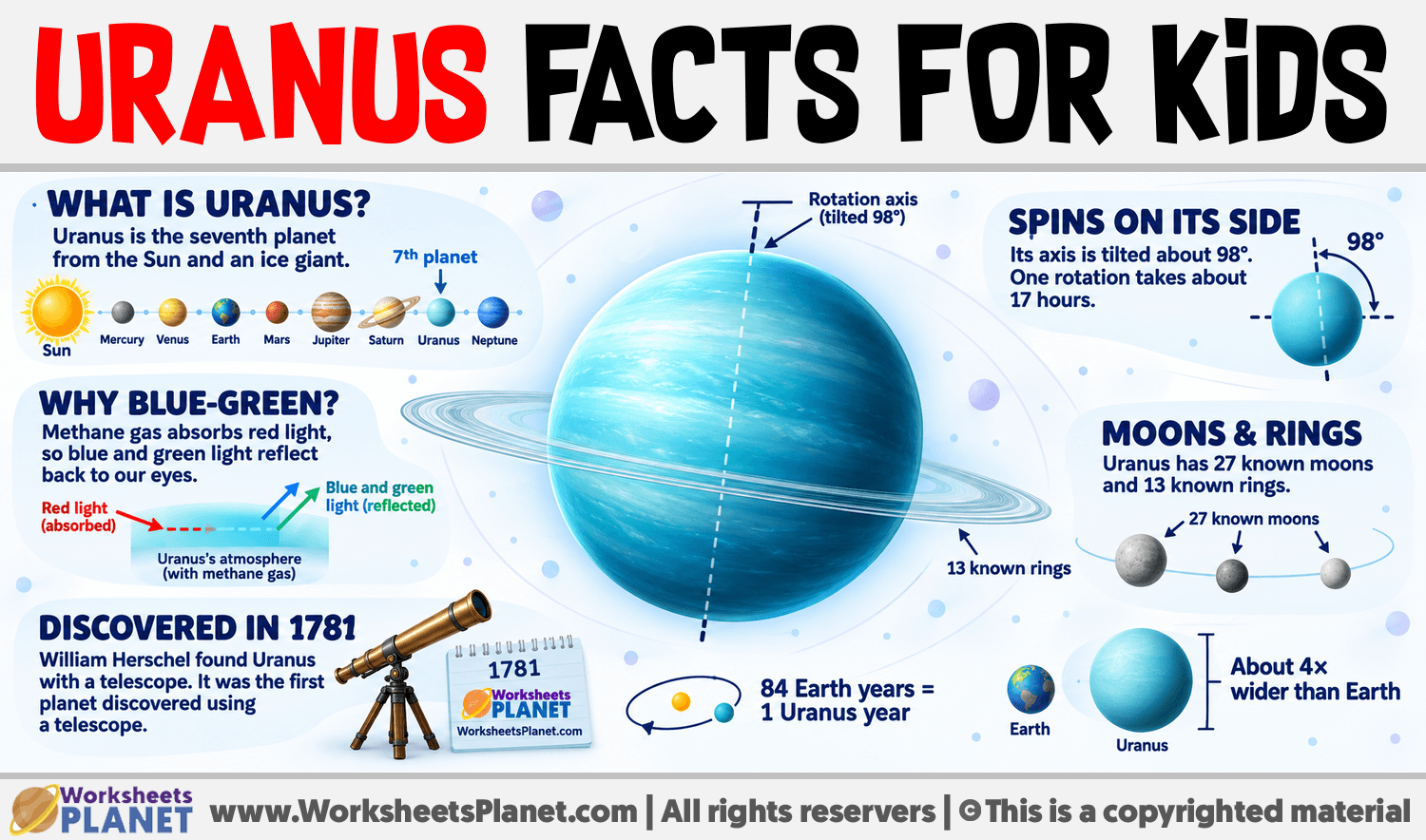
Uranus is a giant planet, much larger than Earth. It is often called an ice giant because it contains icy materials such as water, ammonia, and methane, mixed with gases like hydrogen and helium. Even though it is called an ice giant, Uranus is not a solid ball of ice. Like Jupiter and Saturn, it does not have a hard surface that you could stand on.
Uranus is the third-largest planet in the Solar System by diameter. It is about four times wider than Earth. However, because it is made mostly of lighter gases and icy materials, it is not as heavy as it might look. If Earth were the size of a grape, Uranus would be closer to the size of a small apple.
- Position from the Sun: seventh planet
- Planet type: ice giant
- Diameter: about 50,724 kilometers
- Color: pale blue-green
- Neighboring planets: Saturn and Neptune
Why Does Uranus Look Blue-Green?
Uranus has a calm-looking blue-green color because of a gas called methane in its upper atmosphere. Methane absorbs red light from the Sun and reflects blue and green light back into space. This gives Uranus its soft, icy color.
Although Uranus may look smooth in many pictures, its atmosphere is not empty or boring. Scientists have found clouds, strong winds, and storms. Some winds on Uranus can blow at hundreds of kilometers per hour. Because the planet is so far away, details are hard to see, but modern telescopes have helped scientists discover more weather activity than they once expected.
The atmosphere of Uranus is mostly made of hydrogen and helium, with a smaller amount of methane. Beneath the atmosphere, scientists think there is a thick layer of hot, slushy material made from water, ammonia, and methane. Deep inside, Uranus may have a small rocky core.
Uranus Spins on Its Side
One of the most surprising Uranus facts for kids is that the planet spins almost sideways. Most planets rotate like spinning tops, with their poles pointing roughly up and down compared with their path around the Sun. Uranus is different. Its axis is tilted about 98 degrees, which means it rolls around the Sun more like a ball than a top.
Scientists are not completely sure why Uranus is tilted so much. One common idea is that, long ago, a large object may have crashed into the young planet and knocked it sideways. Another possibility is that several smaller impacts changed its tilt over time.
This sideways spin creates very strange seasons. A year on Uranus lasts about 84 Earth years. During part of that long year, one pole points toward the Sun for decades while the other pole faces darkness. Then, later in its orbit, the situation changes. This means some areas can have extremely long periods of sunlight or night.
- Length of one day: about 17 hours
- Length of one year: about 84 Earth years
- Axis tilt: about 98 degrees
- Season length: each season lasts more than 20 Earth years
Moons and Rings Around Uranus
Uranus has both moons and rings. Its rings are much darker and harder to see than Saturn’s bright rings. They are made mostly of small pieces of rock and dust. Uranus was the second planet, after Saturn, to have rings discovered around it.
The planet has 27 known moons. Many of them are named after characters from the works of William Shakespeare and Alexander Pope, which makes them different from many other moons in the Solar System that are named after figures from Greek or Roman mythology.
Some of the largest moons of Uranus are important because they may have icy surfaces, cracks, valleys, and signs of geological activity. Scientists study them to learn more about how moons form and change over time.
- Titania: the largest moon of Uranus
- Oberon: a large, icy moon with many craters
- Umbriel: one of the darker moons
- Ariel: has bright areas and deep valleys
- Miranda: famous for its strange, patchy surface
How Was Uranus Discovered?
Uranus was discovered in 1781 by the astronomer William Herschel. Before that, people had seen it in the night sky, but they thought it was a star because it moves slowly and is difficult to see clearly. Herschel first believed he had found a comet, but other astronomers studied its path and realized it was a new planet.
This discovery was very important because Uranus became the first planet found with a telescope. The planets Mercury, Venus, Mars, Jupiter, and Saturn had been known since ancient times because they can be seen with the naked eye. Uranus showed that the Solar System was larger than people had once thought.
Only one spacecraft has visited Uranus: Voyager 2. It flew past the planet in 1986 and sent back valuable images and measurements. Most of what scientists know today comes from Voyager 2, powerful telescopes, and space observatories.
Quick Uranus Facts for Kids to Remember
Uranus is a cold, distant world with many features that make it different from Earth. It has no solid surface, spins sideways, and takes a very long time to travel around the Sun. Even though it is far away, studying Uranus helps scientists learn how planets form, how atmospheres work, and why the outer Solar System is so different from the inner rocky planets.
For students, Uranus is a great planet to compare with Earth, Saturn, and Neptune. Earth is rocky and warm enough for liquid water on its surface. Saturn is famous for its bright rings. Neptune is darker blue and even farther from the Sun. Uranus stands out because of its sideways rotation, pale color, icy composition, and long seasons.
- Uranus is the coldest planetary atmosphere measured in the Solar System, reaching about -224°C.
- It is too far from Earth for humans to visit with current technology.
- Its blue-green color comes from methane gas.
- It has rings, but they are faint and dark.
- A person could not walk on Uranus because it has no solid surface.
- Uranus helps scientists understand the difference between gas giants and ice giants.

Leave A Comment