
The Moon is the bright, round object we often see in the night sky. It is Earth’s only natural satellite, which means it travels around our planet without being made by people. Learning Moon facts for kids helps students understand space, time, tides, and why the night sky changes from week to week. The Moon may look close, but it is about 238,855 miles, or 384,400 kilometers, away from Earth. Even though it is much smaller than Earth, it has played an important role in science, exploration, calendars, and stories from many cultures.
What Is the Moon Made Of?
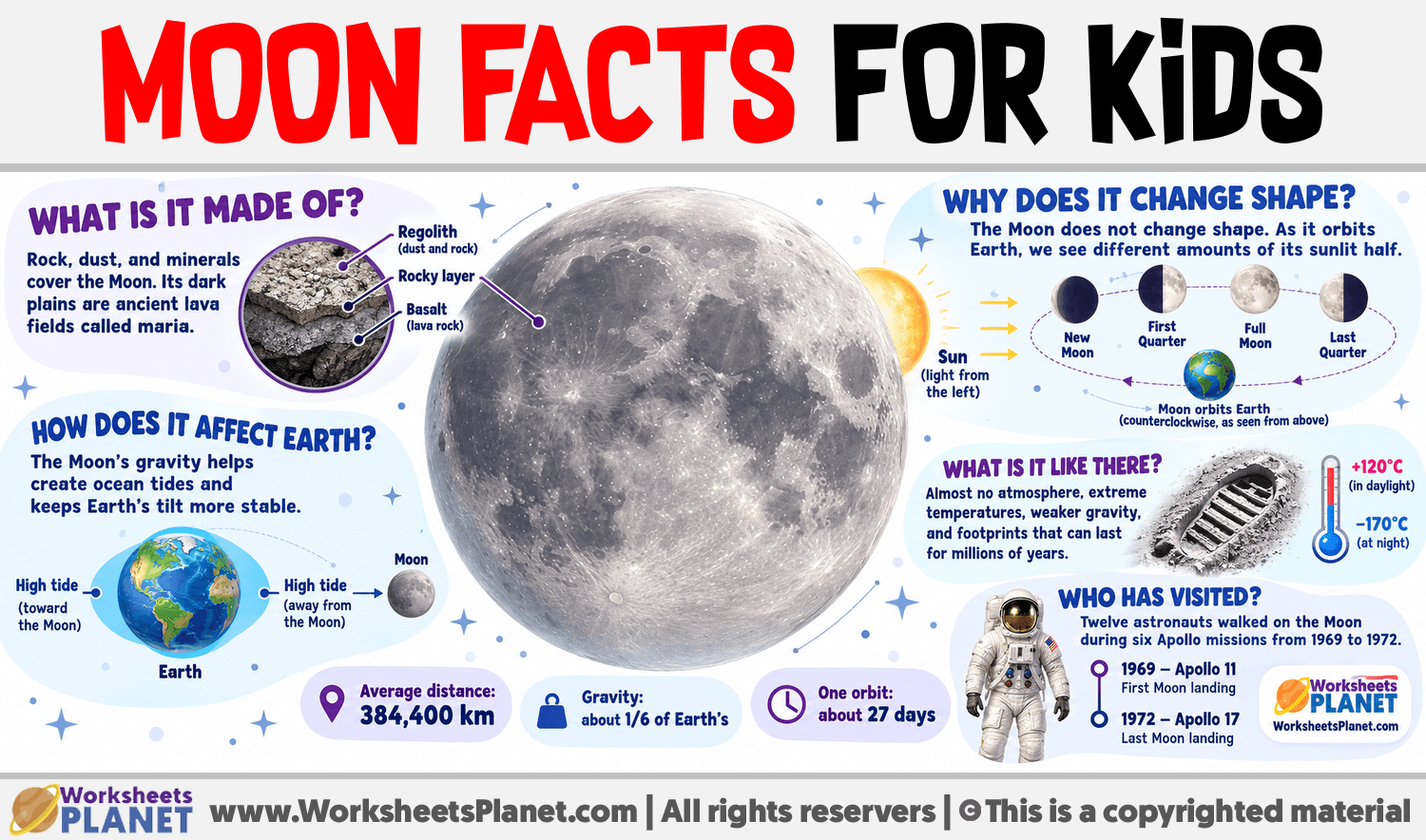
The Moon is a rocky world with mountains, valleys, flat plains, and many craters. It does not have forests, oceans, rivers, or animals. Its surface is covered with a dusty layer of broken rock called lunar soil, or regolith. This dust was made when space rocks crashed into the Moon over millions and millions of years.
The Moon has different layers, a little like Earth. Scientists think it has a small core, a mantle, and a crust. The crust is the outer rocky layer that we can see from Earth. Some of the dark patches on the Moon are called maria, which means seas in Latin, although they are not filled with water. They are wide plains made from ancient lava that cooled long ago.
- The Moon is mostly made of rock and metal.
- Its surface has many impact craters caused by asteroids and meteoroids.
- The dark areas are old lava plains, not real seas.
- The Moon has no breathable air and no liquid water on its surface.
- Footprints left by astronauts can last for a very long time because there is almost no wind or rain to erase them.
Why Does the Moon Change Shape?
The Moon does not really change its shape. It always stays round, like a ball. What changes is how much of the sunlit side we can see from Earth. These changing views are called phases of the Moon. The phases happen because the Moon orbits Earth while the Sun lights up half of it.
A full cycle of Moon phases takes about 29.5 days. This is close to one month, which is why many calendars are connected to the Moon. When the Moon looks like a thin curved shape, it is called a crescent. When it looks like half a circle, we call it a half moon, although we are really seeing half of the lit side.
- New Moon: the Moon is between Earth and the Sun, so the bright side faces away from us.
- First Quarter: we see half of the Moon’s lit side.
- Full Moon: Earth is between the Sun and the Moon, so the whole near side looks bright.
- Last Quarter: we see the other half of the Moon’s lit side.
- Waxing means the bright part is growing, and waning means it is shrinking.
How Does the Moon Affect Earth?
The Moon may seem far away, but it affects Earth every day. One of its most important effects is on the oceans. The Moon’s gravity pulls on Earth, and this pull helps create tides. Tides are the regular rise and fall of ocean water. In many coastal places, the water level changes two times a day.
The Moon also helps keep Earth’s tilt more stable. Earth is tilted as it moves around the Sun, and that tilt gives us seasons. Without the Moon, Earth’s tilt might wobble more over long periods of time. This means the Moon helps make our planet’s climate more steady than it might otherwise be.
The Moon also gives light at night by reflecting sunlight. It does not make its own light like the Sun. Instead, its gray surface reflects some sunlight back toward Earth. That is why the Moon can look bright in the night sky.
- The Moon’s gravity helps cause high and low tides.
- Moonlight is really reflected sunlight.
- The Moon helps make Earth’s tilt more stable over time.
- The Moon has helped people track months and seasons for thousands of years.
What Is It Like on the Moon?
The Moon is a very different place from Earth. There is almost no atmosphere, which means there is no air for people to breathe. Astronauts must wear space suits that provide oxygen, protect them from extreme temperatures, and keep their bodies safe in low pressure.
Temperatures on the Moon can be extremely hot in sunlight and extremely cold in darkness. A day on the Moon is not like a day on Earth. The Moon rotates slowly, so one daytime period and one nighttime period together last about 29.5 Earth days. That means the surface can be in sunlight for many Earth days in a row, then in darkness for many days.
Gravity on the Moon is weaker than gravity on Earth. If you could safely stand there, you would weigh about one-sixth of your Earth weight. A child who weighs 60 pounds on Earth would weigh about 10 pounds on the Moon. However, their body would still have the same amount of matter, called mass.
- There is no breathable air on the Moon.
- The sky looks black, even during the day, because there is almost no atmosphere to scatter sunlight.
- The Moon has weaker gravity than Earth.
- Sound cannot travel well there because there is no air to carry it.
- Astronauts need special suits, helmets, oxygen, and protection.
Who Has Visited the Moon?
Humans first walked on the Moon during NASA’s Apollo 11 mission in 1969. The first person to step onto the Moon was Neil Armstrong, followed by Buzz Aldrin. Michael Collins stayed in the spacecraft orbiting the Moon while the other two astronauts explored the surface. This mission was a major moment in human history.
In total, 12 astronauts walked on the Moon during the Apollo missions between 1969 and 1972. They collected rocks, took photographs, set up science experiments, and learned what the lunar surface was like. Moon rocks brought back to Earth helped scientists study how the Moon formed and how old it is.
Many scientists think the Moon formed after a giant object hit young Earth about 4.5 billion years ago. Pieces of material from the crash may have gathered together to form the Moon. Today, space agencies are planning new missions to study the Moon again. These missions may help humans learn how to live and work in space for longer periods.
- The first Moon landing happened in 1969.
- Apollo astronauts brought back Moon rocks for scientists to study.
- Only 12 people have walked on the Moon so far.
- Robots and spacecraft continue to explore the Moon today.
- Studying the Moon helps scientists learn about Earth, space travel, and the history of the solar system.

Leave A Comment