
The Sun is the bright star at the center of our solar system. It gives Earth light, heat, seasons, weather, and energy for life. Even though it looks like a small yellow circle in the sky, the Sun is actually an enormous ball of hot gas about 93 million miles, or 150 million kilometers, away from Earth. These Sun facts for kids explain what the Sun is, how it works, why it matters, and how to observe it safely.
What is the Sun?
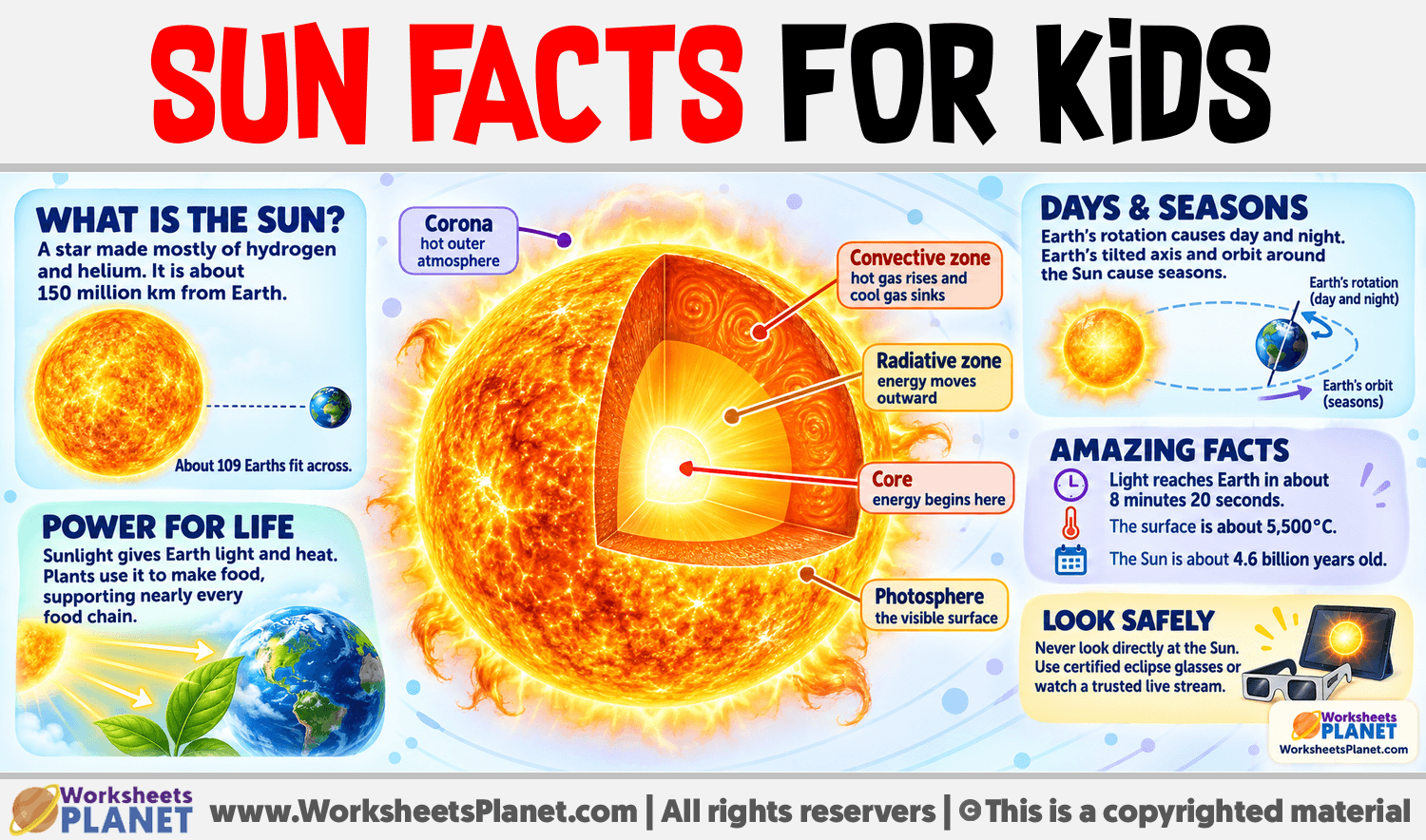
The Sun is a star, not a planet. A star is a huge glowing ball of gas that makes its own light and heat. The Sun is the closest star to Earth, which is why it looks much bigger and brighter than the stars we see at night.
The Sun is mostly made of hydrogen and helium. Deep inside its core, hydrogen changes into helium in a process called nuclear fusion. This process releases an enormous amount of energy, which travels outward and eventually reaches Earth as sunlight.
Scientists estimate that the Sun is about 4.6 billion years old. It is middle-aged for a star, which means it has been shining for a very long time and will continue to shine for billions of years more.
- The Sun is the center of our solar system.
- Earth and the other planets orbit, or travel around, the Sun.
- The Sun is so large that about 1.3 million Earths could fit inside it.
- Sunlight takes about 8 minutes and 20 seconds to reach Earth.
Why is the Sun important for life on Earth?
The Sun is essential because it provides the energy that keeps Earth warm enough for living things. Without the Sun, our planet would be extremely cold and dark. Oceans would freeze, plants could not grow, and animals and humans would not survive.
Plants use sunlight to make food through a process called photosynthesis. During photosynthesis, plants take in carbon dioxide, water, and sunlight to produce sugar and oxygen. This oxygen is the air that many living things breathe.
The Sun also drives Earth’s water cycle. Its heat warms water in oceans, lakes, and rivers, causing some of it to evaporate into the air. Later, the water falls back to Earth as rain, snow, sleet, or hail.
- It helps plants grow and produce oxygen.
- It warms land, water, and air.
- It powers weather patterns such as wind and storms.
- It helps create day and night as Earth rotates.
- It provides natural light for people, animals, and ecosystems.
What are the main parts of the Sun?
The Sun does not have a solid surface like Earth. Instead, it is made of layers of very hot gas and plasma. Plasma is a state of matter similar to gas, but with charged particles. The Sun’s layers help scientists understand how energy moves from the center of the Sun into space.
The core is the hottest part of the Sun. This is where nuclear fusion happens. Around the core are layers where energy slowly moves outward. By the time energy reaches the outer layers, it can escape into space as light and heat.
The visible part of the Sun is called the photosphere. This is the layer we see from Earth, although we should never look directly at it. Above it are the chromosphere and the corona. The corona is the Sun’s outer atmosphere and can sometimes be seen during a total solar eclipse.
- Core: the center, where the Sun makes energy.
- Radiative zone: a layer where energy moves slowly outward.
- Convective zone: a layer where hot material rises and cooler material sinks.
- Photosphere: the visible “surface” of the Sun.
- Corona: the outer atmosphere, stretching far into space.
How does the Sun affect Earth’s seasons and days?
The Sun helps create day and night, but not because the Sun moves around Earth. Day and night happen because Earth rotates, or spins, once about every 24 hours. When your part of Earth faces the Sun, it is daytime. When it turns away, it is nighttime.
Seasons happen because Earth is tilted on its axis as it orbits the Sun. When one half of Earth is tilted toward the Sun, it receives more direct sunlight and has warmer weather. This is summer. When that half is tilted away, the sunlight is less direct and the weather is cooler. This is winter.
The Sun also affects the length of shadows. When the Sun is high in the sky, shadows are shorter. When the Sun is low near the horizon, such as in the morning or late afternoon, shadows are longer. This makes shadow watching a useful classroom activity for learning about the Sun’s position.
- Earth’s rotation causes day and night.
- Earth’s tilt helps create the seasons.
- More direct sunlight usually means warmer temperatures.
- Less direct sunlight usually means cooler temperatures.
- The Sun’s position in the sky changes how shadows look.
Amazing Sun facts and safe ways to learn about it
The Sun is fascinating, but it must be studied safely. Looking directly at the Sun can seriously damage your eyes, even if it does not hurt right away. Sunglasses are not enough protection for solar viewing. To observe the Sun, students should use safe tools and follow adult instructions.
One safe way to study the Sun is by tracking shadows outdoors. Students can place a stick in the ground and mark the shadow at different times of day. They will see that the shadow changes direction and length as Earth rotates. Another safe activity is reading weather reports and noticing how sunlight affects temperature, clouds, and daily weather.
During a solar eclipse, the Moon passes between Earth and the Sun. This can make the Sun look partly or completely covered. Eclipses are exciting science events, but they require certified solar eclipse glasses or indirect viewing methods. Safety should always come first.
- Never look directly at the Sun without proper solar viewing equipment.
- Use eclipse glasses that meet approved safety standards during solar events.
- Try shadow experiments to learn about the Sun’s apparent movement.
- Compare sunny, cloudy, and rainy days to explore how sunlight affects temperature.
- Remember that the Sun is a star, and it is the reason Earth is full of light, warmth, and life.

Leave A Comment