
Earth is our home planet and the only place in the universe where we know life exists. Learning Earth facts for kids helps students understand oceans, land, air, weather, animals, plants, and even space. Earth may look like a simple blue ball from far away, but it is a busy planet with moving plates, powerful storms, deep oceans, and a thin layer of air that protects living things. These facts explain what makes Earth special and why it is important to take care of it.
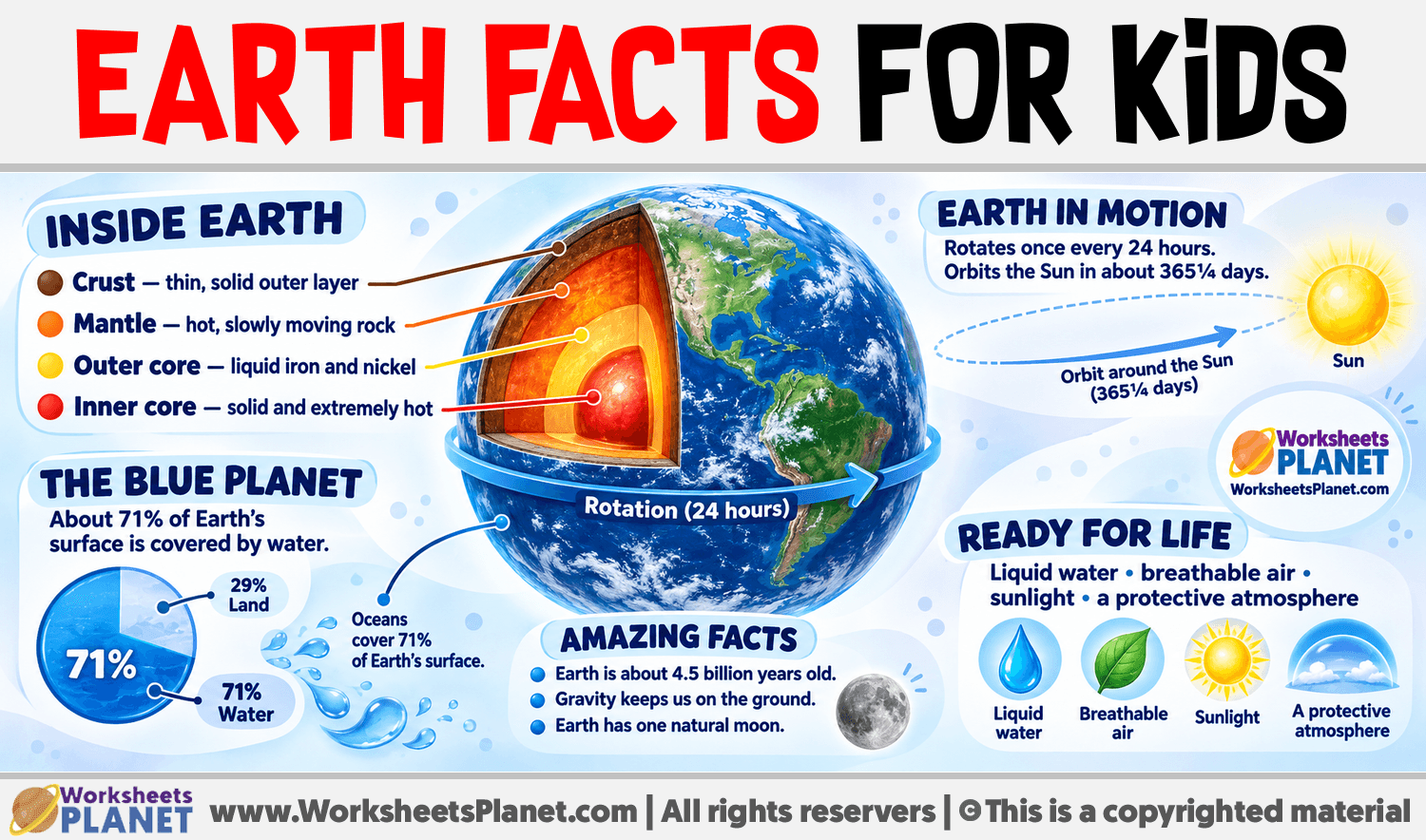
What is Earth made of?
Earth is a rocky planet with several layers. The outside layer, where we live, is called the crust. It includes continents, ocean floors, mountains, valleys, and soil. Under the crust is the mantle, a very hot layer of rock that can move slowly over time. Deeper inside are the outer core and inner core, which are mostly made of metal.
The inner core is extremely hot, but it stays solid because of the huge pressure around it. The outer core is liquid metal, and its movement helps create Earth’s magnetic field. This magnetic field acts like a shield, helping protect Earth from some harmful particles that come from the Sun.
- Crust: the thin outer layer where people, animals, and plants live.
- Mantle: a hot, thick layer of rock beneath the crust.
- Outer core: a liquid layer made mostly of iron and nickel.
- Inner core: a solid metal center at the middle of Earth.
Why is Earth called the Blue Planet?
Earth is often called the Blue Planet because about 71% of its surface is covered by water. When astronauts look at Earth from space, the oceans make it appear bright blue. Most of this water is salty and found in oceans and seas. Only a small part is fresh water, which people, animals, and plants need to survive.
Water on Earth moves through the water cycle. The Sun heats water in oceans, lakes, and rivers, causing it to evaporate into the air. The water vapor cools and forms clouds. Later, it falls back to the ground as rain, snow, sleet, or hail. This cycle helps fill rivers, grow crops, and provide drinking water.
- Oceans help control Earth’s temperature.
- Fresh water is found in rivers, lakes, glaciers, underground water, and ice caps.
- Clouds form when water vapor cools in the atmosphere.
- Rain and snow return water to the land and oceans.
How does Earth move in space?
Earth is always moving, even though we do not feel it. It spins on its axis, an imaginary line that runs from the North Pole to the South Pole. One full spin takes about 24 hours, which gives us day and night. The side of Earth facing the Sun has daytime, while the side turned away has nighttime.
Earth also travels around the Sun. This trip is called an orbit, and it takes about 365 days, or one year. Earth’s axis is tilted, and this tilt helps create the seasons. When one half of Earth is tilted toward the Sun, it gets more direct sunlight and has warmer weather. When it is tilted away, it gets less direct sunlight and has cooler weather.
The Moon moves around Earth, too. Its gravity pulls on Earth’s oceans and causes tides. High tide happens when ocean water is pulled higher, and low tide happens when the water level drops.
What makes Earth able to support life?
Earth has the right conditions for life. It is not too close to the Sun and not too far away, so temperatures can allow liquid water to exist. Liquid water is one of the most important things living things need. Earth also has an atmosphere, which is the layer of gases surrounding the planet.
The atmosphere contains oxygen, which many animals and humans need to breathe. It also contains carbon dioxide, which plants use to make food through photosynthesis. The atmosphere helps trap some warmth from the Sun, protects Earth from many small space rocks, and blocks much of the Sun’s harmful radiation.
Another reason Earth supports life is its great variety of habitats. A habitat is a place where a living thing can find food, water, shelter, and space. Earth has forests, deserts, grasslands, wetlands, coral reefs, polar regions, mountains, and oceans. Each habitat is home to different kinds of living things.
- Forests provide homes for many birds, insects, mammals, and plants.
- Oceans contain tiny plankton, fish, whales, sharks, and coral reefs.
- Deserts are dry but still support animals like lizards, camels, and scorpions.
- Polar regions are cold and icy, with animals such as penguins, seals, and polar bears.
Amazing Earth facts kids should know
Earth is full of surprising facts that show how active and special our planet is. It has weather, seasons, volcanoes, earthquakes, mountains, deep ocean trenches, and living things of many shapes and sizes. Some changes happen quickly, like storms or earthquakes. Other changes, such as the movement of continents, happen very slowly over millions of years.
Earth’s surface is divided into large pieces called tectonic plates. These plates move slowly over the mantle. When they push, pull, or slide past each other, they can form mountains, cause earthquakes, or create volcanoes. This movement is one reason Earth’s surface keeps changing.
People also play an important role on Earth. We use land, water, minerals, plants, and animals in many ways. Because Earth’s resources are not unlimited, it is important to reduce waste, save water, recycle when possible, and protect natural places. Taking care of Earth helps protect the air, water, soil, and living things that make our planet healthy.
- Earth is the third planet from the Sun.
- It is about 4.5 billion years old.
- Earth has one natural satellite: the Moon.
- The deepest known ocean area is the Mariana Trench.
- Mount Everest is the highest mountain above sea level.
- Earth’s atmosphere is mostly nitrogen and oxygen.

Leave A Comment