
Saturn is one of the most amazing planets in our Solar System. It is famous for its wide, bright rings, but there is much more to learn about this giant world. Saturn is the sixth planet from the Sun and the second-largest planet after Jupiter. It is so big that more than 700 Earths could fit inside it, but it is also very different from our rocky planet. Saturn is a gas giant, which means it is made mostly of gases instead of solid ground. These Saturn facts for kids can help students understand what makes this planet special, from its rings and moons to its weather and place in space.
What is Saturn made of?
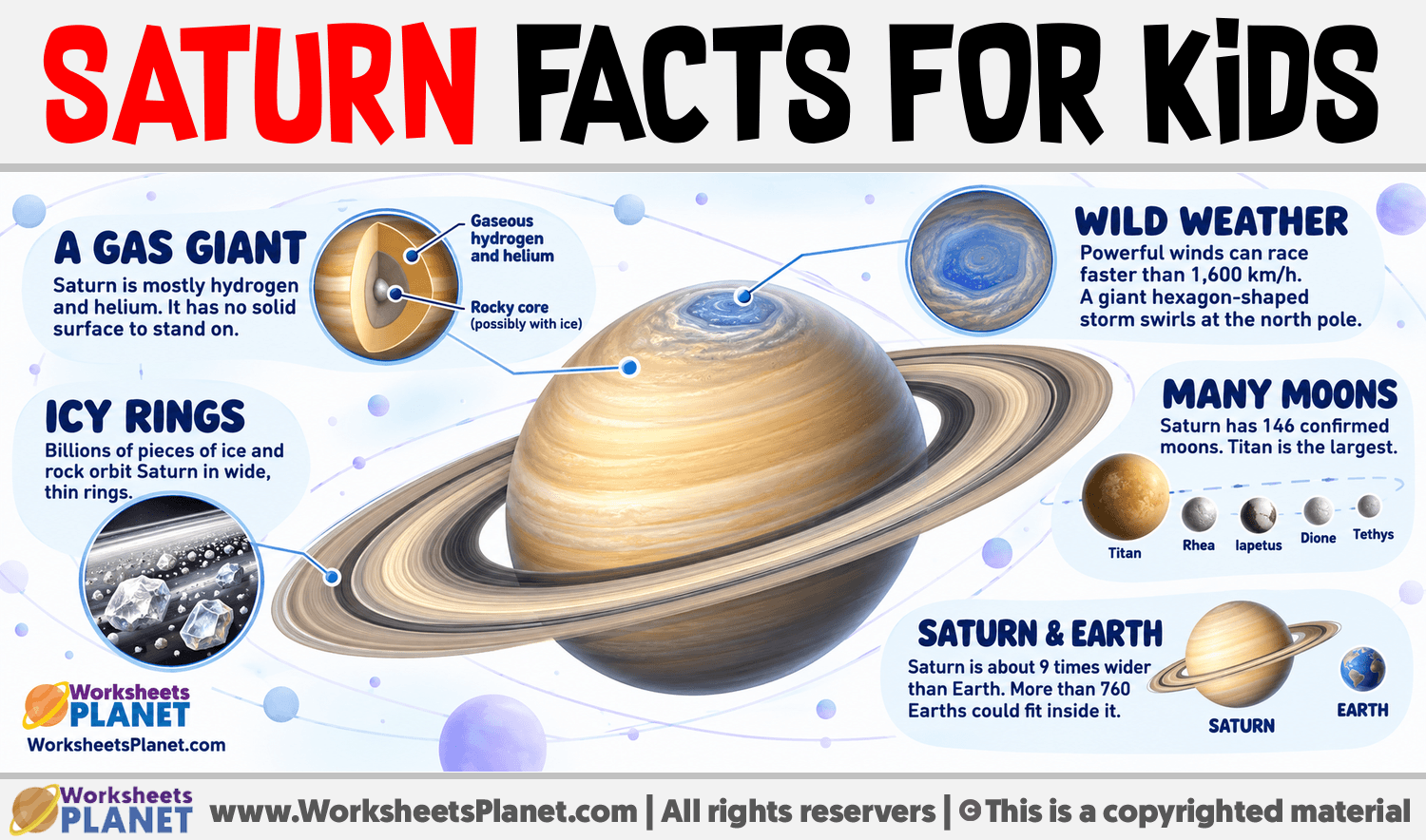
Saturn is not a rocky planet like Earth, Mars, Mercury, or Venus. It is made mostly of hydrogen and helium, the same two gases found in many stars. Because of this, Saturn does not have a hard surface where a spacecraft could land. If you tried to stand on Saturn, you would sink deeper and deeper into thick layers of gas and liquid-like materials.
Even though Saturn is huge, it is surprisingly light for its size. In fact, Saturn is the least dense planet in the Solar System. Scientists often explain this by saying that if there were a bathtub big enough to hold Saturn, the planet would float. Of course, such a bathtub could never exist, but the idea helps show how low Saturn’s density is compared with other planets.
- Saturn is mostly made of hydrogen.
- It also contains helium and small amounts of other gases.
- It has no solid surface like Earth.
- Its deep interior is under enormous pressure.
- Saturn’s outer layers look yellow, gold, and brown because of clouds and gases in its atmosphere.
Why does Saturn have rings?
Saturn’s rings are its most famous feature. They look like smooth, flat bands from far away, but they are actually made of countless pieces of ice, rock, and dust. Some ring particles are tiny, like grains of sand, while others may be as large as houses. These pieces orbit Saturn because of the planet’s strong gravity.
Scientists think the rings may have formed from broken moons, comets, or other icy objects that came too close to Saturn. Instead of forming one large moon, the pieces spread out into rings around the planet. Saturn is not the only planet with rings, but its rings are the largest and brightest in our Solar System, which is why they are so easy to recognize in pictures.
The rings are very wide, stretching hundreds of thousands of kilometers around Saturn, but they are also surprisingly thin. In many places, they may be only about as thick as a tall building. This makes them one of the most beautiful and unusual structures in space.
How many moons does Saturn have?
Saturn has many moons, and scientists continue to study and discover more about them. Some are tiny and irregular in shape, while others are large and round. Saturn’s moons are important because they help scientists learn about ice, gravity, and even the possibility of life beyond Earth.
The largest moon is Titan. Titan is bigger than the planet Mercury and has a thick atmosphere. It also has lakes and rivers, but they are not made of water. Instead, they are made of liquid methane and ethane, which are chemicals that stay liquid in Titan’s freezing temperatures. Titan is one of the most interesting places in the Solar System for scientists.
Another fascinating moon is Enceladus. This icy moon has geysers that spray water vapor and ice particles into space. Scientists believe there may be a salty ocean hidden under its icy crust. Because liquid water is important for life as we know it, Enceladus is carefully studied by space scientists.
- Titan is Saturn’s largest moon and has a thick atmosphere.
- Enceladus may have an ocean beneath its icy surface.
- Some moons help shape Saturn’s rings with their gravity.
- Many of Saturn’s moons are covered in ice.
- Saturn’s moon system is one of the most complex in the Solar System.
What is the weather like on Saturn?
Saturn’s weather is extreme compared with Earth’s. The planet has powerful winds, giant storms, and thick layers of clouds. Winds near Saturn’s equator can reach speeds of over 1,600 kilometers per hour. That is much faster than the strongest hurricanes on Earth.
One of Saturn’s strangest weather features is a huge storm pattern at its north pole called the hexagon. It is a six-sided cloud pattern that has lasted for many years. Scientists are still studying why it keeps such a clear shape. Saturn also has large storms that can grow so big they wrap around much of the planet.
Saturn is very cold because it is far from the Sun. The average temperature in its upper clouds is about -178 degrees Celsius. However, Saturn also gives off some heat from inside, which may come from slow changes in its deep interior. This internal heat helps power some of its weather patterns.
How does Saturn compare with Earth?
Saturn and Earth are both planets that orbit the Sun, but they are extremely different. Earth is a small rocky planet with land, oceans, and life. Saturn is a huge gas giant with no solid surface, many moons, and a giant ring system. Comparing the two planets helps students understand the variety of worlds in our Solar System.
A day on Saturn is short. Saturn spins very quickly, so one day lasts only about 10.7 Earth hours. But a year on Saturn is very long because it takes much more time to travel around the Sun. One Saturn year lasts about 29.5 Earth years. That means a child who is 10 years old on Earth would not even be one Saturn year old.
Saturn can sometimes be seen from Earth without a telescope, appearing like a bright point of light in the night sky. However, a telescope is needed to see its rings. Space missions, especially NASA’s Cassini spacecraft, have helped us learn a great deal about Saturn, its rings, and its moons. Cassini orbited Saturn for more than 13 years and sent back thousands of images and measurements before its mission ended in 2017.
- Earth is rocky, while Saturn is a gas giant.
- Earth has one Moon, while Saturn has many moons.
- Earth has a breathable atmosphere, but Saturn’s atmosphere is not safe for humans.
- A Saturn day is shorter than an Earth day.
- A Saturn year is much longer than an Earth year.

Leave A Comment