
Matter is anything that has mass and takes up space, such as water, air, wood, metal, paper, and food. Matter can change in many ways, but not all changes create a new substance. Physical changes of matter are changes that affect the form, size, shape, state, or appearance of a material without changing what the material is made of. When ice melts, paper is cut, or a glass of water evaporates, the substance is still the same matter, just in a different form. Understanding physical changes helps students observe the world carefully, compare materials, and explain everyday events using science vocabulary.
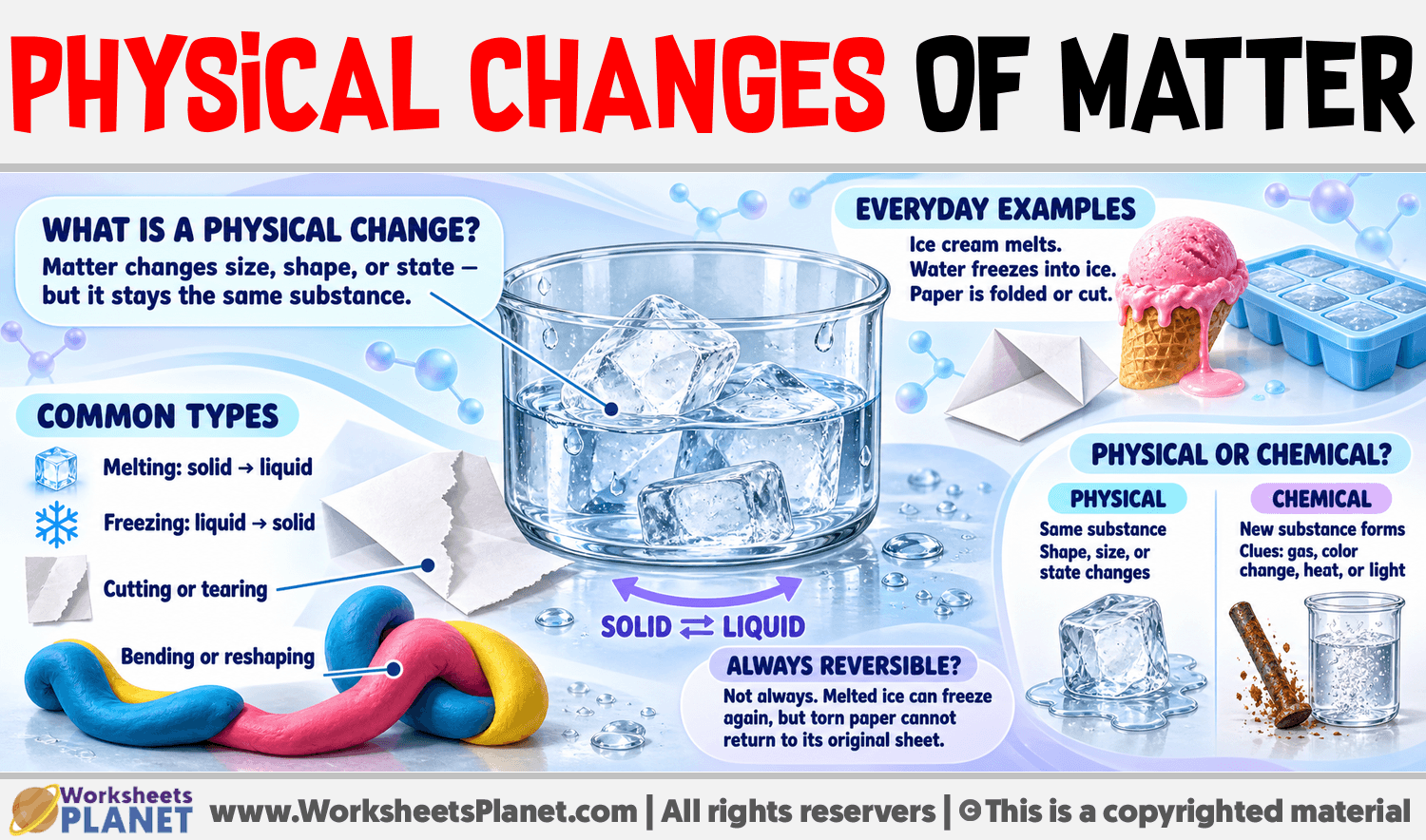
What Is a Physical Change of Matter?
A physical change happens when matter changes in a way that does not produce a new substance. The particles that make up the material remain the same, even if their arrangement, movement, or shape changes. For example, when a solid piece of chocolate melts, it becomes liquid chocolate, but it is still chocolate.
Physical changes are different from chemical changes. In a chemical change, a new substance forms, such as when wood burns and turns into ash and smoke. In a physical change, the material may look different, but its identity stays the same. A crumpled sheet of paper is still paper, and crushed ice is still frozen water.
- No new substance is formed.
- The change may affect size, shape, texture, or state.
- Many physical changes can be reversed, although not all of them are easy to undo.
- The material keeps the same basic properties, such as what it is made of.
Common Types of Physical Changes
Physical changes can happen in several ways. Some involve a change in state, such as melting or freezing. Others involve a change in shape or size, such as bending, breaking, folding, or cutting. These changes may happen because of heat, cooling, pressure, movement, or force.
One of the most important types of physical change is a change of state. Matter commonly exists as a solid, liquid, or gas. When energy is added or removed, particles move differently, and the matter may change from one state to another. Water is a helpful example because it can be ice, liquid water, or water vapor while remaining the same substance: H2O.
- Melting: a solid changes into a liquid, such as ice turning into water.
- Freezing: a liquid changes into a solid, such as water becoming ice.
- Evaporation: a liquid changes into a gas, such as puddles drying in the sun.
- Condensation: a gas changes into a liquid, such as water droplets forming on a cold glass.
- Cutting or tearing: the size or shape changes, but the material stays the same.
- Dissolving: one substance spreads evenly through another, such as salt dissolving in water.
Everyday Examples Students Can Observe
Physical changes of matter are easy to find at home, in the classroom, and outside. Cooking, cleaning, playing, and weather all include many examples. Observing these changes helps students connect science to real life rather than seeing it only as a textbook idea.
A pencil being sharpened is a physical change because the wood and graphite become smaller pieces, but they do not become a new substance. A rubber band stretching is also a physical change because its shape changes when pulled and often returns to its original form when released. Even mixing sand and water is physical because the sand is still sand and the water is still water.
- Breaking a cracker into smaller pieces
- Folding clothes or paper
- Melting butter on warm toast
- Water vapor forming on a bathroom mirror after a hot shower
- Crushing a can
- Mixing cereal with milk
- Snow melting on a sunny day
- Dissolving sugar in tea or lemonade
Are Physical Changes Always Reversible?
Many physical changes are reversible, but reversible does not mean every physical change is easy to undo. Ice can melt into water and then freeze again into ice. Water can evaporate and later condense back into liquid. These are clear examples of changes that can go back and forth when temperature changes.
However, some physical changes are difficult or impossible to reverse in a practical way. If a glass cup breaks, the pieces are still glass, so it is a physical change, but putting the cup back exactly as it was is not easy. If paper is cut into tiny pieces, it remains paper, but the original sheet cannot be restored perfectly. This is why students should not rely only on reversibility to identify a physical change. The better question is: Did a new substance form? If the answer is no, the change is physical.
How to Tell Physical and Chemical Changes Apart
Students often confuse physical and chemical changes because both can change how matter looks. The key difference is whether the substance itself changes into something new. A physical change may involve a new shape or state, while a chemical change produces new materials with different properties.
Some signs can suggest a chemical change, such as bubbling, a new smell, a color change, heat or light being produced, or a solid forming when liquids are mixed. But these signs must be used carefully. For example, boiling water makes bubbles, but it is still a physical change because the bubbles are water vapor, not a new substance. Melting a colored crayon changes its shape and state, but the crayon material remains the same.
A simple classroom question can guide students: What was the matter before, and what is it after? If ice becomes water, it is still water. If wood burns and becomes ash, smoke, and gases, new substances have formed. That makes burning a chemical change, not a physical one.
- Ask whether a new substance was created.
- Check if the change is mainly in shape, size, or state.
- Remember that changes in appearance do not always mean a chemical change.
- Use evidence, not guesses, to explain your answer.
Why Physical Changes of Matter Matter in Science Learning
Learning about physical changes helps students build a strong foundation for later science topics, including states of matter, the water cycle, mixtures, solutions, heat energy, and conservation of matter. It also encourages careful observation. Instead of simply saying “it changed,” students learn to describe how it changed and what stayed the same.
Physical changes of matter also show that matter can look very different while remaining the same substance. This idea is important in experiments and daily life. When students melt ice, dissolve salt, or tear paper, they are practicing scientific thinking: observing, comparing, asking questions, and using evidence. These skills help them understand not only matter, but also how scientists study the world around them.

Leave A Comment