Matter is anything that has mass and takes up space, such as air, water, wood, metal, food, and even the cells in our bodies. Matter can change in different ways. Some changes only affect how something looks or feels, but other changes create a new substance. These are called chemical changes of matter. Understanding chemical changes helps students explain everyday events, from cooking an egg to rust forming on a bicycle. It also helps teachers and parents connect science lessons to real life in a simple and meaningful way.
What Are Chemical Changes of Matter?
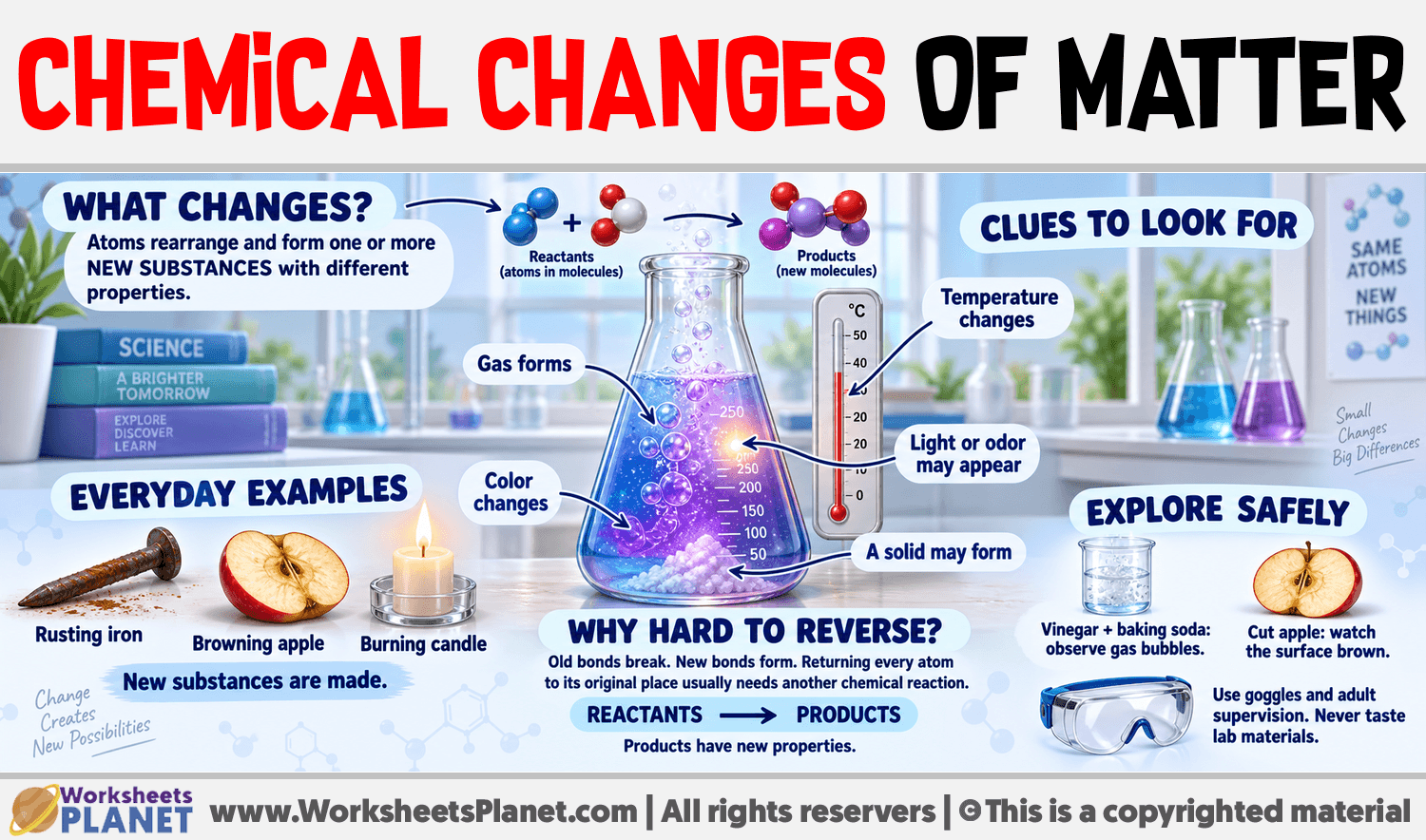
A chemical change happens when one or more substances change into one or more different substances. The new substance has properties that are not the same as the original materials. For example, when paper burns, it does not simply become smaller paper. It changes into ash, smoke, and gases. These new substances cannot easily be changed back into paper.
Chemical changes are different from physical changes. In a physical change, the substance stays the same even if its size, shape, or state changes. Melting ice is a physical change because the water is still water. But when iron rusts, the iron reacts with oxygen and water to form rust, which is a new substance.
- Physical change: cutting paper, freezing water, breaking glass, melting chocolate.
- Chemical change: burning wood, baking a cake, digesting food, rusting metal.
How Can You Tell a Chemical Change Has Happened?
Scientists look for evidence that a new substance has formed. Sometimes the signs are easy to see, such as flames during burning. Other times, they are more subtle, like a change in smell or the slow formation of a solid inside a liquid. One sign alone does not always prove a chemical change, but several signs together can give strong evidence.
For example, when vinegar and baking soda are mixed, bubbles appear quickly. The bubbles are carbon dioxide gas, which was not present in that form before the reaction. This is a clear sign that a chemical reaction has taken place.
- A color change, such as leaves turning brown as they decay.
- A new gas forming, often seen as bubbles or fizzing.
- A temperature change without heating or cooling from outside.
- A new smell, such as food spoiling or bread baking.
- A solid forming when two liquids are mixed, called a precipitate.
- Light or flames being produced, as in burning or fireworks.
Common Types of Chemical Changes in Everyday Life
Chemical changes happen all around us, not only in science laboratories. One of the most familiar types is combustion, which occurs when a substance reacts with oxygen and releases energy as heat and light. Burning a candle, lighting a campfire, and fuel burning in a car engine are examples of combustion.
Another important type is oxidation. Rusting is a common oxidation reaction. When iron is exposed to oxygen and moisture, it slowly forms iron oxide, or rust. Oxidation also happens when sliced apples turn brown after being left in the air.
In the kitchen, chemical changes are especially easy to observe. Cooking often changes the structure of food. When an egg is heated, its proteins unfold and join together in a new way, changing the clear liquid egg white into a firm white solid. Baking bread or cookies involves chemical reactions that create new flavors, smells, colors, and textures.
- Combustion: wood burning in a fireplace.
- Rusting: a metal gate reacting with air and water.
- Cooking: pancakes browning on a hot pan.
- Digestion: food breaking down into useful nutrients.
- Decomposition: dead plants and animals breaking down in soil.
Why Are Chemical Changes Usually Hard to Reverse?
Many chemical changes are difficult to reverse because the atoms in the original substances have rearranged to form new substances. In a chemical reaction, bonds between atoms may break, and new bonds may form. This rearrangement changes the identity of the material.
For instance, after wood burns, the ash and gases cannot simply be put back together to make the original log. The atoms are still present somewhere, but they are now part of different substances. This connects to an important science idea called the law of conservation of mass. In a closed system, matter is not created or destroyed during a chemical reaction; it is rearranged.
Some chemical changes can be reversed using other chemical reactions, but this usually requires special conditions, energy, or equipment. That is why students often learn that chemical changes are “not easily reversible” rather than “never reversible.” This wording is more accurate and helps avoid confusion.
Simple Classroom and Home Examples to Explore Safely
Teachers and parents can help students understand chemical changes by using safe, familiar materials. The goal is not only to watch something exciting happen, but also to ask good questions: What changed? What evidence do we see? Did a new substance form? These questions encourage students to think like scientists.
One simple activity is mixing baking soda and vinegar in a cup. Students can observe fizzing and feel whether the cup becomes cooler. Another useful example is leaving a slice of apple exposed to air and comparing it with a slice coated in lemon juice. The untreated apple usually browns faster because of oxidation, while lemon juice slows the process.
Safety is important during all experiments. Students should avoid tasting materials, keep mixtures away from eyes, and wash hands afterward. Activities involving flames, strong chemicals, or hot surfaces should only be done with careful adult supervision.
- Ask students to record before-and-after observations.
- Have them identify possible signs of a chemical change.
- Compare chemical changes with physical changes using everyday objects.
- Encourage explanations using words like react, new substance, gas, and evidence.

Leave A Comment