
A galaxy is a huge system of stars, gas, dust, dark matter, and other objects held together by gravity. Our home galaxy, the Milky Way, contains hundreds of billions of stars, including the Sun. When students learn about the parts of a galaxy, they discover that galaxies are not just random collections of stars. They have organized regions, each with its own features and role in how the galaxy forms, moves, and changes over time.
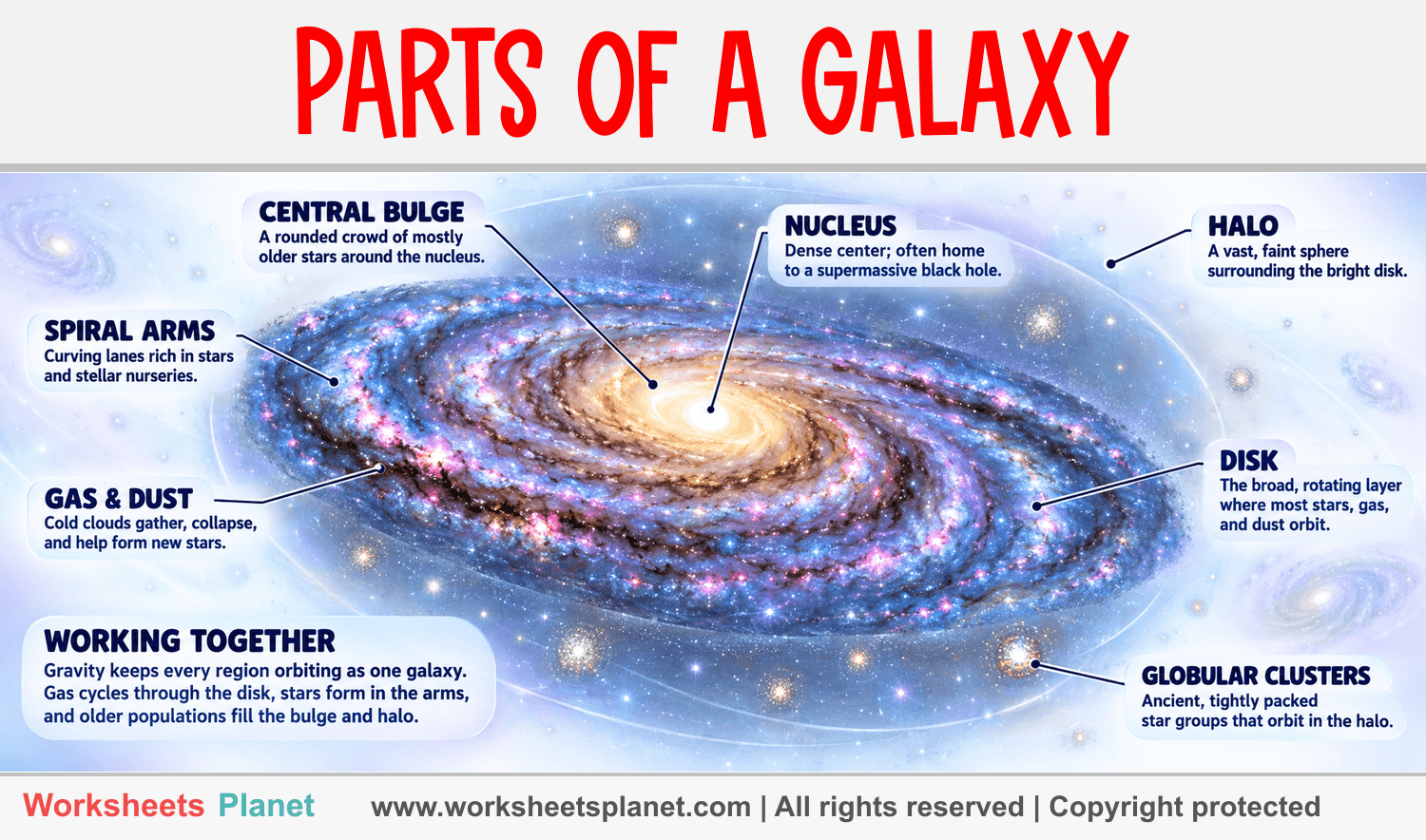
What are the main parts of a galaxy?
The main parts of a galaxy include the nucleus, central bulge, disk, spiral arms, halo, and clouds of gas and dust. Not every galaxy has all of these parts in the same way. Spiral galaxies, such as the Milky Way, show these regions clearly, while elliptical galaxies look smoother and have fewer obvious structures.
Each part helps astronomers understand the galaxy’s history. For example, areas with many young blue stars usually show where new stars are forming. Regions with older red or yellow stars may tell us that star formation slowed down long ago.
- Nucleus: the very center of a galaxy, often containing a supermassive black hole.
- Bulge: a rounded, crowded region of mostly older stars near the center.
- Disk: a flat, rotating region that may contain stars, gas, and dust.
- Spiral arms: curved areas rich in gas, dust, and young stars in spiral galaxies.
- Halo: a large, faint outer region surrounding the galaxy, containing old stars and globular clusters.
The nucleus and central bulge
The nucleus is the central region of a galaxy. In many large galaxies, this area contains a supermassive black hole. A black hole is not a hole in the usual sense, but an object with gravity so strong that even light cannot escape if it gets too close. The black hole at the center of the Milky Way is called Sagittarius A*.
Around the nucleus is the central bulge, a thick, rounded area filled with stars. These stars are often older than many stars found in the disk. Because the bulge is crowded, stars there are closer together than in the Sun’s neighborhood. If Earth were located near the galactic center, the night sky might look much brighter because many more stars would be visible.
The bulge is important because it gives clues about how the galaxy formed. Some bulges may have grown through galaxy collisions, while others developed as stars and gas moved inward over billions of years.
The disk, spiral arms, gas, and dust
In a spiral galaxy, the disk is the broad, flat part that rotates around the center. The Milky Way’s disk contains the Sun, the planets, and most of the visible stars we see in the night sky. This disk is not empty space between stars. It also contains interstellar gas and cosmic dust.
The spiral arms are some of the most eye-catching parts of a galaxy. They are not solid arms like those of a person. Instead, they are curved regions where stars, gas, and dust are more crowded. These areas often contain bright, hot, young stars that shine blue-white. They also hold nebulae, which are clouds where stars can be born.
Gas and dust may sound unimportant, but they are essential. Without them, galaxies would eventually stop making many new stars. Dust can block visible light, making some parts of a galaxy look dark, but it can also be studied using infrared telescopes.
- Gas clouds provide the raw material for new stars.
- Dust lanes can hide stars and shape how a galaxy appears from Earth.
- Nebulae are star-forming regions often found in spiral arms.
- Young star clusters help scientists identify active regions of star birth.
The halo and globular clusters
The halo is a large, faint region that surrounds the main body of a galaxy. It is much less crowded than the disk or bulge, but it can stretch far into space. The halo contains old stars, star clusters, and a large amount of invisible matter called dark matter.
One of the most interesting features of the halo is its globular clusters. These are tightly packed groups of ancient stars. A single globular cluster may contain tens of thousands or even millions of stars held together by gravity. Because these stars are very old, they help astronomers estimate the age and early history of a galaxy.
Dark matter is also connected to the halo. Scientists cannot see dark matter directly, but they know it is there because of its gravitational effects. Galaxies rotate in ways that cannot be explained by visible stars, gas, and dust alone. The halo of dark matter helps hold galaxies together.
How the parts of a galaxy work together
A galaxy is a system, not just a collection of separate pieces. Gravity connects its parts and controls their motion. Stars orbit the galactic center, gas clouds move through the disk, and spiral arms can help gather material into regions where new stars form.
The life of a galaxy changes over time. Gas may cool and collapse into new stars. Massive stars may explode as supernovae, spreading heavier elements into space. Those elements can later become part of new stars, planets, moons, and even living things. In this way, the parts of a galaxy are connected to the story of the universe itself.
Different types of galaxies arrange these parts differently. Spiral galaxies have disks and arms, elliptical galaxies are more rounded and contain mostly older stars, and irregular galaxies have no clear shape. By comparing these types, students can see that the parts of a galaxy reveal how it formed, what it contains, and how it may change in the future.
- The center influences the motion of stars and may contain a supermassive black hole.
- The disk and arms often hold the materials needed for star formation.
- The halo preserves some of the galaxy’s oldest objects.
- The gas and dust recycle material from old stars into new ones.

Leave A Comment