
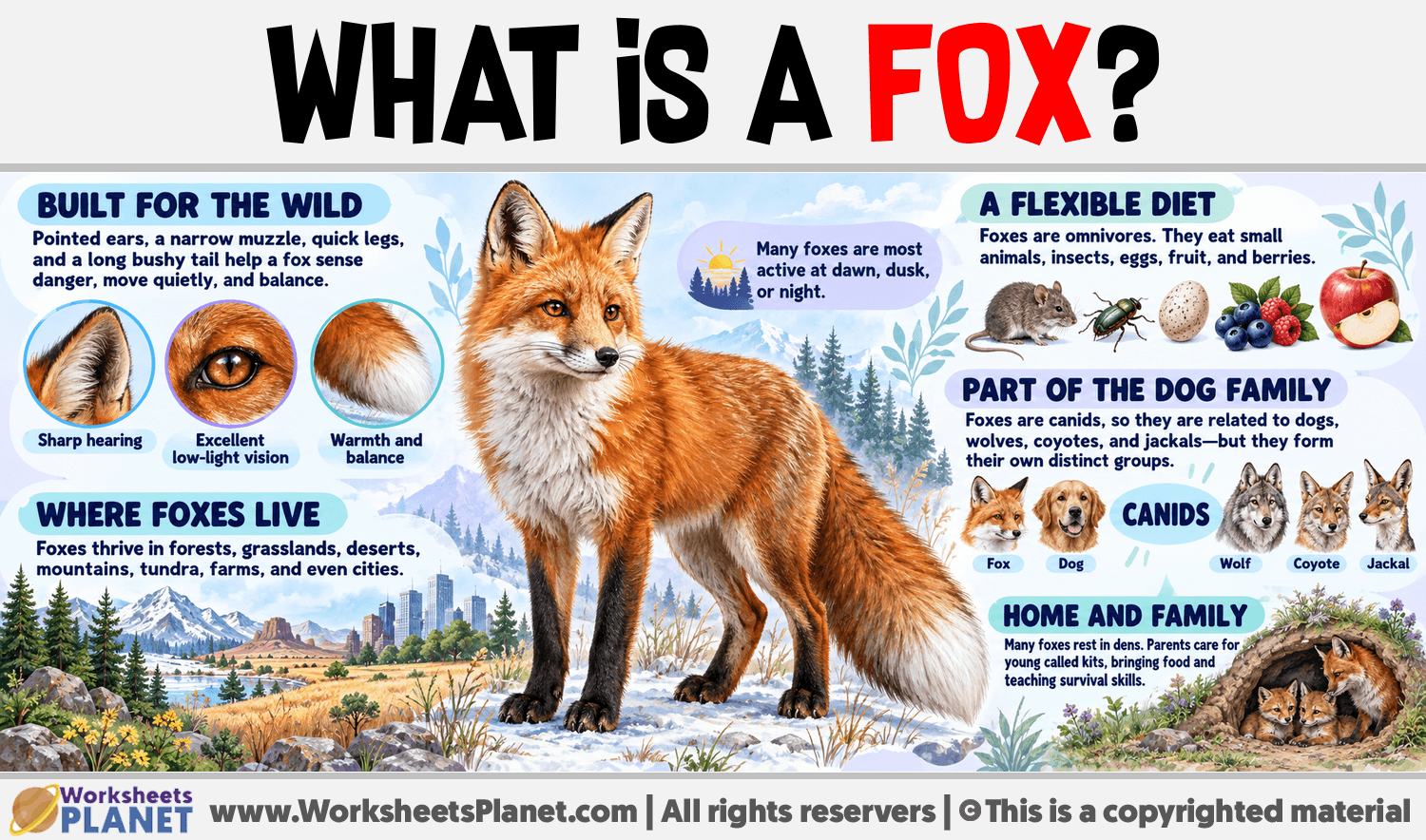
A fox is a small to medium-sized wild mammal that belongs to the dog family, called Canidae. Foxes are known for their pointed ears, long bushy tails, sharp noses, and quick movements. They are often shown in stories as clever animals, and in real life they are indeed skilled at finding food, avoiding danger, and living in many different environments. When students ask, “What is a fox?”, the best answer is that a fox is a wild canine, related to wolves, coyotes, and domestic dogs, but usually smaller, lighter, and more solitary.
What does a fox look like?
Most foxes have a slim body, a narrow face, upright ears, and a thick tail called a brush. Their fur helps protect them from cold, rain, and scratches from plants. The most familiar species, the red fox, often has reddish-orange fur, a white chest, black legs, and a white tip on its tail. However, not all foxes are red. Some are gray, sandy, silver, brown, or even almost white.
Foxes are built for moving quietly and quickly. Their paws are light, their legs are fairly short, and their bodies are flexible. These features help them sneak through grass, woodland, snow, or rocky ground while hunting. A fox’s tail is not just for appearance; it helps with balance when running and turning, and it can also keep the animal warm when it curls up to sleep.
- Pointed ears help foxes hear small animals moving underground or in grass.
- A long bushy tail helps with balance and warmth.
- Sharp teeth are used for eating meat, insects, fruit, and other foods.
- Good eyesight and smell help foxes find food and notice danger.
Where do foxes live?
Foxes live on several continents, including North America, Europe, Asia, Africa, and parts of Australia where they were introduced by people. They are highly adaptable, which means they can survive in many habitats. Some foxes live in forests, grasslands, mountains, deserts, farms, or tundra. Others live close to towns and cities, where they may search for food in parks, gardens, and quiet streets at night.
A fox home is often called a den or earth. A den may be dug by the fox itself, or it may be an old burrow made by another animal. Foxes use dens for resting, hiding from bad weather, and raising their young. Adult foxes may not sleep in a den every day, but dens are especially important during the breeding season when kits are born.
- Arctic foxes live in cold tundra regions and have thick winter fur.
- Fennec foxes live in deserts and have very large ears that help release heat.
- Red foxes can live in countryside, forests, mountains, and urban areas.
- Gray foxes are good climbers and can even climb trees to escape danger or search for food.
What do foxes eat?
Foxes are omnivores, which means they eat both animals and plants. Their diet changes depending on the season, habitat, and what food is available. A fox may hunt mice, rabbits, birds, frogs, insects, or worms. It may also eat berries, apples, seeds, eggs, and leftover food found near human homes.
One of the most interesting fox behaviors is the hunting pounce. A fox listens carefully for a small animal moving under snow, leaves, or grass. Then it leaps into the air and lands with its front paws down to catch the prey. This behavior shows how important hearing is for foxes. They can detect tiny movements that people would not notice.
Foxes also store food. If a fox catches more than it can eat, it may hide the extra food in the ground and return later. This is called caching. It helps the fox survive when food is harder to find.
- Common animal foods include mice, voles, rabbits, birds, insects, and worms.
- Common plant foods include berries, fruits, and seeds.
- In towns, foxes may eat scraps, but they should not depend on people for food.
- Foxes help control populations of small animals such as rodents.
Are foxes related to dogs and wolves?
Yes, foxes are related to dogs and wolves because they all belong to the same animal family, Canidae. This family includes domestic dogs, wolves, coyotes, jackals, and foxes. However, foxes are not simply small wolves or wild dogs. They have their own body shape, behavior, and way of living.
Compared with wolves, foxes are usually smaller and less social. Wolves often live and hunt in packs, while many foxes live alone or in small family groups. Compared with pet dogs, foxes are much more independent and are not domesticated in the same way. A fox may look cute, but it is still a wild animal with natural instincts for hunting, hiding, and defending itself.
Foxes also make many sounds. They can bark, scream, yelp, growl, and make softer calls. These sounds help them communicate, especially during mating season or when warning other foxes to stay away from their territory.
- Foxes, dogs, and wolves are all canines.
- Foxes are generally smaller than wolves and many dog breeds.
- Foxes usually hunt alone rather than in packs.
- A fox is wild and should not be treated like a pet.
How do foxes live and raise their young?
Foxes are often most active at night, dawn, or dusk, although they may also move around during the day in quiet places. They use scent markings and calls to communicate with other foxes. Many foxes have a territory, which is an area they know well and use for finding food, shelter, and mates.
Baby foxes are called kits, pups, or cubs. They are usually born in a den and cannot see or care for themselves at first. The mother stays close to keep them warm and safe, while the father may help bring food. As the kits grow, they begin to explore outside the den, play with each other, and practice hunting skills. Play is not just fun; it helps young foxes learn balance, speed, biting control, and social behavior.
Foxes have an important place in ecosystems. By eating rodents, insects, and fruit, they help keep nature in balance. They can spread seeds through their droppings and provide food for larger predators in some areas. At the same time, foxes may sometimes take chickens or small pets if they are not protected, so people living near foxes should use secure fencing and keep pets safe, especially at night.
The most important thing to remember is that a fox is a clever, adaptable, and valuable wild mammal. It is not a cartoon trickster or a household pet, but a real animal with special body features, survival skills, and a role in the natural world.
- Do not try to touch or feed a wild fox.
- Keep garbage bins closed so foxes do not become dependent on human food.
- Protect small pets and poultry with secure shelters.
- Watch foxes from a distance if you are lucky enough to see one.

Leave A Comment