
A bullfrog is a large frog known for its deep, booming call that can sound a little like a cow saying “jug-o-rum.” When students ask, “What is a bullfrog?” the simplest answer is that it is an amphibian: an animal that can live both in water and on land during different parts of its life. Bullfrogs are often found near ponds, lakes, marshes, and slow-moving streams. They are important animals to study because they show how amphibians grow, hunt, survive, and fit into a wetland ecosystem.
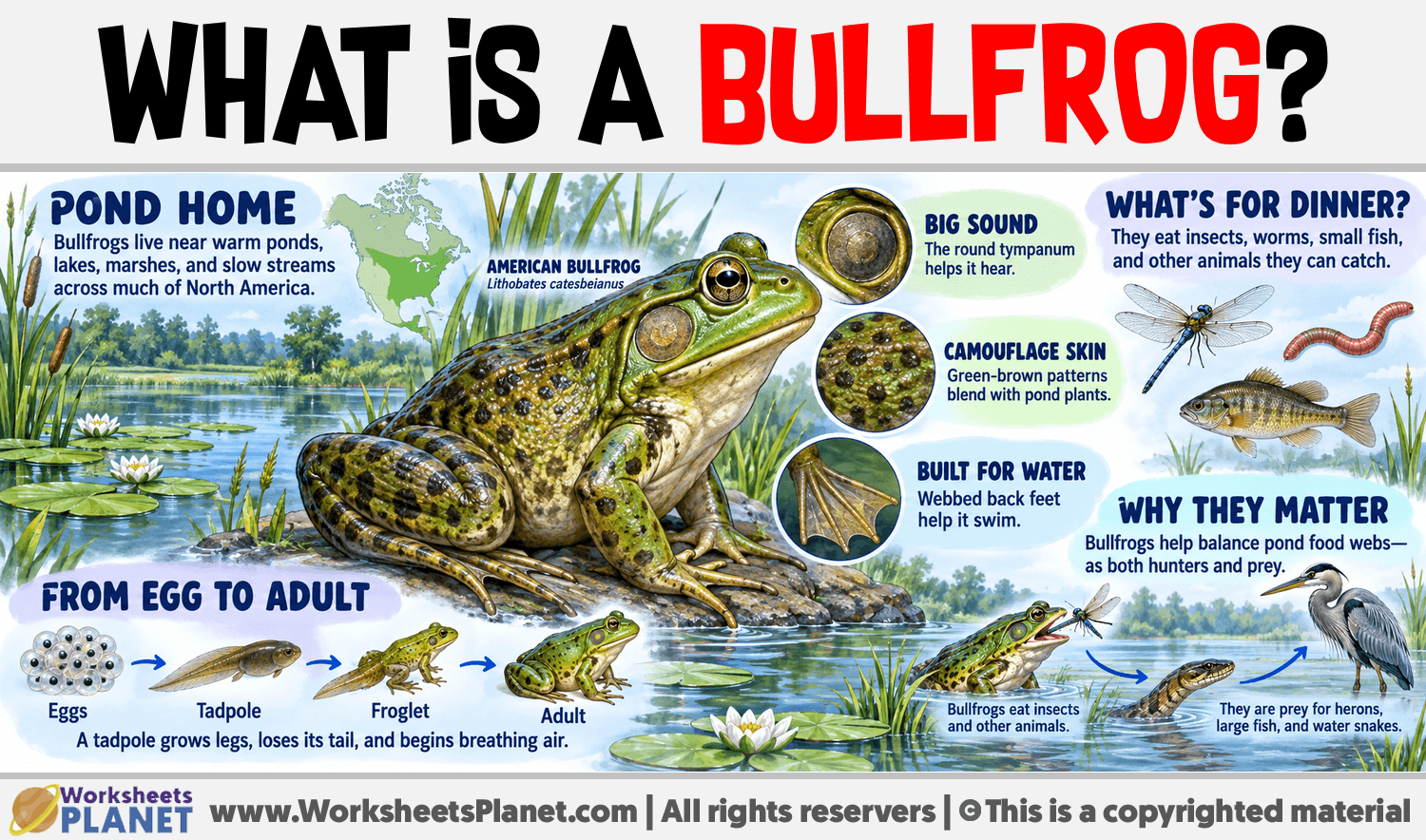
What does a bullfrog look like?
Bullfrogs are among the largest frogs in North America. An adult American bullfrog can be about 3.5 to 8 inches long from nose to body, not counting its powerful back legs. These legs help it make long jumps and swim quickly through water.
A bullfrog usually has green, olive, or brownish skin with darker markings. Its belly is lighter, often white or yellowish. Like other frogs, it has smooth, moist skin that helps it absorb water and breathe a little through its skin. This is one reason frogs need damp places to live.
One noticeable feature is the round disc behind each eye. This is the tympanum, or eardrum. In male bullfrogs, the tympanum is usually larger than the eye. In females, it is about the same size as the eye. This can help careful observers tell males and females apart.
- Large body compared with many other frogs
- Strong hind legs for jumping and swimming
- Green, brown, or olive coloring for camouflage
- Round tympanum behind the eye
- Wide mouth for catching and swallowing prey
Where do bullfrogs live?
Bullfrogs need habitats with plenty of water because their eggs and tadpoles develop in aquatic environments. They are commonly seen sitting at the edge of ponds or floating with only their eyes and nose above the surface. This position helps them watch for both food and danger.
The American bullfrog is native to eastern North America, but people have introduced it to many other places. In some regions, bullfrogs have become a problem because they can eat native animals and compete with local frog species. This makes them an important example when teaching about invasive species and how moving animals to new habitats can affect ecosystems.
A good bullfrog habitat usually includes shallow water, plants along the edges, insects and other small animals to eat, and safe places to hide from predators such as birds, snakes, raccoons, and larger fish.
- Ponds and lakes
- Marshes and wetlands
- Slow streams or canals
- Edges of reservoirs and farm ponds
- Areas with aquatic plants and muddy banks
What do bullfrogs eat?
Bullfrogs are carnivores, which means they eat other animals. They are also opportunistic predators, so they often eat whatever they can catch and swallow. Their diet changes as they grow. Tadpoles mostly feed on algae, tiny plant material, and small bits of organic matter in the water. Adult bullfrogs become strong hunters.
An adult bullfrog uses a sit-and-wait hunting strategy. It stays very still, often near the water’s edge, until prey comes close. Then it lunges forward and uses its sticky tongue and wide mouth to capture the animal. Bullfrogs do not chew like humans do. They usually swallow their food whole.
Bullfrogs may eat insects, spiders, worms, small fish, small snakes, other frogs, and even small birds or mice if they can catch them. This wide diet helps explain why bullfrogs can survive in many different watery habitats.
- Young tadpoles eat algae and tiny plant matter
- Adults eat insects, worms, fish, and small animals
- They hunt by waiting quietly and striking quickly
- They swallow prey whole instead of chewing
How does a bullfrog grow from egg to adult?
A bullfrog has a life cycle that includes metamorphosis, the process of changing body form as it grows. Like other frogs, it begins life in water as an egg. Female bullfrogs can lay thousands of eggs at one time in a floating mass on the surface of a pond or marsh.
After the eggs hatch, the young are called tadpoles. Tadpoles look very different from adult frogs. They have tails, no legs at first, and gills that help them live underwater. Over time, their bodies change. Back legs grow, then front legs appear, the tail becomes smaller, and lungs develop so the young frog can breathe air.
Bullfrog tadpoles often take longer to become adults than the tadpoles of many other frog species. In colder areas, they may remain tadpoles for more than one year before completing metamorphosis. This makes bullfrogs a useful animal for learning that life cycles can vary depending on species and environment.
- Eggs are laid in water
- Tadpoles hatch and swim with tails
- Legs grow as the body changes
- The tail shrinks and lungs develop
- The young frog becomes an adult bullfrog
Why are bullfrogs important in nature?
Bullfrogs play several roles in their ecosystems. As predators, they help control populations of insects and other small animals. As prey, they provide food for herons, snakes, turtles, fish, raccoons, and other animals. This makes the bullfrog part of a food web, where many living things depend on one another.
Bullfrogs can also help people learn about environmental health. Because amphibians have sensitive skin and depend on clean water, changes in frog populations may give clues about pollution, habitat loss, or changes in wetlands. If frogs disappear from an area, scientists may investigate whether the habitat has become unsafe.
However, bullfrogs are not always helpful everywhere. In places where they are introduced and not native, they may reduce populations of local frogs, small fish, and other animals. This shows that an animal can be natural and useful in one ecosystem but harmful in another if it is moved by humans.
For students, the bullfrog is a fascinating example of adaptation. Its strong legs, camouflaged skin, loud call, wetland habitat, and changing life cycle all help answer the question, what is a bullfrog? It is not just a big frog; it is an amphibian with an important place in nature.
- They control some insect and small animal populations
- They are food for many wetland predators
- Their presence can show clues about water quality
- They can become invasive when introduced to new places

Leave A Comment