
A republic is a form of government in which the country is considered a public matter, not the private property of a king, queen, emperor, or ruling family. In a republic, the people have an important role in choosing leaders, making laws, or holding the government accountable. Many countries today describe themselves as republics, but they do not all work in exactly the same way. Learning what a republic is helps students understand elections, citizenship, rights, laws, and the difference between government by the people and government by inherited power.
What is a republic in simple words?
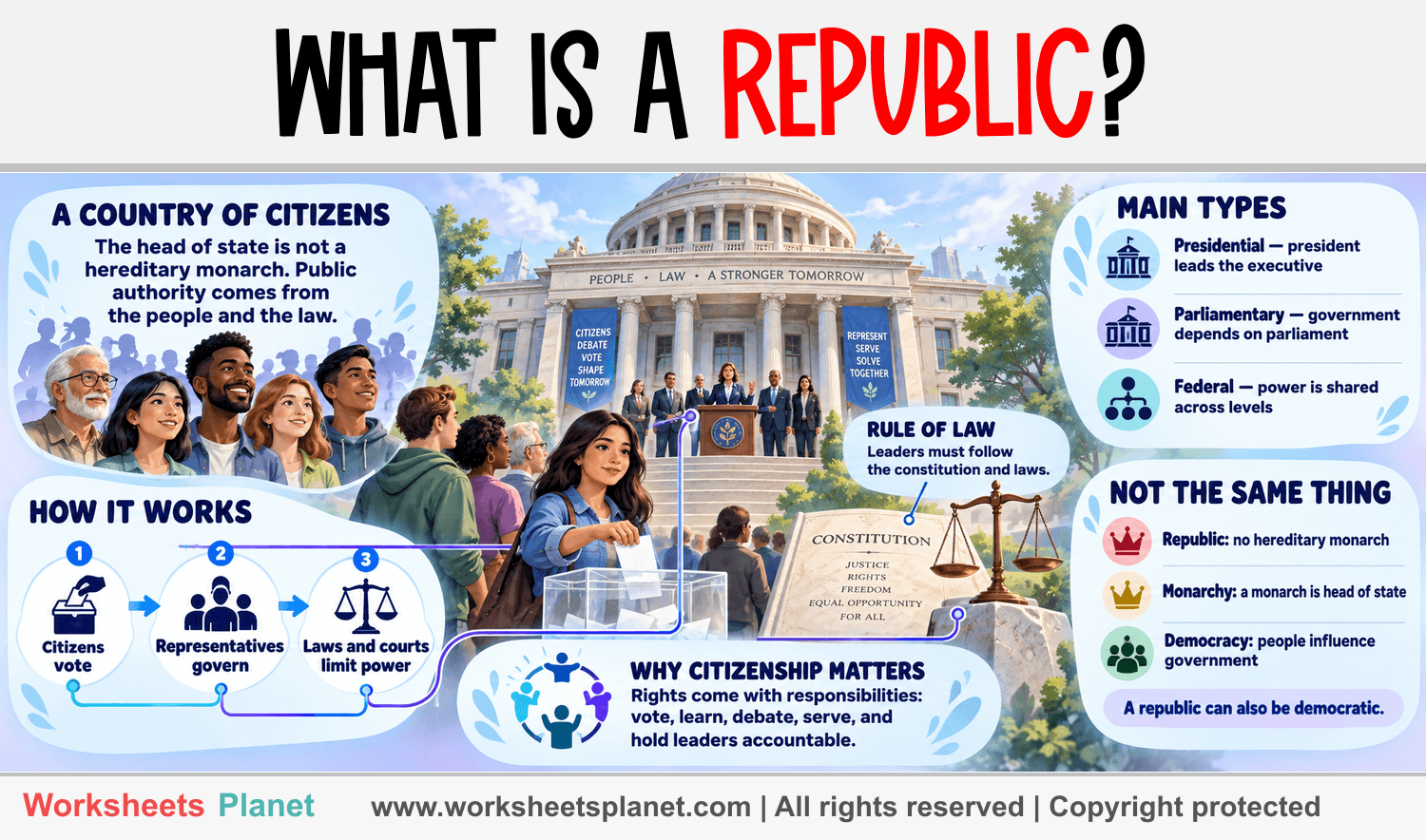
A republic is a country where political power belongs to the people, at least in principle. Instead of being ruled by a monarch who inherits the throne, citizens choose representatives or leaders to govern on their behalf. These leaders are usually expected to follow a constitution or a set of laws that limits what they can do.
The word “republic” comes from the Latin phrase <em>res publica</em>, which means “public thing” or “public matter.” This idea is important because it suggests that the government should serve the common good, not just one ruler or one powerful family.
In everyday language, a republic often means a country with elected officials, laws that apply to everyone, and a system for replacing leaders. However, a country can call itself a republic and still be more or less democratic depending on how fair its elections are and how much freedom citizens really have.
- A republic is not ruled by an inherited monarch.
- Citizens usually vote for leaders or representatives.
- Government power is limited by laws or a constitution.
- Leaders are expected to serve the public, not own the country.
How does a republic work?
Most republics use representative government. This means citizens do not vote on every single law themselves. Instead, they elect people to make decisions, debate laws, approve budgets, and speak for different communities. These representatives may work in a parliament, congress, national assembly, or similar law-making body.
A republic usually has different branches of government so that no single person or group becomes too powerful. For example, one branch may make laws, another may carry them out, and another may interpret the laws in courts. This system is often called separation of powers.
Elections are an important part of many republics, but elections alone are not enough. A healthy republic also needs rule of law, meaning leaders must obey the law just like ordinary citizens. It also needs basic freedoms, such as the ability to speak, organize, vote, and criticize the government without fear.
- Voters choose leaders for a limited period of time.
- Representatives make laws and decisions for the public.
- Courts may protect rights and settle legal disagreements.
- Constitutions often explain how power is shared and limited.
What are the main types of republics?
Republics can be organized in different ways. Some give more power to a president, while others give more power to a parliament. Some are highly democratic, while others may have elections but limit political freedom. Understanding these differences helps explain why not all republics look the same.
In a presidential republic, the president is usually both the head of state and the head of government. The president is often elected separately from the legislature. The United States and Brazil are examples of countries with presidential systems.
In a parliamentary republic, citizens elect a parliament, and the government is usually led by a prime minister chosen from that parliament. The president may have a mostly ceremonial role. Germany, India, and Italy are examples of parliamentary republics. There are also federal republics, where power is shared between a national government and regional governments, such as states or provinces.
- Presidential republic: a president has major executive power.
- Parliamentary republic: a prime minister leads the government through parliament.
- Federal republic: national and regional governments share authority.
- Democratic republic: citizens have meaningful rights and fair elections.
How is a republic different from a monarchy or a democracy?
A republic is often compared with a monarchy. In a monarchy, the head of state is usually a king, queen, or emperor who receives the position by birth. In a republic, the head of state is usually elected directly by voters or indirectly by representatives. This is one of the clearest differences.
A republic is also often compared with a democracy. These two words are related, but they are not exactly the same. Democracy means rule by the people. A republic is a system where the people’s power is usually exercised through elected representatives and laws. A country can be both a republic and a democracy if citizens have real choices, fair elections, and protected rights.
Some monarchies are democratic, such as the United Kingdom, Sweden, or Japan, because elected parliaments make the main political decisions. On the other hand, some countries call themselves republics but may not allow fair competition, free speech, or real political choice. This shows that the name of a system is less important than how it actually works.
- Republic vs. monarchy: elected leadership instead of inherited rule.
- Republic vs. direct democracy: representatives usually make decisions for citizens.
- Democratic republic: combines elected representatives with citizen rights and public accountability.
Why are republics important for citizenship?
Republics are important because they teach that government is a public responsibility. Citizens are not just subjects who obey a ruler; they are members of a political community. They can vote, learn about issues, discuss public problems, and ask leaders to explain their decisions.
In a republic, good citizenship matters. If people do not pay attention to public life, representatives may not act in the public interest. Citizens help protect a republic by voting thoughtfully, respecting laws, listening to different opinions, and defending the rights of others.
For students, the idea of a republic connects to many school topics, including history, civics, geography, and social studies. Ancient Rome is often studied as an early republic, while modern countries show how republican ideas have changed over time. The key lesson is that a republic depends not only on leaders, but also on active and informed citizens.
A simple way to remember the meaning is this: in a republic, the country belongs to the public, leaders are chosen rather than born into power, and laws are supposed to protect the people from unfair rule.
- Citizens have responsibilities as well as rights.
- Voting and public discussion help keep leaders accountable.
- Laws and constitutions protect the republic from abuse of power.
- Education helps people understand how their government works.

Leave A Comment