
The Thomson Atomic Model was one of the first scientific attempts to explain what an atom looks like inside. Proposed by the British physicist J. J. Thomson in 1904, it came after his discovery of the electron. Before this, many scientists believed atoms were solid, indivisible particles. Thomson’s work changed that idea by showing that atoms contain smaller, negatively charged particles. His model is often called the plum pudding model because it compared the atom to a round pudding with tiny pieces of fruit scattered through it. Although this model was later replaced, it played an important role in the development of modern atomic theory.
What did Thomson discover about the atom?
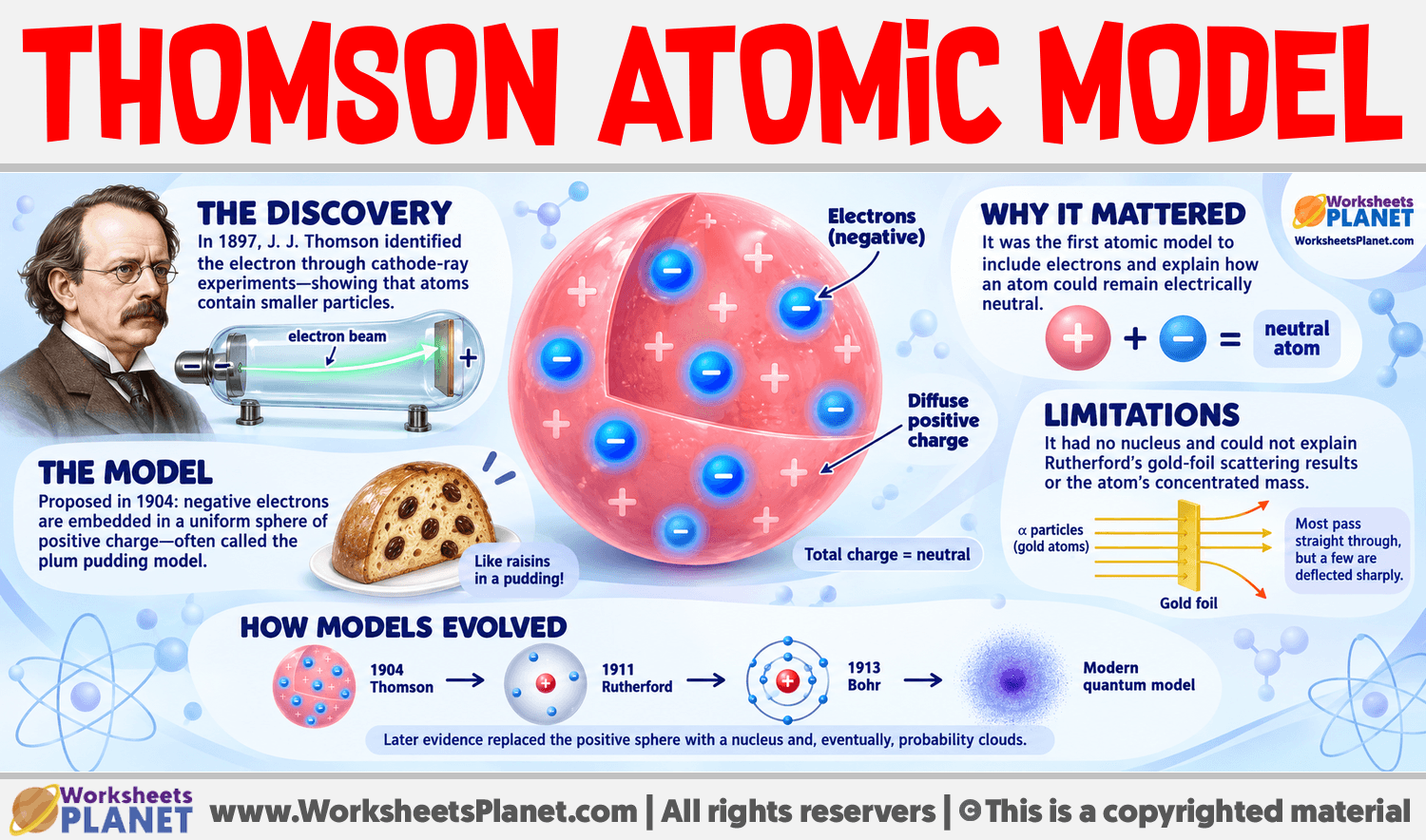
J. J. Thomson discovered the electron in 1897 while studying cathode rays. Cathode rays are streams of particles that move through a vacuum tube when electricity passes through it. Thomson found that these rays were attracted to a positive charge and pushed away by a negative charge. This showed that the particles in the rays had a negative electric charge.
This discovery was surprising because atoms were thought to be the smallest units of matter. If electrons existed inside atoms, then atoms could not be solid and indivisible. They had to contain smaller parts. Thomson’s experiment helped scientists understand that the atom had an internal structure, even though that structure was not yet fully understood.
- The electron was much smaller than the atom.
- Electrons carried a negative charge.
- Atoms were no longer considered indivisible.
- A new atomic model was needed to explain where electrons were located.
How does the Thomson Atomic Model describe an atom?
The Thomson Atomic Model describes the atom as a sphere of positive charge with negatively charged electrons embedded throughout it. Thomson imagined that the positive charge was spread evenly across the atom, while the electrons were placed inside it, rather like raisins in a cake or plums in a pudding.
This is why the model became known as the plum pudding model. In this comparison, the pudding represents the positively charged part of the atom, and the plums represent the electrons. The atom as a whole was considered neutral because the positive charge balanced the negative charge of the electrons.
Thomson’s model did not include a nucleus. At the time, scientists had not yet discovered that most of the atom’s mass and positive charge were concentrated in a tiny center. Instead, Thomson believed the positive charge filled the entire atom.
- The atom was imagined as a round, positively charged sphere.
- Electrons were scattered inside the positive sphere.
- The total positive and negative charges balanced each other.
- The model did not include protons, neutrons, or a nucleus.
Why was the Thomson Atomic Model important?
Even though the model was not completely correct, it was a major step forward in science. It was the first atomic model to include subatomic particles, which are particles smaller than the atom. This made scientists rethink the idea that atoms were simple, solid balls.
The Thomson Atomic Model also encouraged more experiments. Once scientists accepted that electrons existed, they wanted to know how these particles were arranged inside the atom. This led to new investigations and eventually to better models, including Rutherford’s nuclear model and Bohr’s model of the atom.
For students, Thomson’s model is important because it shows how science develops over time. Scientific ideas are often improved when new evidence appears. Thomson did not have all the information we have today, but his model helped open the door to modern atomic physics.
- It introduced the idea that atoms have internal parts.
- It helped explain the presence of electrons in matter.
- It challenged older ideas about atoms being indivisible.
- It provided a foundation for later atomic models.
What were the limitations of the Thomson Atomic Model?
The main weakness of the Thomson Atomic Model was that it could not explain the results of later experiments. In 1909, Ernest Rutherford and his team carried out the famous gold foil experiment. They fired tiny positively charged particles, called alpha particles, at a thin sheet of gold foil. If Thomson’s model had been correct, most particles should have passed through with only small changes in direction.
Most particles did pass through, but a few were deflected at large angles, and some even bounced back. This showed that the positive charge of the atom was not spread evenly throughout the atom. Instead, it was concentrated in a very small, dense region called the nucleus.
Because Thomson’s model had no nucleus, it could not explain these observations. It also did not describe the arrangement of electrons accurately. Later discoveries showed that electrons exist outside the nucleus in regions related to energy levels, not simply embedded in a positive sphere.
- It did not include a nucleus.
- It could not explain Rutherford’s gold foil experiment.
- It did not show how electrons move or are arranged.
- It did not explain the concentrated mass of the atom.
How does Thomson’s model compare with later atomic models?
Thomson’s model was an improvement over Dalton’s atomic model, which described atoms as solid, indivisible spheres. Dalton’s model was useful for explaining chemical reactions, but it did not include electrons or any internal structure. Thomson added an important new idea: atoms contain negative particles.
Rutherford’s model replaced Thomson’s idea of a spread-out positive charge with the concept of a small, dense, positively charged nucleus. Later, Niels Bohr suggested that electrons move in specific energy levels around the nucleus. Modern atomic theory goes even further, describing electrons as existing in probability regions called orbitals.
A simple way to remember the progression is that each model answered questions left by the previous one. Thomson explained the electron, Rutherford explained the nucleus, and Bohr helped explain electron energy levels. The Thomson Atomic Model may no longer be accepted as accurate, but it remains a key chapter in the history of science.
- Dalton: atoms are solid indivisible spheres.
- Thomson: atoms contain electrons in a positive sphere.
- Rutherford: atoms have a small central nucleus.
- Bohr: electrons occupy specific energy levels.
- Modern model: electrons are found in orbitals around the nucleus.

Leave A Comment