
Subtraction facts are the basic subtraction equations students learn so they can subtract quickly and accurately without counting every time. Examples include 9 − 4 = 5, 12 − 7 = 5, and 6 − 0 = 6. These facts are an important part of early math because they help children solve word problems, understand number relationships, and prepare for multi-digit subtraction. When students know their subtraction facts well, they can focus on the meaning of a problem instead of using all their energy to count backward.
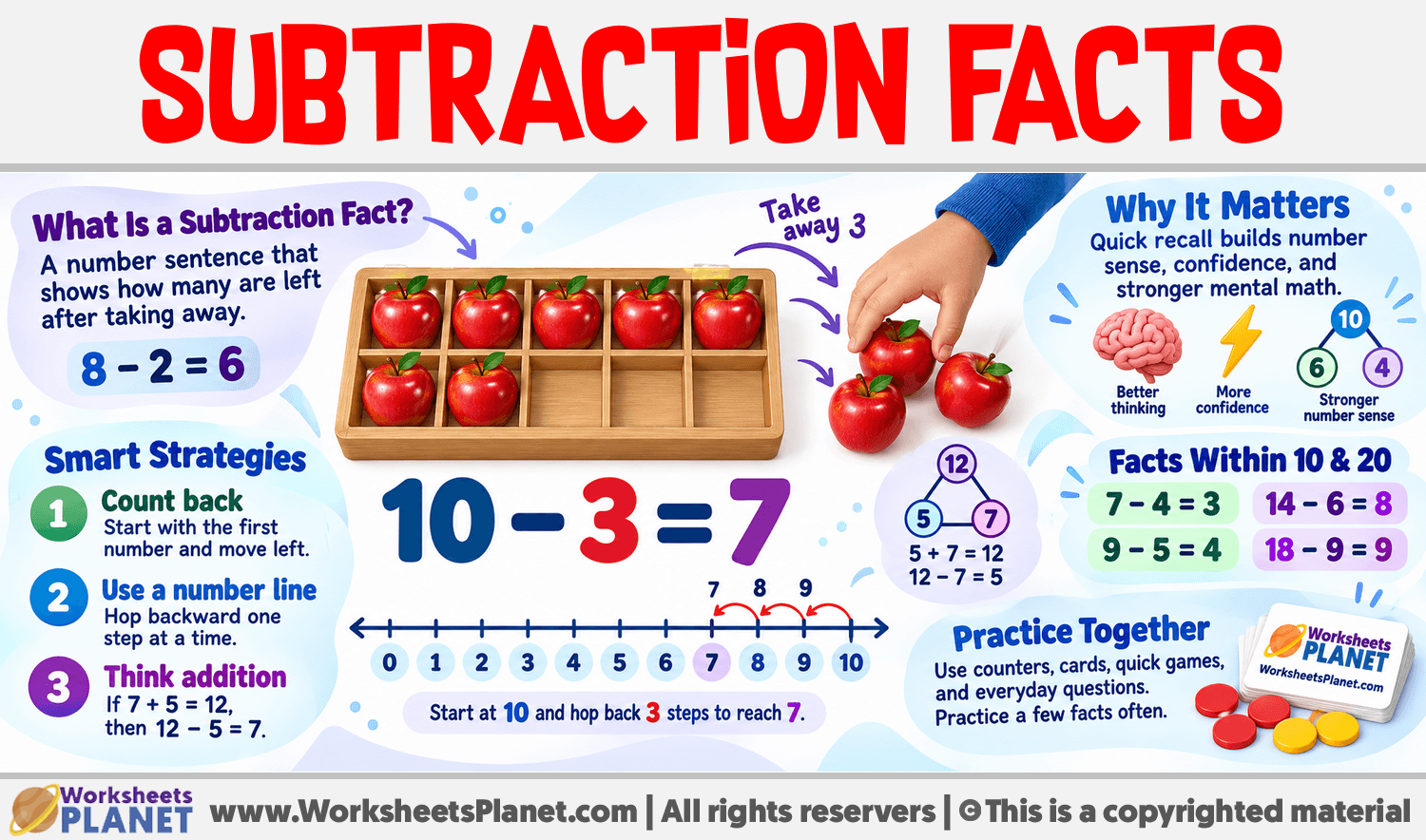
What are subtraction facts?
Subtraction facts are simple number sentences that show how one number is taken away from another. In elementary math, the term usually refers to facts within 20, such as 15 − 8 = 7 or 10 − 3 = 7. These facts are often practiced until students can answer them from memory or with very quick mental strategies.
A subtraction fact has three important parts. The minuend is the number you start with, the subtrahend is the number being taken away, and the difference is the answer. In 14 − 6 = 8, 14 is the minuend, 6 is the subtrahend, and 8 is the difference.
- 8 − 5 = 3: 8 is the starting number, 5 is taken away, and 3 is left.
- 11 − 2 = 9: subtracting a small number can often be done by counting back.
- 13 − 7 = 6: this fact is often easier when connected to the addition fact 6 + 7 = 13.
Why are subtraction facts important for young learners?
Subtraction facts help students build number sense, which means understanding how numbers work together. A child who knows that 10 − 6 = 4 also begins to understand that 6 and 4 make 10. This relationship supports both subtraction and addition, making math feel more connected and less like a set of separate rules.
Fluency with subtraction facts also makes larger problems easier. For example, when solving 63 − 28, a student must subtract ones and tens. If basic facts such as 13 − 8 = 5 are automatic, the student can pay attention to regrouping and place value. Without fact fluency, multi-step problems can become frustrating.
- They support mental math in daily situations, such as finding how many items are left.
- They help children understand the connection between addition and subtraction.
- They reduce mistakes in multi-digit subtraction, money problems, measurement, and word problems.
- They build confidence because students can answer common facts quickly.
Common strategies for learning subtraction facts
Memorization alone is not the best starting point for subtraction facts. Students usually learn more deeply when they practice strategies that show why the answer makes sense. Over time, these strategies become faster and may turn into automatic recall.
One helpful strategy is counting back. For 9 − 2, a child can say 8, 7 and know the answer is 7. This works well when subtracting 1, 2, or 3. For larger subtrahends, students often need more efficient methods.
Another powerful strategy is using related addition facts. If a student sees 12 − 5, they can think, “What number plus 5 makes 12?” Since 7 + 5 = 12, the answer is 7. This helps students understand subtraction as the opposite of addition.
- Subtracting zero: any number minus 0 stays the same, such as 14 − 0 = 14.
- Subtracting one: the answer is the number just before, such as 10 − 1 = 9.
- Doubles facts: if students know 6 + 6 = 12, they can solve 12 − 6 = 6.
- Make ten: for 15 − 8, think 15 − 5 = 10, then subtract 3 more to get 7.
- Fact families: 4, 9, and 13 make 13 − 9 = 4, 13 − 4 = 9, 9 + 4 = 13, and 4 + 9 = 13.
Examples of subtraction facts within 10 and 20
Subtraction facts within 10 are usually the first set children practice. These facts include equations like 7 − 3 = 4, 9 − 6 = 3, and 5 − 5 = 0. Students may use fingers, counters, ten-frames, number lines, or pictures at first. The goal is not to rush, but to help them see what subtraction means.
Subtraction facts within 20 are more challenging because they often require crossing ten. Facts such as 14 − 8, 16 − 9, and 13 − 6 can be difficult if students only count backward. This is where make-ten strategies and addition connections become especially useful.
For example, to solve 16 − 9, a child might think: 16 − 6 = 10, and 3 more must be subtracted, so 10 − 3 = 7. Another child may think: 9 + 7 = 16, so 16 − 9 = 7. Both methods are correct and show flexible thinking.
- Facts within 10: 6 − 4 = 2, 10 − 7 = 3, 8 − 8 = 0.
- Facts within 20: 12 − 5 = 7, 18 − 9 = 9, 15 − 6 = 9.
- Teen subtraction facts often become easier when students break numbers apart around 10.
How teachers and parents can practice subtraction facts
The best practice is short, frequent, and meaningful. A few minutes each day is often more effective than a long worksheet once a week. Children benefit from seeing subtraction in different ways: with objects, drawings, number lines, equations, games, and real-life questions.
It is also important to watch for understanding, not just speed. A student who answers quickly but guesses may need more visual practice. A student who understands the idea but works slowly may need repeated exposure and confidence-building activities. Accuracy should come before speed.
Real-life subtraction gives facts a purpose. Questions like “You had 10 grapes and ate 4. How many are left?” or “There are 12 pencils, and 5 are in the box. How many are on the table?” help students connect subtraction facts to everyday thinking.
- Use counters, blocks, buttons, or drawings to show taking away.
- Practice fact families so students see how addition and subtraction are connected.
- Play quick games with cards or dice, such as subtracting the smaller number from the larger number.
- Ask students to explain their thinking instead of only giving an answer.
- Review a small group of facts at a time, especially the facts that are hardest for the child.

Leave A Comment