
The Schrödinger Atomic Model is one of the most important ideas in modern science because it changed the way people understand atoms. Earlier models imagined electrons moving around the nucleus in fixed paths, almost like planets orbiting the Sun. Schrödinger’s model showed that electrons do not travel in neat circular tracks. Instead, they are found in regions of probability called orbitals. This model helps students understand why atoms behave the way they do, how elements form bonds, and why chemistry follows patterns that can be studied and predicted.
What is the Schrödinger Atomic Model?
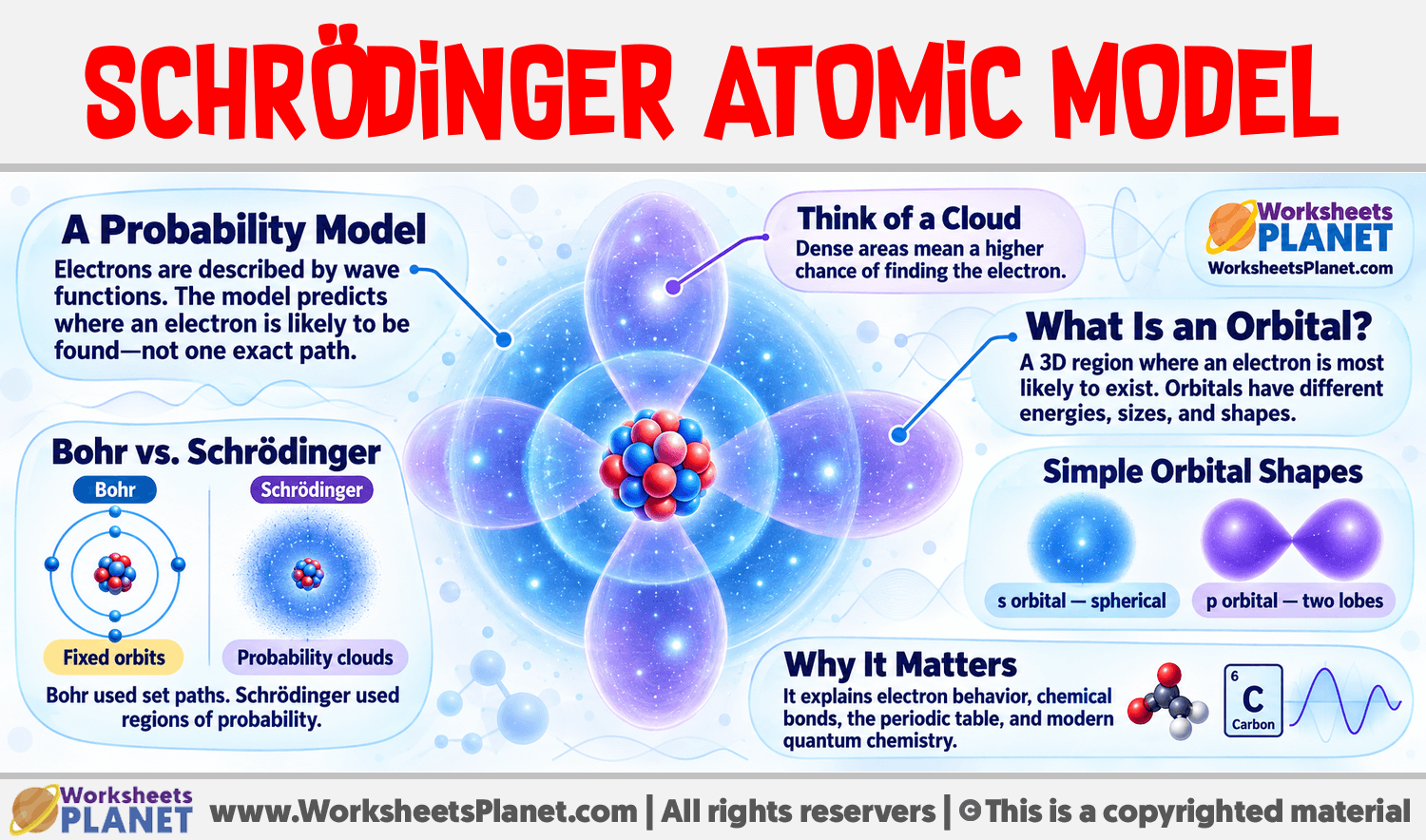
The Schrödinger Atomic Model, also called the quantum mechanical model of the atom, was developed by the Austrian physicist Erwin Schrödinger in 1926. It describes electrons as particles with wave-like behavior. Instead of saying exactly where an electron is at every moment, the model uses mathematics to calculate where an electron is most likely to be found.
This idea may sound unusual, but it solved problems that older atomic models could not explain. In this model, the atom still has a small, dense nucleus made of protons and neutrons. Electrons are arranged around the nucleus, but not in simple rings. They occupy three-dimensional spaces called atomic orbitals. Each orbital represents a possible area where an electron may appear.
- It is based on quantum mechanics, the science of very small particles.
- It describes electrons using wave functions, which help predict electron location.
- It replaces fixed electron paths with probability clouds.
- It explains atomic behavior more accurately than earlier models.
How is it different from Bohr’s model?
Before Schrödinger, Niels Bohr proposed a model in which electrons moved in fixed energy levels around the nucleus. Bohr’s model was useful, especially for explaining the hydrogen atom, but it was too simple for atoms with many electrons. It pictured electrons like tiny balls moving along set paths.
Schrödinger’s model kept the idea that electrons have specific energy levels, but it changed the meaning of those levels. Electrons are not placed on exact circular orbits. Instead, they exist in orbitals that have different shapes and energies. This makes the model much better for explaining the periodic table, chemical bonding, and the behavior of complex atoms.
A helpful comparison is to imagine trying to find a fast-moving bee in a garden. Bohr’s model would draw a single path for the bee. Schrödinger’s model would show the areas where the bee is most likely to be found. For electrons, this second idea is much closer to reality.
- Bohr’s model: electrons move in fixed circular orbits.
- Schrödinger’s model: electrons are found in orbitals, or probability regions.
- Bohr’s model works best for simple atoms; Schrödinger’s model works for many-electron atoms.
- Schrödinger’s model explains more details about chemical properties and bonding.
What are orbitals in the Schrödinger Atomic Model?
An orbital is not a track or a shell that an electron follows. It is a region around the nucleus where there is a high chance of finding an electron. In diagrams, orbitals are often drawn as clouds or shapes, but these pictures are only models. They help us visualize something that cannot be seen directly.
Orbitals have different shapes. The simplest type is the s orbital, which is spherical. The p orbital has a dumbbell-like shape. More complex orbitals, such as d and f orbitals, have more complicated shapes and are important for understanding transition metals and heavier elements.
Electrons also fill orbitals according to rules. They usually enter the lowest available energy level first. Each orbital can hold a limited number of electrons, and the arrangement of these electrons is called the electron configuration of an atom. Electron configuration is a key idea in chemistry because it helps explain why elements react in certain ways.
- s orbitals are round and can hold up to 2 electrons.
- p orbitals appear in sets of three and can hold up to 6 electrons in total.
- d orbitals can hold up to 10 electrons and are important in many metals.
- f orbitals can hold up to 14 electrons and appear in heavier elements.
Why did Schrödinger’s model become so important?
The Schrödinger Atomic Model became important because it matched experimental evidence better than earlier models. Scientists had discovered that electrons behave in ways that cannot be explained by everyday motion. They can act like particles, but they also show wave-like properties. Schrödinger created an equation that treated electrons as waves and helped predict their possible locations and energies.
This model is especially useful in chemistry lessons. It explains why elements in the same group of the periodic table often have similar properties. For example, elements such as lithium, sodium, and potassium are reactive metals because each has one electron in its outer energy level. Schrödinger’s model helps describe where that outer electron is likely to be and why it is involved in chemical reactions.
The model also helps explain how atoms form bonds. When atoms react, their outer electrons interact. Understanding orbitals helps students see why some atoms share electrons, why others transfer electrons, and why molecules have particular shapes.
- It explains the structure of the periodic table.
- It helps predict how atoms will bond with other atoms.
- It supports modern ideas about molecular shape and chemical reactions.
- It connects physics and chemistry through quantum theory.
Simple examples for students to understand the model
A useful example is the hydrogen atom, which has one proton and one electron. In Bohr’s model, the electron circles the nucleus in a fixed orbit. In the Schrödinger Atomic Model, the electron is most likely to be found in a spherical region around the nucleus. This region is the hydrogen atom’s lowest-energy orbital.
Another example is oxygen. Oxygen has eight electrons, and these electrons are arranged in different orbitals. The way oxygen’s outer electrons are arranged helps explain why oxygen often forms two bonds, such as in a water molecule. This shows how the model is not just an abstract idea; it helps explain real substances students know, like water, carbon dioxide, and oxygen gas.
For classroom learning, it is important to remember that atomic models are not photographs of atoms. They are scientific tools. The Schrödinger model is valuable because it gives a more accurate and useful way to describe electrons, even though it is based on probability rather than certainty. In science, a model is strong when it explains evidence and helps make reliable predictions.
- Electrons are not in fixed paths; they are in probability regions.
- Orbitals show where electrons are most likely to be found.
- Electron arrangements help explain chemical behavior.
- The model is central to modern atomic theory and school chemistry.

Leave A Comment