
Rattlesnakes are some of the most recognizable snakes in the Americas because of the warning sound made by their tails. These reptiles are often feared, but they are also important animals that help keep ecosystems balanced. Learning rattlesnake facts can help students understand how these snakes live, how they protect themselves, and why people should treat them with caution and respect rather than panic.
What Is a Rattlesnake?
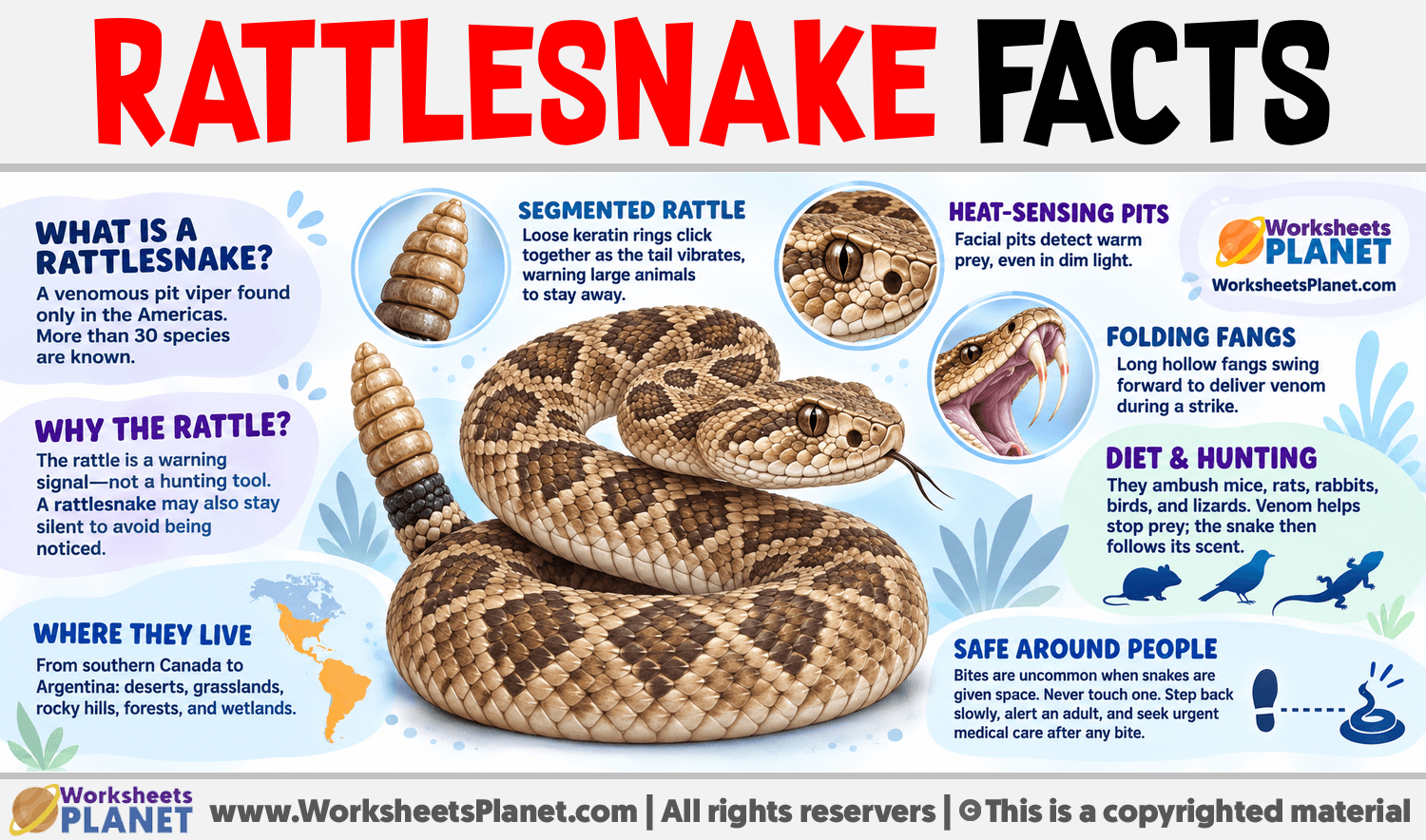
A rattlesnake is a type of venomous pit viper. Pit vipers have special heat-sensing pits on their heads, located between the eyes and nostrils. These pits help them detect warm-blooded animals, such as mice, rats, rabbits, and birds, even in darkness.
Rattlesnakes belong to a group of snakes found mainly in North, Central, and South America. They are known for the rattle at the end of the tail, which they shake to warn other animals to stay away. This warning is not an invitation to attack. In most cases, a rattlesnake would rather avoid danger than fight.
Like all snakes, rattlesnakes are reptiles. They are cold-blooded, which means their body temperature depends on the environment around them. They often warm themselves in the sun and hide in shade, burrows, or under rocks when it is too hot.
Why Do Rattlesnakes Have Rattles?
The rattle is one of the most interesting rattlesnake facts because it is a special body part used for defense. A rattlesnake’s rattle is made of hard, dry pieces of keratin, the same material found in human fingernails. These pieces fit loosely together, so when the snake vibrates its tail quickly, they knock against each other and make a buzzing sound.
A baby rattlesnake is born with a small button at the end of its tail, but it cannot make a full rattling sound yet. Each time the snake sheds its skin, a new rattle segment is added. However, you cannot accurately tell a rattlesnake’s age by counting the segments because rattles can break off, and snakes may shed more than once a year.
The rattle helps the snake avoid being stepped on or attacked by larger animals. It is a clear message: “I am here. Do not come closer.” This warning system is useful for both the rattlesnake and the animal or person nearby.
- The rattle is used mainly as a warning signal.
- It is made from keratin, not bone.
- New segments are added when the snake sheds its skin.
- A quiet rattlesnake can still be dangerous, so people should never rely only on hearing a rattle.
Where Do Rattlesnakes Live?
Rattlesnakes live in many different habitats. Some species prefer deserts, while others live in grasslands, forests, rocky hillsides, wetlands, or mountain areas. They are especially common in parts of the United States and Mexico, but different species can be found throughout much of the Americas.
The habitat a rattlesnake chooses depends on the species and the availability of food, shelter, and suitable temperatures. In hot deserts, rattlesnakes may be more active at night to avoid extreme heat. In cooler areas, they may be active during the day when the sun is warm.
During cold months, many rattlesnakes spend time in dens, sometimes with other snakes. This resting period is similar to hibernation and helps them survive when temperatures drop and food is harder to find.
- Desert rattlesnakes may hide under rocks, shrubs, or in animal burrows.
- Forest species may live near logs, leaf litter, or rocky slopes.
- Grassland rattlesnakes often use holes made by other animals for shelter.
- Some rattlesnakes return to the same den year after year.
What Do Rattlesnakes Eat and How Do They Hunt?
Rattlesnakes are carnivores, meaning they eat other animals. Their diet usually includes rodents, small rabbits, lizards, birds, and sometimes frogs or insects when they are young. By eating rodents, rattlesnakes help control animal populations that can damage crops or spread disease.
Most rattlesnakes are ambush hunters. Instead of chasing prey for a long distance, they stay still and wait for an animal to come close. Their heat-sensing pits help them locate prey, and their forked tongue collects scent particles from the air. The snake then uses a special organ in its mouth, called the Jacobson’s organ, to “read” those smells.
When a rattlesnake strikes, it uses hollow fangs to inject venom. The venom helps stop the prey and begins breaking down its tissues. After the prey dies, the rattlesnake swallows it whole. Snakes do not chew their food; their jaws can stretch widely to take in animals larger than their heads.
Are Rattlesnakes Dangerous to People?
Rattlesnakes can be dangerous because they are venomous, but they are not aggressive animals that hunt people. Most bites happen when someone accidentally steps near a snake, tries to touch it, or attempts to move or kill it. The safest choice is to give a rattlesnake plenty of space and let it leave on its own.
A rattlesnake bite is a medical emergency. People should seek help immediately and avoid old “treatments” such as cutting the bite, sucking out venom, or applying ice. These methods can make the injury worse. Staying calm and getting professional medical care quickly is the best response.
Students should remember that wild animals should be observed from a safe distance. A rattlesnake may look still, but it can strike quickly if it feels threatened. Respecting wildlife is an important part of outdoor safety.
- If you see a rattlesnake, stop and slowly move away.
- Do not touch, tease, or try to pick up any snake.
- Wear sturdy shoes when walking in rocky, grassy, or desert areas.
- Look carefully before placing hands near rocks, logs, or brush.
- If someone is bitten, call emergency services or go to a hospital right away.
Interesting Rattlesnake Facts for Students
Rattlesnakes have many adaptations that help them survive. Their colors and patterns often provide camouflage, allowing them to blend into sand, leaves, rocks, or dry grass. This makes it easier to hide from predators and surprise prey.
Unlike many reptiles that lay eggs, most rattlesnakes give birth to live young. Baby rattlesnakes are independent from birth and must find food and shelter on their own. Although they are small, they are venomous and should never be handled.
Rattlesnakes also play an important role in food webs. They are predators, but they can also become prey for animals such as hawks, eagles, roadrunners, coyotes, and kingsnakes. Their presence shows how living things are connected in an ecosystem. Understanding these rattlesnake facts helps students see that even animals that seem scary can have a valuable place in nature.
- Some rattlesnakes can sense heat from nearby animals.
- They shed their skin as they grow.
- Their pupils are usually vertical, like a cat’s.
- They help reduce rodent populations in many habitats.
- They use venom for hunting and defense, not for attacking without reason.

Leave A Comment