
The Quantum Atomic Model is the modern scientific explanation of how electrons behave inside atoms. Earlier atomic models imagined electrons moving around the nucleus in simple paths, almost like planets orbiting the Sun. The quantum model changed that idea. It shows that electrons do not travel in fixed circles. Instead, they exist in regions of space where they are most likely to be found. This model is important because it helps explain the structure of atoms, the organization of the periodic table, chemical bonding, and even the colors of light given off by different elements.
What is the Quantum Atomic Model?
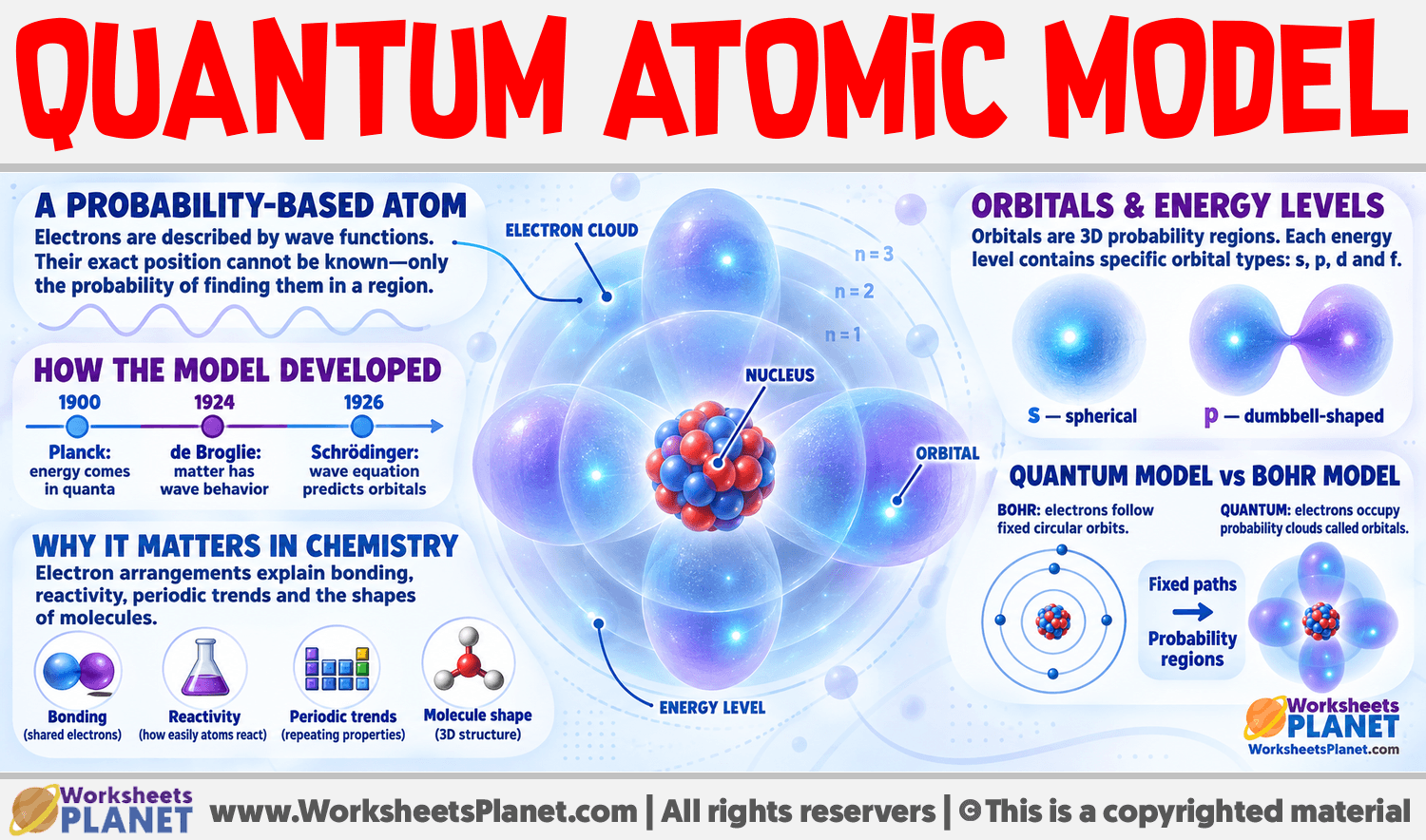
The Quantum Atomic Model is a way of describing atoms using the ideas of quantum mechanics, a branch of physics that studies matter and energy at very small scales. In this model, the atom has a dense central nucleus made of protons and neutrons, while electrons occupy areas around the nucleus called orbitals.
An orbital is not a path or a track. It is a three-dimensional region where there is a high probability of finding an electron. This is one of the biggest differences between the quantum model and older atomic models. Instead of saying exactly where an electron is at every moment, scientists use probability to describe where it is likely to be.
This model also explains that electrons can have only certain amounts of energy. These allowed energy amounts are called energy levels. An electron cannot simply have any energy it wants; it must exist in one of the permitted levels. This idea helps explain why atoms absorb and release light in specific colors.
How did scientists develop the Quantum Atomic Model?
The Quantum Atomic Model did not appear all at once. It developed as scientists discovered that older models could not explain all atomic behavior. John Dalton described atoms as tiny solid particles. J. J. Thomson discovered the electron. Ernest Rutherford showed that atoms have a small, positive nucleus. Niels Bohr then suggested that electrons move in fixed energy levels around the nucleus.
Bohr’s model was useful, especially for explaining hydrogen, but it was still too simple. It treated electrons as if they followed neat circular paths. Later scientists, including Louis de Broglie, Erwin Schrödinger, and Werner Heisenberg, helped create a more accurate model. They showed that electrons have both particle-like and wave-like behavior.
Schrödinger developed mathematical equations that describe the wave behavior of electrons. Heisenberg introduced the uncertainty principle, which states that it is impossible to know both the exact position and exact momentum of an electron at the same time. Together, these ideas shaped the modern quantum view of the atom.
- Dalton: described atoms as basic particles of matter.
- Thomson: discovered electrons and showed atoms have smaller parts.
- Rutherford: discovered the nucleus through the gold foil experiment.
- Bohr: proposed fixed electron energy levels.
- Schrödinger and Heisenberg: helped explain electrons using waves, probability, and uncertainty.
What are orbitals and energy levels?
In the Quantum Atomic Model, electrons are arranged in energy levels around the nucleus. These levels can be thought of as general zones of energy, but they are not physical shells like layers of an onion. Within these energy levels are sublevels and orbitals, which describe more specific regions where electrons may be found.
Different orbitals have different shapes. For example, an s orbital is roughly spherical, while a p orbital has a dumbbell-like shape. More complex orbitals, such as d and f orbitals, appear in atoms with more electrons. These orbital shapes help explain why atoms bond in certain ways and form specific molecular shapes.
Each orbital can hold a limited number of electrons. Usually, an orbital can hold two electrons, and those electrons must have opposite spins. This rule helps scientists predict how electrons fill atoms and why elements in the same group of the periodic table often have similar chemical properties.
- Energy levels describe the general energy of electrons.
- Sublevels organize electrons more specifically within energy levels.
- Orbitals show where electrons are most likely to be found.
- Electron spin helps explain how electrons share space in an orbital.
Why is the Quantum Atomic Model important in chemistry?
The Quantum Atomic Model is important because it explains patterns that students see throughout chemistry. The periodic table, for example, is arranged partly according to electron structure. Elements in the same column often react similarly because they have the same number of valence electrons, or electrons in the outermost energy level.
The model also helps explain chemical bonding. Atoms form bonds when their electrons interact. In an ionic bond, electrons are transferred from one atom to another. In a covalent bond, atoms share electrons. The position and energy of electrons determine how easily atoms gain, lose, or share them.
Another important use of the model is explaining atomic spectra. When electrons absorb energy, they can move to higher energy levels. When they fall back to lower levels, they release energy as light. Because each element has a unique electron arrangement, each element produces a unique pattern of light. This is why scientists can identify elements in stars by studying the light they emit.
How is it different from the Bohr model?
The Bohr model is often taught before the Quantum Atomic Model because it is easier to picture. In the Bohr model, electrons move in fixed circular orbits around the nucleus. This model works fairly well for hydrogen, the simplest atom, but it does not accurately describe larger atoms.
The Quantum Atomic Model gives a more realistic explanation. It does not show electrons as tiny balls following exact paths. Instead, it uses probability clouds to show where electrons are likely to be found. These clouds can have different shapes depending on the orbital.
A simple comparison is helpful: the Bohr model is like drawing a map with exact roads for electrons, while the quantum model is like showing the areas where electrons are most likely to appear. The quantum model may be harder to visualize, but it is much more accurate and useful for explaining real atomic behavior.
- Bohr model: electrons travel in fixed circular orbits.
- Quantum model: electrons exist in orbitals, not set paths.
- Bohr model: best for simple atoms like hydrogen.
- Quantum model: works for complex atoms and chemical bonding.
- Bohr model: easier to draw; quantum model: more scientifically accurate.
Key classroom facts about the Quantum Atomic Model
Students do not need advanced mathematics to understand the main idea of the Quantum Atomic Model. The most important point is that atoms are not tiny solar systems. Electrons are better described by energy, probability, and orbitals than by exact paths.
This model connects many science topics that may seem separate at first. It helps explain why neon signs glow, why metals react differently from nonmetals, why the periodic table has its shape, and why atoms join to form molecules. Understanding the quantum model gives students a stronger foundation for chemistry, physics, and modern technology.
Many modern inventions depend on quantum ideas, including lasers, LED lights, computer chips, and medical imaging tools. Although the inside of an atom cannot be seen directly in a simple classroom experiment, the effects of electron behavior are all around us.
- Electrons do not orbit the nucleus like planets.
- Orbitals are regions of probability, not solid rings.
- Electrons can only occupy certain energy levels.
- The arrangement of electrons affects an element’s chemical behavior.
- The Quantum Atomic Model is the most accepted model of the atom today.

Leave A Comment