
The Pueblo Peoples are Indigenous peoples of the American Southwest whose communities have lived for centuries in what is now New Mexico, Arizona, Texas, and nearby areas. The word “Pueblo” comes from Spanish and means “village,” but it is important to remember that Pueblo Peoples are not one single tribe. They include many distinct nations and communities, each with its own history, language, traditions, and government. Pueblo cultures are known for their strong connection to land, farming, architecture, art, ceremony, and community life. Learning about the Pueblo Peoples helps students understand the deep history of North America and the continuing presence of Native nations today.
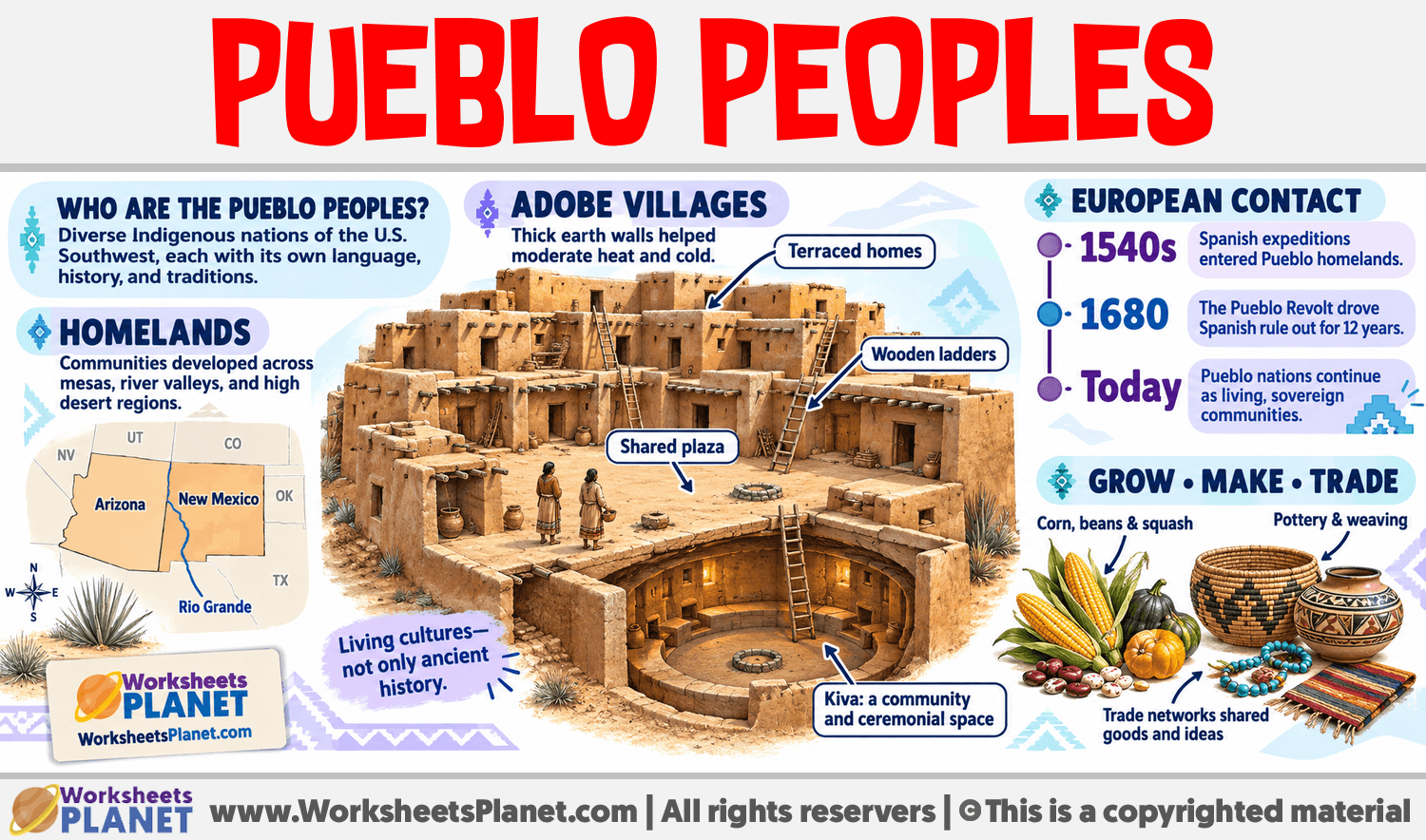
Who are the Pueblo Peoples?
The Pueblo Peoples include several Indigenous nations, such as the Hopi, Zuni, Acoma, Taos, Laguna, Santa Clara, San Ildefonso, Isleta, and many others. Today, there are 19 Pueblos in New Mexico, along with Pueblo communities in Arizona and Texas. Each Pueblo has its own identity, leaders, and cultural practices.
Although outsiders often group them together, Pueblo Peoples speak different languages. These include Keres, Tewa, Tiwa, Towa, Zuni, and Hopi. Some of these languages are not closely related to one another, which shows how diverse Pueblo communities are. Many Pueblo people today work hard to keep their languages alive through family teaching, schools, and community programs.
- Pueblo Peoples are Indigenous peoples of the Southwest, not a single tribe.
- Their communities include both ancient villages and modern towns.
- Many Pueblo nations have lived in the same regions for hundreds or even thousands of years.
- Each Pueblo has its own government, traditions, and community responsibilities.
Where did Pueblo communities develop?
Pueblo communities developed in the dry lands of the Southwest, especially along rivers, mesas, valleys, and high desert areas. This environment can be challenging because rainfall is limited and temperatures can change greatly between day and night. Pueblo Peoples developed clever ways to live in this landscape, using local materials and careful knowledge of the seasons.
One of the most famous ancient Pueblo regions is the area connected with Ancestral Puebloans, sometimes called Anasazi in older sources, though many people avoid that term because it comes from outside the culture. Important sites such as Chaco Canyon, Mesa Verde, and Bandelier show that ancient Pueblo communities built complex settlements, roads, ceremonial spaces, and storage areas. These places remind us that Pueblo history did not begin with European contact; it reaches far back into the ancient past.
- Pueblo settlements were often built near water sources, farming land, or defensible mesa tops.
- Local stone, clay, wood, and adobe were used for construction.
- Communities adapted to desert conditions through farming skill, storage, and cooperation.
How did Pueblo architecture and villages work?
Pueblo architecture is one of the most recognizable features of Pueblo culture. Traditional Pueblo buildings were often made from adobe, a mixture of earth, water, and straw, or from stone covered with plaster. These materials kept homes cooler in summer and warmer in winter, which was useful in the desert climate.
Many Pueblo villages were built as connected apartment-like structures, sometimes several stories high. Families lived in rooms grouped around plazas, where people gathered for work, trade, and ceremonies. Some entrances were reached by ladders, especially in earlier periods, which helped with safety and defense.
A very important part of Pueblo villages is the kiva, a ceremonial room often built partly underground. Kivas have been used for religious, social, and teaching purposes. While visitors may learn basic facts about kivas, many details of Pueblo spiritual life are private and should be treated with respect.
- Adobe walls helped control temperature inside homes.
- Plazas served as important open spaces for community life.
- Kivas were connected with ceremony, teaching, and community identity.
- Village design reflected both practical needs and cultural values.
What did Pueblo Peoples grow, make, and trade?
Farming has long been central to Pueblo life. Pueblo farmers grew crops that could survive in dry conditions, especially corn, beans, and squash. These three crops are sometimes called the “Three Sisters” because they support one another when planted together. Corn has special importance in many Pueblo cultures, both as food and as part of cultural and spiritual traditions.
Because water was limited, Pueblo farmers used techniques such as planting near floodplains, building small check dams, and carefully observing seasonal rains. They also stored food for times when harvests were poor. This planning helped communities survive in an environment where drought could be a serious problem.
Pueblo Peoples are also known for beautiful and useful arts. Pottery, weaving, jewelry, baskets, and carved items were made for daily life, ceremony, and trade. Pueblo pottery, in particular, is famous for its shapes, painted designs, and careful hand-building methods.
- Common crops included corn, beans, squash, cotton, and later peaches and wheat after Spanish contact.
- Pottery was used for cooking, storage, carrying water, and ceremony.
- Trade connected Pueblo communities with other Native peoples across the Southwest and beyond.
- Artistic designs often carried meaning connected to family, place, and tradition.
How did European contact affect the Pueblo Peoples?
Spanish explorers, soldiers, and missionaries entered Pueblo homelands in the 1500s and 1600s. Their arrival brought major changes, including new animals, crops, religion, forced labor, and attempts to control Pueblo communities. Many Pueblo people resisted these pressures while also adapting in different ways.
One of the most important events in Pueblo history was the Pueblo Revolt of 1680. Pueblo communities, led by figures including Popé from Ohkay Owingeh, united against Spanish rule and drove the Spanish out of the region for more than a decade. This revolt is one of the most successful Indigenous uprisings in North American history. It showed the strength of Pueblo cooperation and the determination to protect land, religion, and self-government.
Later, Pueblo communities faced rule by Spain, Mexico, and the United States. These changes affected land ownership, religious freedom, education, and political rights. Despite these challenges, Pueblo nations continued to maintain their identities and defend their communities.
Why are the Pueblo Peoples important today?
The Pueblo Peoples are not only part of the past. Pueblo nations are living communities with governments, schools, farms, artists, businesses, and cultural programs. Many Pueblo people balance modern life with responsibilities to family, language, land, and ceremony.
Today, Pueblo communities work to protect sacred places, water rights, cultural knowledge, and traditional arts. Pueblo artists continue to create pottery, jewelry, paintings, textiles, and other works that are admired around the world. At the same time, many communities decide carefully what should be shared with outsiders and what should remain private.
For students, studying the Pueblo Peoples is a chance to understand that Native history is not just one story. It includes many nations, many languages, and many ways of living. The Pueblo Peoples show how communities can adapt to difficult environments, preserve knowledge across generations, and continue as strong nations in the present.
- Respect Pueblo Peoples as contemporary nations, not only historical groups.
- Use specific Pueblo names when possible, such as Hopi, Zuni, Acoma, or Taos.
- Remember that some cultural and ceremonial knowledge is private.
- Recognize Pueblo contributions to architecture, farming, art, history, and Indigenous sovereignty.

Leave A Comment