
Multiplication strategies are practical ways to solve multiplication problems without relying only on memorization. They help students understand what multiplication means, choose efficient methods, and explain their thinking clearly. Instead of seeing 7 × 8 as a fact to remember or forget, students learn to connect it to arrays, repeated addition, doubling, place value, and known facts. This makes multiplication less intimidating and more meaningful for learners in elementary and middle grades.
What Are Multiplication Strategies?
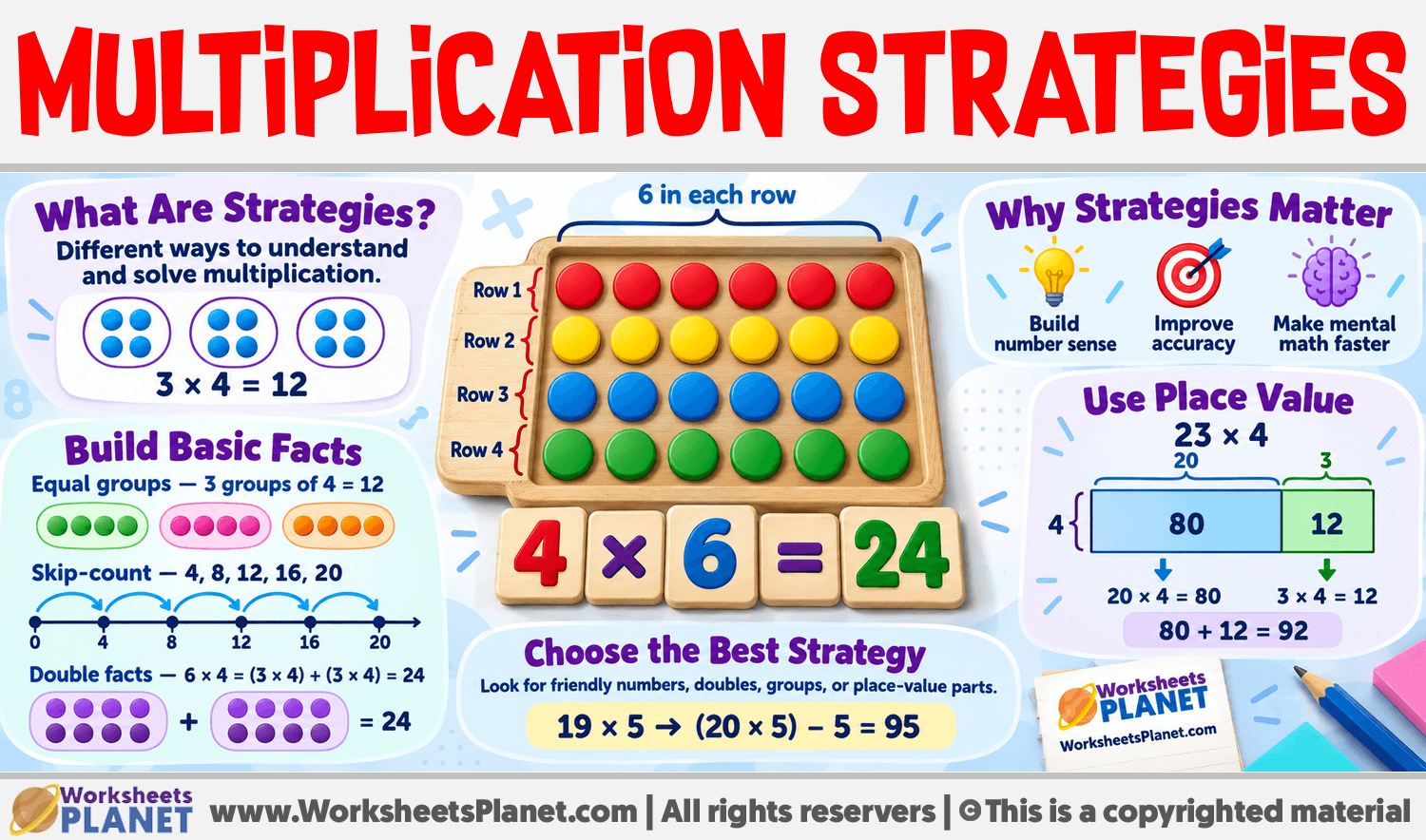
A multiplication strategy is a planned method for finding a product. Some strategies are visual, such as drawing equal groups or arrays. Others are mental, such as breaking numbers apart or using a fact that is already known. The goal is not to make every problem longer, but to help students build number sense and choose a method that fits the numbers.
For example, a student solving 6 × 9 might think, “I know 6 × 10 is 60, so 6 × 9 is 6 less, or 54.” This student is using a near fact strategy. Another student might draw 6 rows of 9 dots and count the total. Both methods can be useful, depending on the student’s understanding and the difficulty of the problem.
- Equal groups: seeing multiplication as groups with the same number in each group, such as 4 groups of 3.
- Arrays: arranging objects in rows and columns to show factors and products.
- Skip counting: counting by a number repeatedly, such as 5, 10, 15, 20.
- Decomposing numbers: breaking factors apart, such as changing 8 × 6 into 8 × 5 + 8 × 1.
- Using known facts: building from facts students already remember, such as doubles or tens.
Why Multiplication Strategies Matter for Learning
Multiplication strategies matter because they connect procedures to understanding. When students only memorize facts, they may answer quickly when they remember, but they can feel stuck when they do not. Strategies give them tools to reason through a problem instead of guessing or giving up.
These strategies also prepare students for larger math ideas. The distributive property, area models, multi-digit multiplication, fractions, ratios, and algebra all depend on understanding how multiplication works. A child who knows that 14 × 6 can be split into 10 × 6 and 4 × 6 is already using a foundation for more advanced computation.
For teachers and parents, multiplication strategies reveal how a student thinks. A wrong answer may come from counting errors, confusion about place value, or a weak understanding of equal groups. Listening to a student explain a strategy often gives more information than simply checking whether the answer is correct.
Helpful Strategies for Basic Multiplication Facts
Basic multiplication facts usually include products from 0 × 0 through 12 × 12. Students do need fluency with these facts, but fluency means more than speed. It includes accuracy, flexibility, and confidence. Strategies help students move from slow counting to efficient recall.
Some facts are easier to learn first. Multiplying by 0, 1, 2, 5, and 10 often gives students early success. From there, they can use these facts to learn more challenging ones. For instance, 7 × 6 can be solved by knowing 7 × 5 = 35 and adding one more group of 7 to get 42.
The commutative property is another powerful idea. It tells students that 3 × 8 has the same product as 8 × 3. This cuts down the number of facts they need to practice because each fact has a related partner.
- Twos facts: use doubling, such as 2 × 7 = double 7 = 14.
- Fives facts: count by 5s or use a clock pattern, such as 5, 10, 15, 20.
- Nines facts: use 10s minus one group, such as 9 × 6 = 10 × 6 − 6 = 54.
- Doubles: learn facts like 4 × 4, 6 × 6, and 8 × 8 as anchor facts.
- Near doubles: use a double fact nearby, such as 6 × 7 = 6 × 6 + 6.
How to Use Place Value in Multi-Digit Multiplication
Place value strategies help students multiply larger numbers by breaking them into tens, hundreds, and ones. This is often easier to understand than jumping directly into the standard algorithm. For example, 23 × 4 can be thought of as 20 × 4 plus 3 × 4. That gives 80 + 12 = 92.
This approach shows why the answer makes sense. It also reduces common mistakes, such as forgetting the value of a digit in the tens place. Students learn that the 2 in 23 means 20, not 2. That understanding is essential when they later learn written algorithms.
Area models and partial products are especially useful here. In an area model for 23 × 14, students can split 23 into 20 and 3, and 14 into 10 and 4. Then they multiply each part: 20 × 10, 20 × 4, 3 × 10, and 3 × 4. Adding the partial products gives the final answer.
- Example: 36 × 5 = 30 × 5 + 6 × 5 = 150 + 30 = 180.
- Example: 42 × 12 = 42 × 10 + 42 × 2 = 420 + 84 = 504.
- Example: 18 × 15 = 18 × 10 + 18 × 5 = 180 + 90 = 270.
Choosing the Best Strategy for a Problem
There is not one perfect multiplication strategy for every situation. The best choice depends on the numbers, the student’s comfort level, and the purpose of the task. A quick mental strategy may be best for 9 × 8, while an area model may be better for 27 × 16. Students should be encouraged to ask, “What do I know about these numbers?” before solving.
Teachers can support this by inviting students to share more than one method. For example, 25 × 8 can be solved as 100 × 2, because four groups of 25 make 100 and eight groups make two hundreds. It can also be solved as 20 × 8 + 5 × 8. Comparing methods helps students see multiplication as flexible and connected.
Practice should include both word problems and number problems. Word problems help students understand when multiplication is useful, such as finding the total number of chairs in rows, the cost of several identical items, or the number of tiles in a rectangular floor. These contexts make multiplication strategies feel practical rather than abstract.
- Use arrays when students need a visual model of rows and columns.
- Use skip counting for early practice with equal groups.
- Use known facts when a problem is close to an easy fact.
- Use place value for two-digit and larger numbers.
- Use area models when students need to see how partial products fit together.

Leave A Comment