
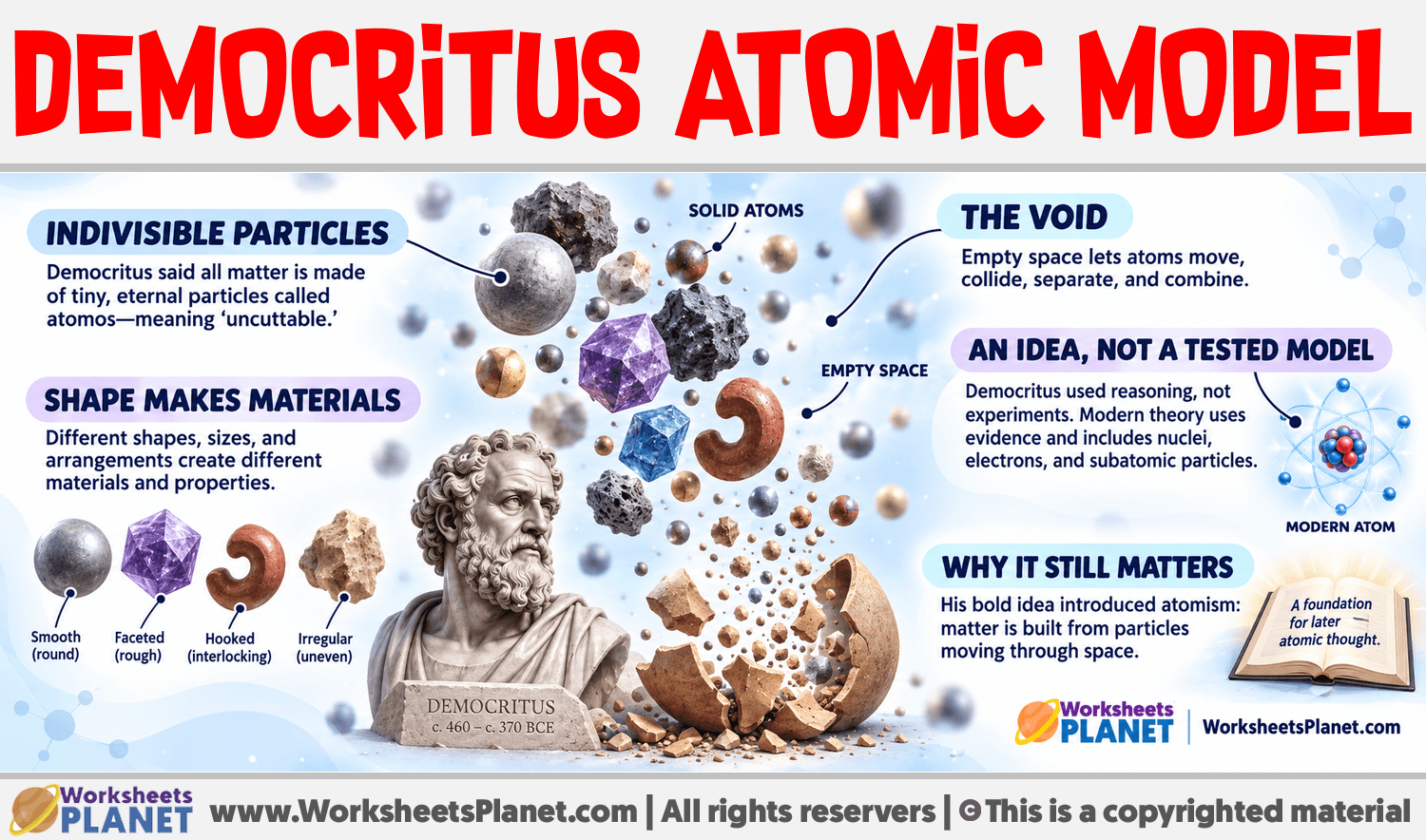
The Democritus Atomic Model is one of the earliest ideas about what matter is made of. Long before microscopes, laboratories, or modern chemistry, the Greek philosopher Democritus proposed that everything in the universe was made of tiny, indivisible particles. He called these particles atomos, a Greek word meaning “uncuttable” or “indivisible.” Although his model was not based on experiments in the modern scientific sense, it was an important step in the history of science because it introduced the idea that matter has a hidden structure too small to see.
What did Democritus believe about atoms?
Democritus lived around 460–370 BCE in ancient Greece. At that time, many philosophers believed that matter was made from basic elements such as earth, water, air, and fire. Democritus disagreed with the idea that matter could be divided forever. He reasoned that if you kept cutting a piece of matter into smaller and smaller pieces, you would eventually reach a particle that could not be cut any further. This smallest piece was the atom.
In the Democritus Atomic Model, atoms were solid, tiny, eternal particles. They could not be destroyed, created, or split apart. Democritus thought that atoms moved through empty space, which he called the void. Different materials existed because their atoms had different shapes, sizes, and arrangements.
- Atoms are the smallest pieces of matter and cannot be divided.
- Atoms are always moving in empty space, or the void.
- Different substances are made from different kinds of atoms.
- Changes in matter happen when atoms rearrange, separate, or combine.
- Atoms themselves do not change, even when materials appear to change.
How did Democritus explain different materials?
Democritus believed that the properties of a substance depended on the shape and arrangement of its atoms. For example, he imagined that smooth atoms might create slippery substances, while rough or hooked atoms might form materials that stick together. This was not scientifically accurate in detail, but it showed an early attempt to explain the physical world using particles instead of myths or magic.
He also suggested that atoms of different sizes and shapes could combine in different ways. This idea is similar to how modern science explains that different substances are made from different atoms and molecules. However, Democritus did not know about protons, neutrons, electrons, chemical bonds, or the periodic table. His atomic model was a philosophical explanation rather than an experimental theory.
- Salt might taste sharp because its atoms were imagined as pointed or jagged.
- Water might flow easily because its atoms were imagined as smooth and round.
- Solid objects might hold their shape because their atoms were packed closely together.
- Soft materials might be made from atoms that could slide past one another more easily.
Why was the void important in the Democritus Atomic Model?
One of the most important parts of the Democritus Atomic Model was the idea of empty space. Democritus argued that atoms needed room to move. If there were no empty space, then motion and change would be impossible. This empty space was known as the void.
This was a bold idea because many ancient thinkers believed that empty space could not exist. Democritus used the void to explain why objects can move, why substances can mix, and why matter can change form. For example, when water spreads out or air fills a room, Democritus would explain this as atoms moving through empty space.
Modern science does not describe the void in exactly the same way Democritus did, but the idea that matter is not completely solid is still important. Atoms contain mostly empty space between the nucleus and electrons. In that sense, Democritus was surprisingly close to a key feature of the atomic view of matter.
How is Democritus’ model different from modern atomic theory?
The Democritus Atomic Model was an impressive idea for its time, but it was very different from the atomic theory used in science classrooms today. Democritus did not perform controlled experiments, collect measurements, or use mathematical evidence. His explanation came mainly from reasoning and observation.
Modern atomic theory is based on centuries of experimental work by scientists such as John Dalton, J.J. Thomson, Ernest Rutherford, Niels Bohr, and many others. Today, scientists know that atoms are not indivisible. Atoms are made of smaller subatomic particles: protons, neutrons, and electrons. Scientists also know that atoms of the same element have the same number of protons, while atoms of different elements have different atomic numbers.
Even so, Democritus deserves credit for proposing a major idea: matter is made of tiny particles. His model helped prepare the way for later scientific thinking, even though many of his details were incorrect.
- Democritus thought atoms were indivisible; modern science shows atoms contain smaller particles.
- Democritus did not use experiments; modern atomic theory depends on experimental evidence.
- Democritus imagined atoms with different shapes; modern science identifies atoms by their number of protons.
- Democritus believed atoms moved in the void; modern science also recognizes that atoms and particles are in constant motion.
Why is the Democritus Atomic Model still taught today?
Students still learn about the Democritus Atomic Model because it is an important starting point in the history of atomic theory. It shows how scientific ideas often begin as questions about the natural world. Even when an early model is incomplete, it can guide later thinkers toward better explanations.
The model is also useful because it helps students compare philosophical reasoning with experimental science. Democritus had a creative and logical idea, but he did not have the tools to prove it. Later scientists tested, corrected, and expanded atomic ideas using evidence. This reminds students that science changes over time as new discoveries are made.
For teachers and parents, Democritus offers a simple way to introduce atoms before moving into more complex models. Students can first understand the basic idea that matter is made of tiny particles, then explore how later models added new details such as electrons, nuclei, energy levels, and chemical behavior.
- It introduces the basic particle view of matter.
- It connects ancient philosophy with modern science.
- It helps students see how scientific models improve over time.
- It encourages curiosity about things too small to see.
- It provides a foundation for learning later atomic models.

Leave A Comment