
The Bohr Atomic Model is one of the most important early models used to explain how atoms are organized. Proposed by Danish physicist Niels Bohr in 1913, it helped scientists understand why atoms give off or absorb only certain colors of light. Although modern science now uses a more advanced quantum model, Bohr’s idea is still very useful in classrooms because it gives students a clear picture of electrons moving in energy levels around the nucleus. It is especially helpful when learning about atomic structure, the periodic table, and the behavior of light.
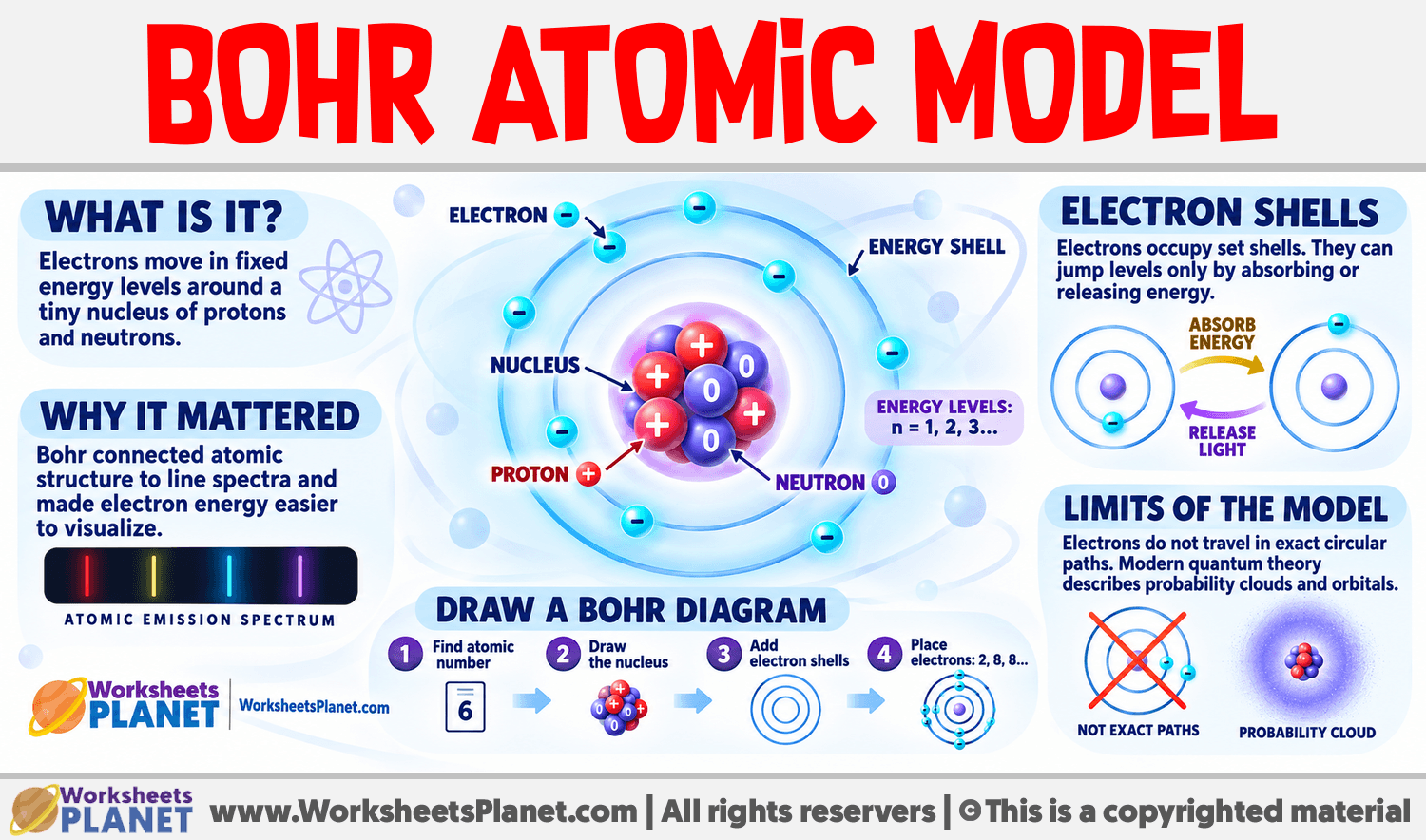
What is the Bohr Atomic Model?
The Bohr Atomic Model describes the atom as a small, positively charged nucleus surrounded by electrons that move in specific paths or shells. These paths are often drawn as circles around the nucleus, a little like planets orbiting the Sun. However, Bohr did not mean that electrons are exactly like planets. His key idea was that electrons can only exist in certain allowed energy levels.
In this model, the nucleus contains protons and, as later discoveries showed, neutrons. The electrons are found outside the nucleus. Each electron shell represents a different amount of energy. Electrons closer to the nucleus have lower energy, while electrons farther away have higher energy.
Bohr’s model was a major improvement over earlier atomic models because it explained something that other models could not: why atoms produce specific patterns of light, called line spectra. This made the model an important step toward modern atomic theory.
- The atom has a central nucleus.
- Electrons move in fixed energy levels or shells.
- Electrons do not normally exist between these levels.
- Atoms can absorb or release energy when electrons change levels.
How does the Bohr model explain electron shells?
In the Bohr Atomic Model, electrons are arranged in shells around the nucleus. Each shell can hold only a certain number of electrons. The first shell is closest to the nucleus and has the lowest energy. The second shell is farther away and has more energy, and so on.
For basic school-level chemistry, students often use a simple rule: the first shell can hold up to 2 electrons, the second shell up to 8 electrons, and the third shell is often shown holding up to 8 electrons in introductory diagrams. This simplified pattern is useful for drawing Bohr diagrams of common elements, especially the first 20 elements of the periodic table.
For example, a hydrogen atom has 1 proton and 1 electron, so its Bohr diagram shows one electron in the first shell. Carbon has 6 electrons: 2 go in the first shell and 4 go in the second shell. Oxygen has 8 electrons: 2 in the first shell and 6 in the second shell.
- Hydrogen: 1 electron in the first shell.
- Helium: 2 electrons in the first shell.
- Carbon: 2 electrons in the first shell and 4 in the second.
- Oxygen: 2 electrons in the first shell and 6 in the second.
- Sodium: 2 electrons in the first shell, 8 in the second, and 1 in the third.
Why was Bohr’s model important?
Bohr’s model was important because it connected atomic structure with the behavior of light and energy. Scientists had already observed that heated gases give off light in very specific colors. For example, hydrogen produces a pattern of bright lines instead of a full rainbow. Earlier models of the atom could not explain this clearly.
Bohr suggested that electrons can jump from one energy level to another. When an electron absorbs energy, it can move to a higher energy level. When it falls back to a lower level, it releases energy in the form of light. The color of that light depends on the amount of energy released.
This idea helped explain the hydrogen emission spectrum, one of the most famous examples in atomic science. The model showed that atoms are not just tiny solid particles; they have internal structure and follow rules related to energy. This was a big step toward the development of quantum physics.
The Bohr model also gave teachers and students a simple way to visualize atoms. Even today, Bohr diagrams are often used to introduce how electrons are arranged and why elements behave differently.
How to draw a Bohr diagram step by step
A Bohr diagram is a simple drawing that shows the nucleus and electron shells of an atom. It is commonly used in science worksheets because it helps students connect the atomic number of an element with its electron arrangement.
To draw one, students need to know the element’s atomic number, which tells the number of protons. In a neutral atom, the number of electrons is the same as the number of protons. Then the electrons are placed into shells, starting with the shell closest to the nucleus.
For example, nitrogen has atomic number 7. That means a neutral nitrogen atom has 7 protons and 7 electrons. In a Bohr diagram, 2 electrons go in the first shell and the remaining 5 go in the second shell. The nucleus is usually labeled with the number of protons and neutrons, if the neutron number is known.
- Find the element on the periodic table.
- Use the atomic number to identify the number of protons and electrons.
- Draw the nucleus in the center of the atom.
- Add electron shells as circles around the nucleus.
- Place electrons in the shells, filling the inner shell first.
- Check that the total number of electrons matches the atomic number for a neutral atom.
What are the limits of the Bohr Atomic Model?
The Bohr Atomic Model is useful, but it is not a complete description of the atom. It works best for hydrogen, which has only one electron. When scientists tried to use the model for larger atoms with many electrons, it did not explain all observations accurately.
Modern atomic theory shows that electrons do not travel in neat circular paths. Instead, they are found in regions called orbitals, where there is a high probability of finding an electron. This means the modern model is more like a probability map than a set of fixed orbits.
Even with these limits, Bohr’s model remains valuable in education. It gives beginners a clear starting point before they learn more complex ideas such as orbitals, electron clouds, and quantum numbers. In the history of science, it also shows how models can be helpful even when they are later improved.
A good way to think about the Bohr Atomic Model is as a learning bridge. It is not the final answer, but it helps students understand the relationship between the nucleus, electrons, energy levels, and light. That makes it an essential topic in early chemistry and physical science.
- It does not fully explain atoms with many electrons.
- It shows electrons in fixed paths, which is not how modern science describes them.
- It cannot explain all details of chemical bonding or atomic spectra.
- It remains useful for learning basic atomic structure and electron arrangement.

Leave A Comment