
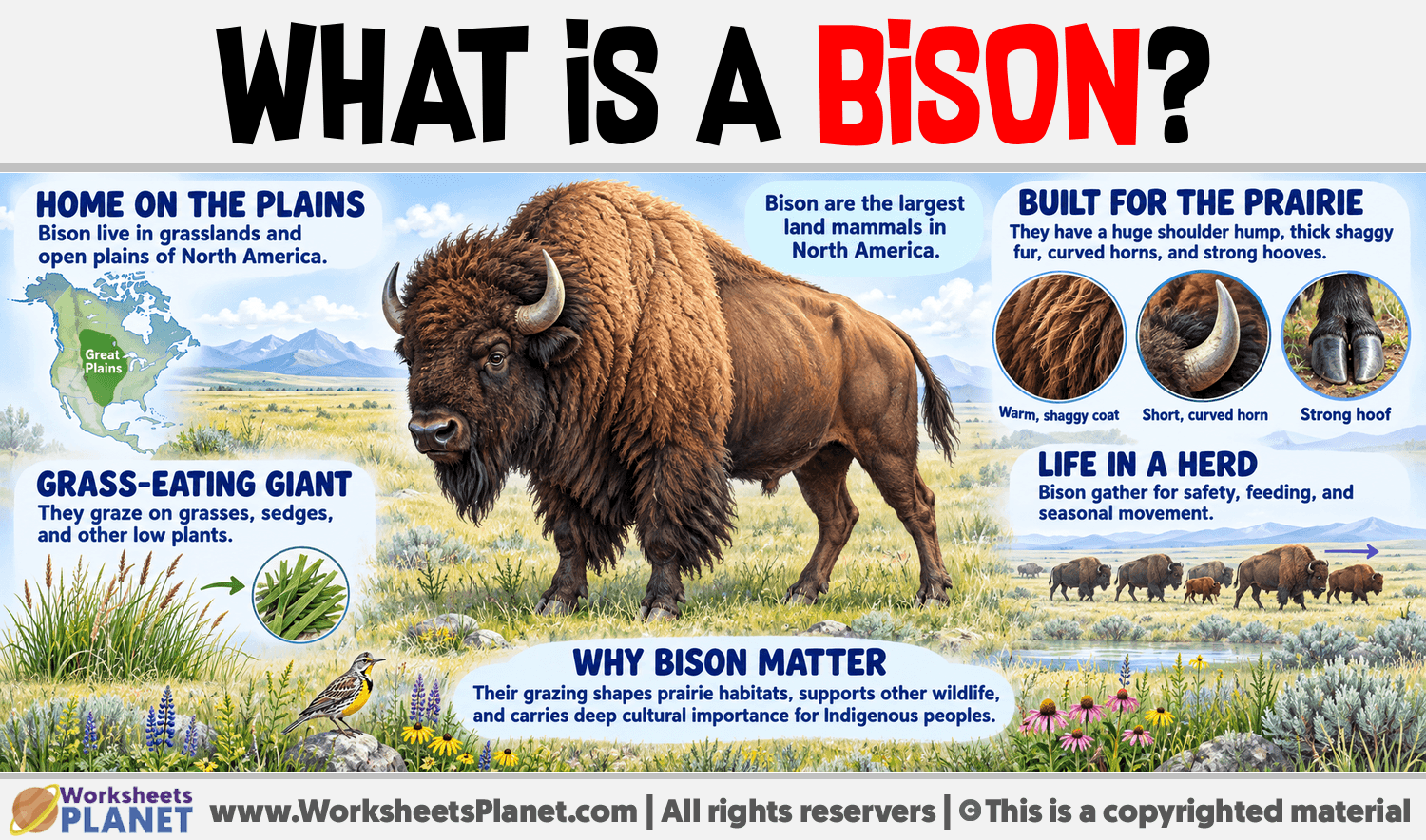
A bison is a large, strong hoofed mammal best known for its huge head, shaggy fur, shoulder hump, and curved horns. Many people picture bison roaming wide grasslands in North America, but there is also a European species that lives in forests and open woodland areas. Bison are important animals to study because they help us understand grassland ecosystems, animal adaptations, conservation, and the relationship between humans and wildlife. Although people sometimes call them buffalo, bison and true buffalo are not the same animal.
What is a bison and where does it live?
A bison is a member of the cattle family, which also includes domestic cows, yaks, and true buffalo. Bison are mammals, meaning they are warm-blooded, have hair or fur, give birth to live young, and feed their babies with milk. They are also herbivores, so they eat plants rather than meat.
There are two living species of bison. The American bison is found mainly in North America, especially in protected parks, reserves, and ranches. The European bison, also called the wisent, lives in parts of Europe where conservation programs have helped it return after nearly disappearing from the wild.
- American bison often live in grasslands, prairies, and open plains.
- European bison are more likely to live in forests, meadows, and woodland edges.
- Both species need enough space to graze, move, and find water.
- Bison are social animals and often live in groups called herds.
What does a bison look like?
Bison are easy to recognize because of their powerful front bodies. Their shoulders are much higher than their hips, creating a noticeable hump. This hump is made of strong muscles supported by long bones, and it helps bison move their heavy heads through snow or thick grass while feeding.
An adult bison has a broad head, short curved horns, a beard under the chin, and thick fur around the head and shoulders. The fur is especially useful in cold weather. In winter, bison grow a dense coat that protects them from freezing temperatures, strong winds, and snow.
- Large head and neck for pushing through snow and vegetation.
- Curved horns used for defense and competition.
- Shaggy brown coat that becomes thicker in winter.
- Hooved feet that help them walk across grasslands and rough ground.
- Strong sense of smell and hearing, useful for detecting danger.
What do bison eat?
Bison mainly eat grasses, but their diet can also include herbs, shrubs, leaves, and other low-growing plants. They spend much of the day grazing, which means they move slowly while feeding on vegetation. Like cows, bison are ruminants. This means they have a special digestive system that helps them break down tough plant material.
A bison first swallows grass quickly and stores it in part of its stomach. Later, it brings some of the food back up, chews it again, and swallows it once more. This process is called chewing cud. It may sound unusual, but it is an important adaptation that allows bison to get nutrients from plants that many other animals cannot digest well.
Bison also need water, but they can survive in harsh environments by moving to find food and water sources. In snowy areas, they may use their heavy heads to push snow aside and reach the grass underneath.
How do bison behave in a herd?
Bison are herd animals, which means they usually live and travel in groups. Herd life helps protect them from predators because many eyes, ears, and noses are better at noticing danger than one. Calves, or baby bison, are especially safer when surrounded by adult animals.
Bison herds can change size depending on the season. Females and young bison often stay together in groups, while adult males may live alone or in smaller groups for part of the year. During the breeding season, called the rut, males compete for the attention of females. They may bellow, paw the ground, wallow in dust, or push against each other with great force.
Even though bison may look slow because of their size, they can run surprisingly fast. An American bison can reach speeds of about 35 miles per hour for short distances. This is one reason people should never approach bison in parks or wild areas.
- A group of bison is called a herd.
- Baby bison are called calves.
- Male bison are called bulls, and female bison are called cows.
- Bison communicate with sounds, body movements, and scent.
- They may roll in dust or mud, a behavior called wallowing, to help remove insects and shed fur.
Why are bison important to nature and people?
Bison play a major role in the health of grasslands. As they graze, they trim plants and help create a mix of short and tall grasses. Their hooves disturb the soil, which can help seeds settle and grow. Their droppings return nutrients to the ground and support insects, fungi, and plants. Because of these effects, bison are sometimes called a keystone species in prairie ecosystems.
Bison have also been deeply important to many Indigenous peoples of North America. For thousands of years, Native nations used bison for food, clothing, tools, shelter materials, and cultural traditions. The animal was not only a resource but also part of spiritual and community life.
In the 1800s, millions of American bison were killed, and their population dropped dangerously low. European bison also nearly disappeared. Thanks to conservation efforts, both species have made important recoveries, although they still need protection, healthy habitats, and careful management.
Is a bison the same as a buffalo?
Many people use the word buffalo when talking about American bison, but scientifically, bison are different from true buffalo. True buffalo include animals such as the African buffalo and the water buffalo of Asia. These animals belong to the same broad cattle family, but they are not the same species as bison.
One clear difference is body shape. Bison have a large shoulder hump and thick shaggy fur, especially around the head and front legs. True buffalo usually have smoother coats and no large hump like a bison. Their horns can also be shaped differently, depending on the species.
So, what is a bison? It is a powerful grazing mammal with special adaptations for life in open grasslands and cold climates. Bison are impressive not just because of their size, but because they show how one animal can shape an ecosystem, support biodiversity, and connect deeply with human history.
- Bison have a high shoulder hump; true buffalo generally do not.
- Bison often have thick shaggy fur; many true buffalo have shorter coats.
- American bison live in North America; water buffalo are native to Asia, and African buffalo live in Africa.
- The common name buffalo is often used casually, but bison is the more accurate scientific term.

Leave A Comment