
Bats are fascinating mammals that can fly, hunt at night, and live in many different habitats around the world. Learning the parts of a bat helps students understand how these animals move, find food, stay safe, and care for their young. Although bats may look a little like birds when they are flying, their bodies are very different. A bat has fur, gives birth to live babies, feeds its young with milk, and has wings made from skin stretched over long finger bones. Each body part has an important job that helps the bat survive.
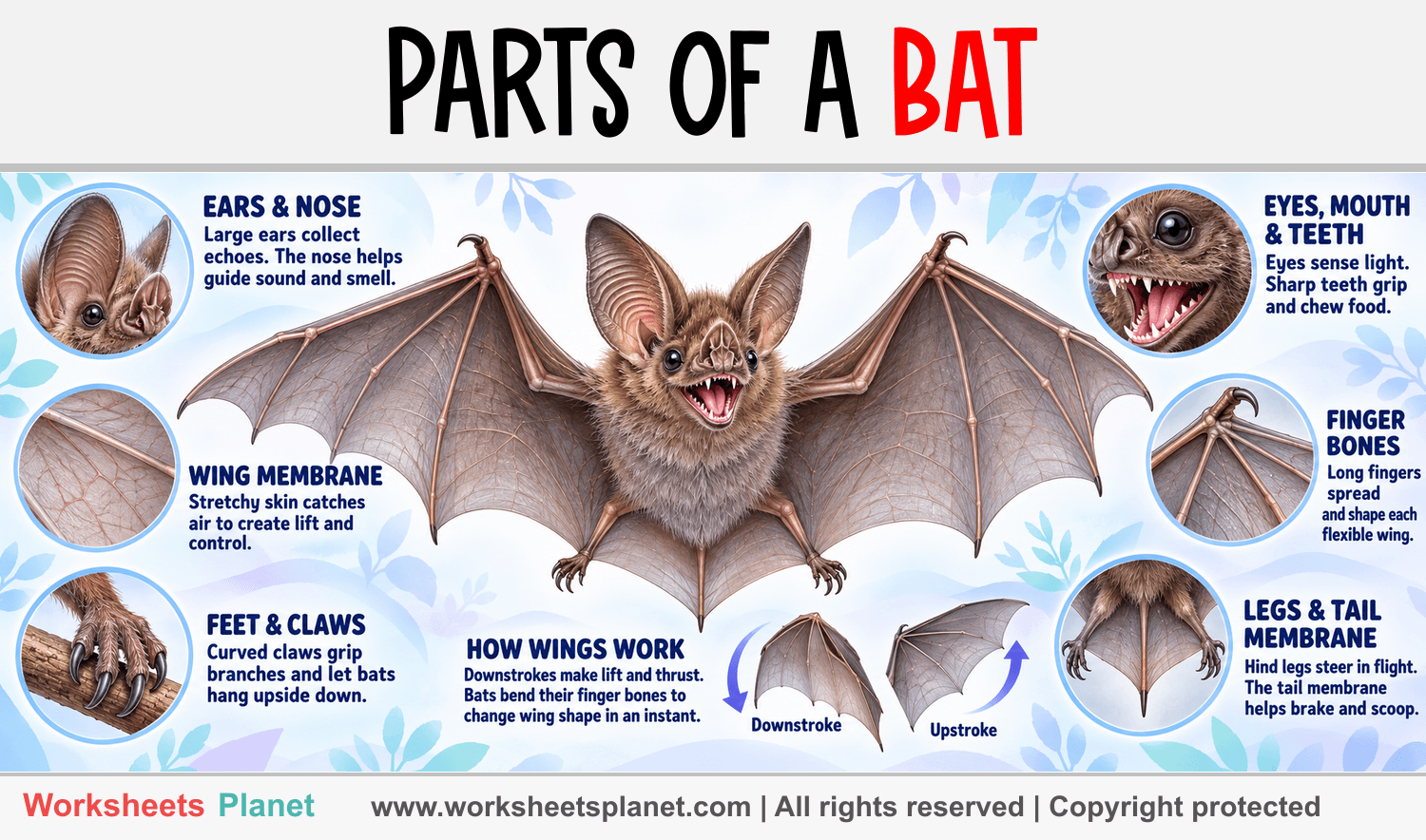
What are the main parts of a bat?
The main parts of a bat include the head, ears, eyes, nose, mouth, body, wings, legs, feet, and tail. These parts work together so the bat can fly, climb, rest upside down, and find food in the dark.
A bat’s body is usually small and lightweight. This helps it fly more easily. Many bats have soft fur on their bodies, which helps keep them warm. Their wings are attached to the sides of the body and stretch all the way to the fingers, legs, and sometimes the tail. This special wing shape gives bats excellent control while flying.
- Head: holds the eyes, ears, nose, mouth, and brain.
- Body: contains the heart, lungs, stomach, and other organs.
- Wings: help the bat fly, turn, glide, and catch insects.
- Feet and claws: help the bat hang upside down and grip surfaces.
- Tail: helps some bats balance and steer during flight.
How do bat wings work?
One of the most important parts of a bat is its wings. A bat’s wing is not covered with feathers like a bird’s wing. Instead, it is made of a thin, flexible layer of skin called a wing membrane. This membrane stretches between the bat’s long fingers, arms, body, legs, and sometimes its tail.
Bat fingers are much longer than human fingers compared with body size. These long finger bones support the wing membrane like the ribs of an umbrella. Because the wing is flexible, a bat can change its shape while flying. This allows bats to make quick turns, slow down, speed up, or hover near flowers and fruit.
The wing membrane is delicate, but it can heal if it gets a small tear. Bats also take care of their wings by grooming them. A healthy wing is very important because bats depend on flight to find food, escape danger, and travel between roosting places.
- The thumb is small and has a claw for climbing.
- The long fingers support the wing membrane.
- The membrane helps create lift for flying.
- The wings can fold close to the body when the bat is resting.
Why are bat ears and noses so important?
Many bats are active at night, when there is little light. To find their way, many species use echolocation. Echolocation means the bat makes high-pitched sounds and listens for the echoes that bounce back from objects. This helps the bat know where insects, trees, walls, and other bats are located.
The ears of a bat are often large compared with its head. Large ears help the bat hear tiny echoes very clearly. Some bats also have special folds and shapes in their ears that help them tell where a sound is coming from. This is especially useful when hunting small flying insects.
The nose can also be important. Some bats send echolocation sounds through their nose instead of their mouth. These bats may have unusual-looking nose shapes called nose leaves. A nose leaf can help direct sound, almost like a tiny megaphone. Not all bats have this feature, but it is very useful in some species.
What jobs do the mouth, teeth, and eyes have?
A bat’s mouth and teeth are shaped for the type of food it eats. Many bats eat insects, so they have sharp teeth that can crunch beetles, moths, mosquitoes, and other small animals. Fruit bats have teeth that help them bite into soft fruit. Nectar-feeding bats may have long tongues for reaching deep into flowers.
Bats are not blind, even though people sometimes say they are. Most bats can see, and some can see quite well. Their eyes help them notice light, shapes, movement, and places to land. However, in dark places, echolocation may be more useful than eyesight for many species.
Different bats have different diets, and their body parts match their way of life. For example, a bat that drinks nectar may have a long snout and tongue, while an insect-eating bat may have a wider mouth for catching prey in the air. These differences show how animal body parts are connected to survival.
- Insect-eating bats often have sharp teeth for crunching insects.
- Fruit bats use their teeth to bite and mash fruit.
- Nectar-feeding bats may have long tongues for reaching flowers.
- Some bats use their mouth to make echolocation calls.
How do bats use their feet, claws, and tail?
Bats are famous for resting upside down. Their feet and claws make this possible. When a bat hangs from a branch, cave roof, or building surface, its claws grip tightly. Hanging upside down helps bats rest safely, save energy, and take off quickly when they need to fly.
A bat’s legs are usually not designed for walking long distances. Instead, they are better for gripping, climbing, and hanging. Some bats can crawl or move along surfaces, but they are much more skilled in the air. Their lightweight legs also help keep the body suitable for flight.
The tail is different from one bat species to another. Some bats have a tail that is enclosed in a membrane between the legs, called the tail membrane. This part can help the bat steer, slow down, or scoop insects while flying. Other bats have very short tails or almost no visible tail.
Simple facts students should remember about bat body parts
Understanding the parts of a bat makes it easier to see why bats are such successful animals. Their bodies are built for nighttime activity, flight, and careful movement through the air. Every part, from the ears to the wing membrane, has a purpose.
Bats also help people and ecosystems. Many insect-eating bats reduce insect populations. Fruit bats spread seeds, and nectar-feeding bats pollinate flowers. By studying bat anatomy, students can learn not only what bats look like, but also why they matter in nature.
- Bats are mammals, not birds.
- A bat wing is made of skin stretched over long finger bones.
- Many bats use echolocation to find food and avoid obstacles.
- Bat feet and claws help them hang upside down.
- Different bat species have different body parts suited to their diets and habitats.

Leave A Comment