
A honeybee is a small flying insect best known for making honey and helping plants grow. Honeybees belong to a group of insects called bees, and they live together in large, organized families called colonies. When people ask, “What is a honeybee?” the answer is more than “a bee that makes honey.” A honeybee is an important pollinator, a hardworking social insect, and a key part of many ecosystems and farms. By moving pollen from flower to flower, honeybees help many fruits, vegetables, seeds, and wild plants reproduce.
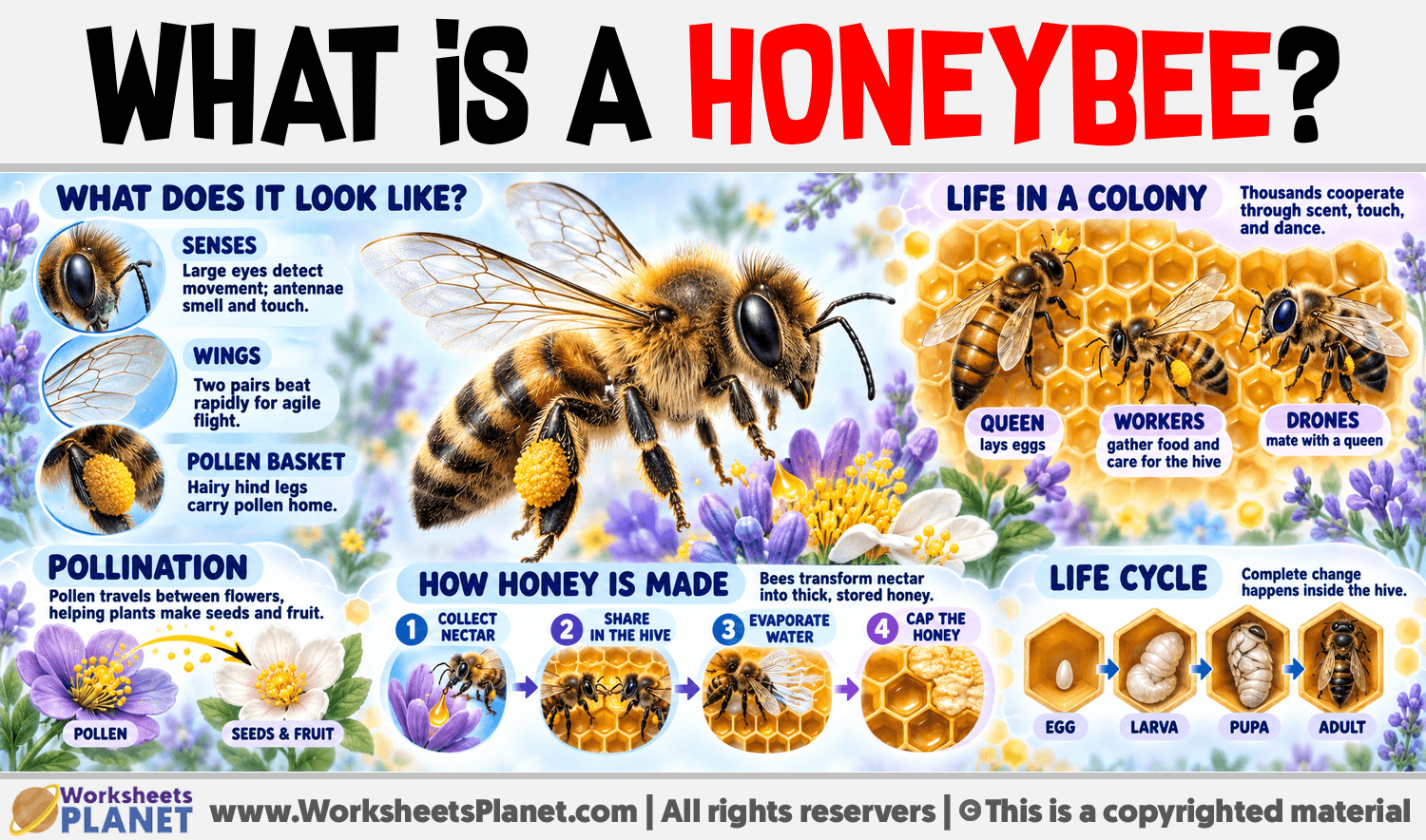
What Does a Honeybee Look Like?
A honeybee has a small body divided into three main parts: the head, thorax, and abdomen. Like all insects, it has six legs. It also has two pairs of wings, antennae, and special body hairs that help it collect pollen from flowers.
Honeybees are usually golden-brown or yellowish with darker stripes. They are often confused with wasps, but honeybees are generally hairier and rounder. Those tiny hairs are very useful because pollen sticks to them while the bee visits flowers.
- Head: contains the eyes, antennae, and mouthparts used for feeding on nectar.
- Thorax: the middle section where the wings and legs are attached.
- Abdomen: the back section, which includes the honey stomach and, in female bees, a stinger.
- Antennae: used to smell, touch, and sense the world around them.
- Pollen baskets: special areas on the back legs where worker bees carry pollen.
How Do Honeybees Live in a Colony?
Honeybees are social insects, which means they live and work together in a group. A honeybee colony can include thousands of bees, each with a role that helps the whole group survive. The colony lives in a hive, which may be a natural hollow space, such as a tree cavity, or a human-made beehive.
Inside the hive, honeybees build wax combs made of many small six-sided cells. These cells are used to store honey and pollen and to raise young bees. The hive is busy, warm, and carefully organized.
- Queen bee: the only female in the colony that usually lays eggs. A healthy queen may lay many eggs each day.
- Worker bees: female bees that do most jobs, including cleaning, feeding young bees, building wax comb, guarding the hive, and collecting nectar and pollen.
- Drones: male bees whose main role is to mate with a queen from another colony.
Why Are Honeybees Important for Pollination?
One of the most important jobs of a honeybee is pollination. Pollination happens when pollen from the male part of a flower reaches the female part of a flower. This allows many plants to make seeds and fruit.
When a honeybee visits a flower, it drinks nectar, a sweet liquid that flowers produce. As the bee moves around the flower, pollen sticks to its body. When the bee visits another flower, some of that pollen rubs off. In this way, honeybees help plants reproduce.
Many foods people enjoy depend partly on pollinators like honeybees. Apples, almonds, blueberries, cucumbers, melons, and many other crops can benefit from bee pollination. Honeybees are not the only pollinators—butterflies, beetles, flies, birds, bats, and wild bees also help—but honeybees are especially important in farming because their colonies can be managed and moved to crop fields.
- Pollination helps plants make seeds, fruits, and vegetables.
- Honeybees collect both nectar for energy and pollen for protein.
- A single bee may visit many flowers in one trip, spreading pollen as it goes.
How Do Honeybees Make Honey?
Honey begins as nectar inside flowers. Worker bees collect nectar using their long, tube-like tongue and store it in a special part of the body often called the honey stomach. This is not the same stomach the bee uses to digest food for itself.
Back at the hive, bees pass the nectar to other worker bees. The nectar is changed by natural enzymes and then placed into wax cells. Bees fan their wings to help water evaporate from the nectar. As it thickens, it becomes honey. Finally, bees seal the honey-filled cells with wax.
Honey is the colony’s food supply. It gives bees energy, especially when flowers are not blooming, such as during cold or dry seasons. Beekeepers may collect extra honey, but responsible beekeepers leave enough for the bees to eat.
What Is the Life Cycle of a Honeybee?
A honeybee goes through a complete life cycle with four stages: egg, larva, pupa, and adult. This type of change is called complete metamorphosis. The process happens inside the wax cells of the hive.
First, the queen lays a tiny egg in a cell. After a few days, the egg hatches into a larva, which looks like a small white grub. Worker bees feed the larva. Later, the cell is capped with wax, and the larva changes into a pupa. Inside the capped cell, the bee develops legs, wings, eyes, and other adult body parts. Finally, the adult bee chews its way out of the cell and begins its work in the colony.
Worker bees often do different jobs as they age. Young workers may clean cells and feed larvae. Older workers may guard the hive or fly out to collect nectar and pollen. This changing set of duties helps the colony run smoothly.
Helpful Facts About Honeybees and Safety
Honeybees are fascinating animals, but they should be treated with care and respect. A honeybee may sting if it feels threatened or if its hive is disturbed. Most honeybees are not looking to sting people; they are usually focused on flowers and hive work.
Students can safely observe honeybees from a distance when they are visiting flowers. Watching quietly can show how bees move from bloom to bloom, gather pollen, and use their wings. It is also helpful to remember that protecting honeybees means protecting habitats with flowering plants, clean water, and fewer harmful chemicals.
- Do not swat at honeybees; move away calmly.
- Never disturb a hive or swarm without an adult expert or beekeeper.
- Planting flowers can provide bees with nectar and pollen.
- Honeybees communicate partly through movement, including the famous waggle dance, which helps show other bees where food is located.
- A honeybee is different from a bumblebee: bumblebees are usually larger, fuzzier, and live in smaller colonies.

Leave A Comment