
A hammer shark is more commonly called a hammerhead shark. It is a type of shark famous for its unusual head shape, which looks wide and flat like the head of a hammer. This special head is not just for looks. It helps the shark see, sense, and hunt in ways that make it different from many other sharks. Hammerhead sharks live in warm oceans around the world, and they are important predators in marine ecosystems. For students, they are a fascinating example of how an animal’s body parts can help it survive in its environment.
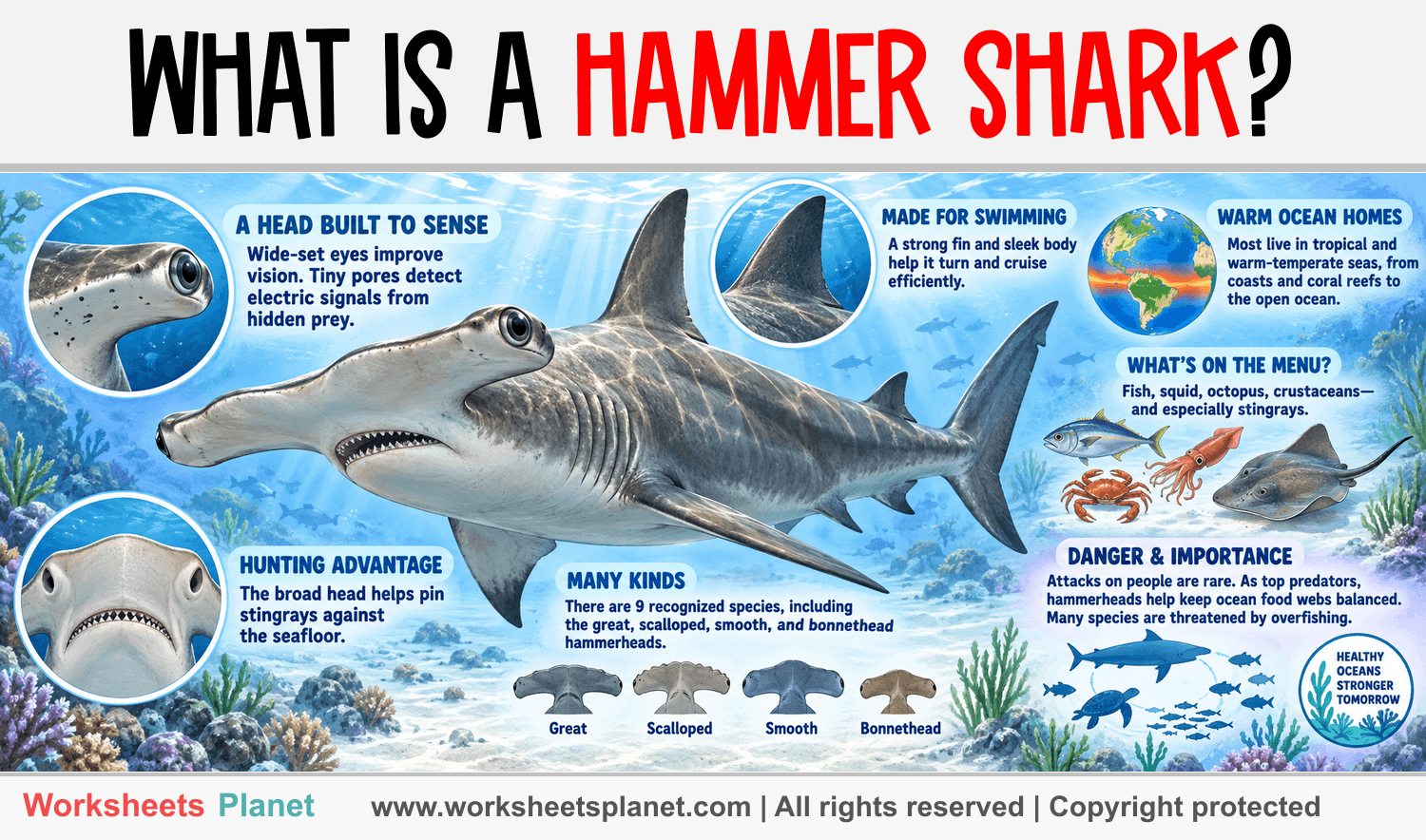
Why does a hammer shark have a hammer-shaped head?
The most noticeable feature of a hammer shark is its wide head, called a cephalofoil. This head shape gives the shark several advantages. Its eyes are placed at the far ends of the head, which helps it see a wider area than many other sharks. This can be useful when searching for food or watching for danger.
Hammerhead sharks also use special sensing organs found in their heads. These organs can detect tiny electrical signals made by other animals. Many sea creatures, such as fish and stingrays, produce weak electrical signals when they move or breathe. A hammer shark can use its broad head like a scanning tool to find hidden prey, even when the prey is buried under sand.
- The wide head helps the shark have a broader field of vision.
- It gives more space for electrical sensors that detect prey.
- It may help the shark make sharp turns while swimming.
- It can help the shark pin down animals such as stingrays on the seafloor.
Where do hammer sharks live?
Hammer sharks are usually found in warm ocean waters, especially in tropical and subtropical regions. They may live near coastlines, around islands, over coral reefs, or in deeper offshore waters. Some species travel long distances, while others stay closer to particular feeding or breeding areas.
Many hammerhead sharks are seen in groups called schools. This is unusual because many sharks are solitary, meaning they spend much of their lives alone. Young hammerheads may gather in shallow coastal areas where there is more protection from larger predators. Adults often move into deeper water as they grow.
- Common habitats include coral reefs, bays, lagoons, and continental shelves.
- Some hammerheads swim alone, while others gather in large schools.
- Young sharks often stay in shallow nursery areas for safety.
- They are found in oceans such as the Atlantic, Pacific, and Indian Oceans.
What do hammer sharks eat?
Hammer sharks are carnivores, which means they eat other animals. Their diet depends on the species, size, and habitat, but many hammerheads eat fish, squid, octopuses, crustaceans, and rays. One of their best-known foods is the stingray. The hammer-shaped head can help the shark detect stingrays hiding under sand.
Like other sharks, hammerheads have rows of sharp teeth. If a tooth breaks or falls out, another tooth can replace it. This is useful for a predator that catches slippery, fast-moving, or tough prey. Hammer sharks do not chew food the way humans do. Instead, they bite and swallow pieces of food.
- Fish, including small schooling fish
- Squid and octopuses
- Crabs, shrimp, and other crustaceans
- Stingrays and other rays
- Occasionally smaller sharks, depending on the species
Are there different kinds of hammer sharks?
There is not just one kind of hammer shark. The name usually refers to several species of hammerhead sharks. Some are very large, while others are much smaller. The biggest is the great hammerhead, which can grow longer than a small car. Other species, such as the bonnethead shark, are much smaller and have a more rounded head shape.
Different species have different behaviors and habitats. For example, the scalloped hammerhead often forms large schools, while the great hammerhead is more often seen alone. The shape of the head can also vary. Some hammerheads have a smooth front edge, while others have a curved or scalloped edge.
- Great hammerhead: the largest hammerhead species and a powerful hunter.
- Scalloped hammerhead: known for the curved, notched shape of its head and large schools.
- Smooth hammerhead: has a smoother head edge and can live in cooler waters than some others.
- Bonnethead shark: a smaller relative with a rounded, shovel-like head.
Are hammer sharks dangerous, and why are they important?
Hammer sharks are wild predators, so people should respect them and keep a safe distance. However, they are not usually looking for humans as food. Most hammerhead species are shy around people, and attacks are very rare. Divers may sometimes see hammerheads in the wild, especially in places where they gather to feed or migrate.
Hammer sharks are important because they help keep ocean food chains balanced. As predators, they control populations of fish, rays, and other sea animals. When large predators disappear, the whole ecosystem can be affected. For example, if there are too many of one prey species, it may reduce other marine life that shares the same habitat.
Sadly, many hammerhead sharks are threatened by overfishing, accidental capture in fishing nets, and the demand for shark fins. Some species grow slowly and have few young, so their populations can take a long time to recover. Protecting hammer sharks helps protect the health of the ocean.
- They help maintain balanced marine ecosystems.
- They are often threatened by fishing and habitat changes.
- They usually do not pose a major danger to humans.
- Learning about them helps students understand adaptation, food chains, and conservation.

Leave A Comment