
A chipmunk is a small, striped rodent known for its quick movements, round cheeks, and busy food-gathering habits. Chipmunks belong to the squirrel family, which means they are related to tree squirrels, ground squirrels, and marmots. Unlike many squirrels that spend much of their time in trees, chipmunks usually live close to the ground and often make underground burrows. These animals are common in forests, gardens, parks, and rocky areas, especially in North America. Learning about chipmunks helps students understand animal habitats, adaptations, food chains, and seasonal behavior in a simple and engaging way.
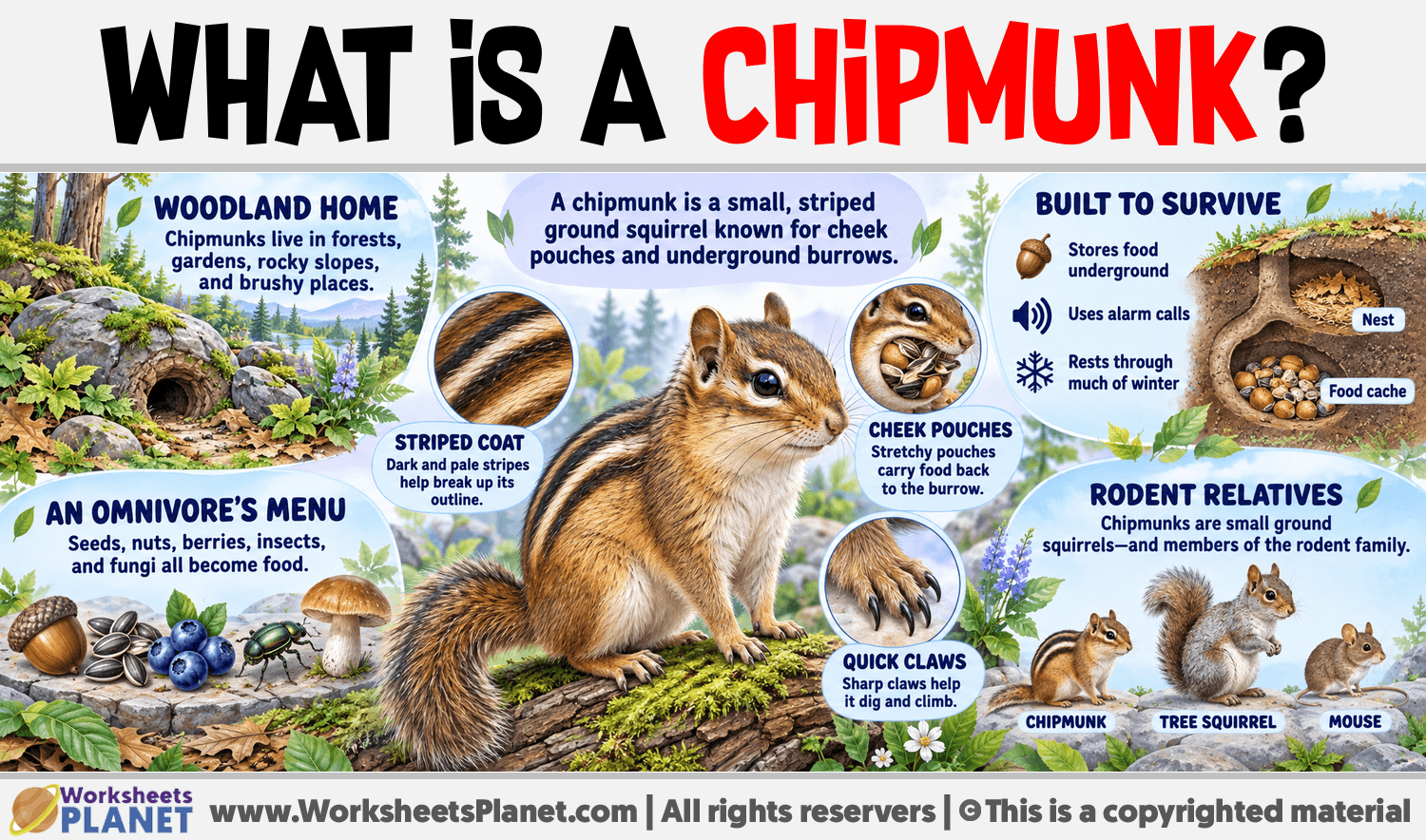
What Does a Chipmunk Look Like?
Chipmunks are easy to recognize because of the dark and light stripes running along their backs and faces. Most chipmunks are small, usually about 4 to 7 inches long, not including the tail. Their tails are furry but not as large or bushy as a tree squirrel’s tail.
One of the most interesting features of a chipmunk is its cheek pouches. These stretchy pockets inside the mouth allow the animal to carry seeds, nuts, and other food back to its burrow. A chipmunk can stuff its cheeks until they look much bigger than normal, which is why many people find them amusing to watch.
- Small body with short legs and quick feet
- Striped fur, often brown, tan, black, and white
- Furry tail used for balance
- Large eyes that help spot danger
- Cheek pouches for carrying food
Where Do Chipmunks Live?
Chipmunks live in places where they can find shelter, food, and safe hiding spots. Many species prefer woodlands and forest edges, but they may also live near stone walls, gardens, brush piles, and backyard sheds. They like areas with logs, leaves, rocks, and plants because these provide protection from predators.
Most chipmunks dig burrows underground. A burrow is not just a simple hole. It can include tunnels, sleeping chambers, food storage rooms, and hidden entrances. Chipmunks often keep the entrance neat by carrying loose dirt away from the opening, making the burrow harder for predators to find.
In North America, the eastern chipmunk is one of the best-known species. Other chipmunk species live in western North America, especially in forests, mountains, and dry rocky areas. A few species are also found in parts of Asia.
What Do Chipmunks Eat?
Chipmunks are omnivores, which means they eat both plant and animal matter. Most of their diet comes from plants, especially seeds and nuts. They also eat berries, fruits, grains, mushrooms, and tender plant shoots. When available, they may eat insects, worms, bird eggs, or very small animals.
A chipmunk’s food-gathering behavior is important for survival. During warm months, chipmunks collect food and store it in their burrows. This stored food helps them survive cold weather when fresh food is harder to find. Unlike animals that sleep deeply all winter, chipmunks may wake up during winter and eat from their stored supplies.
- Acorns, beechnuts, and other nuts
- Sunflower seeds and grains
- Berries, fruit, and small plants
- Mushrooms and fungi
- Insects, worms, and other small invertebrates
How Do Chipmunks Survive in the Wild?
Chipmunks survive by using several helpful adaptations. Their stripes help them blend in with leaves, soil, and shadows on the forest floor. Their speed allows them to dash quickly into bushes, logs, or burrow entrances when danger appears. They also use sharp senses to notice movement, sounds, and smells around them.
Predators of chipmunks include hawks, owls, foxes, snakes, raccoons, coyotes, bobcats, and domestic cats. Because they are small animals, chipmunks must stay alert. They often make sharp chirping or chucking sounds when they sense danger. These warning calls may alert other chipmunks nearby.
Chipmunks are also known for their seasonal habits. In autumn, they work especially hard to collect food. During winter, many chipmunks enter a state called torpor. Torpor is not the same as true hibernation. The animal’s body slows down to save energy, but it can wake up from time to time to eat stored food.
Chipmunks, Squirrels, and Other Small Rodents
Chipmunks are often compared with squirrels because they belong to the same family. However, there are clear differences. Tree squirrels are usually larger, spend more time climbing, and have long bushy tails. Chipmunks are smaller, have clear stripes, and spend much more time on or under the ground.
Chipmunks are also rodents, which means they have front teeth that keep growing throughout their lives. To keep these teeth from becoming too long, they gnaw on hard foods and materials. This feature is shared by mice, rats, beavers, porcupines, and squirrels.
Although chipmunks may visit gardens, they are not simply pests. They play a role in nature by spreading seeds and helping mix soil when they dig. Some forgotten seeds stored by chipmunks may grow into new plants. In this way, chipmunks can help support healthy ecosystems.
- Chipmunks are smaller than most tree squirrels
- Chipmunks have noticeable stripes on the face and back
- They usually store food underground
- They are active during the day, especially morning and afternoon
- They help move seeds from one place to another
Fun Facts About Chipmunks for Students
Chipmunks are excellent animals for classroom learning because they connect to many science topics, including habitats, animal adaptations, food chains, and seasonal changes. Observing a chipmunk can lead to useful questions: What is it carrying? Where does it hide? What might eat it? How does it prepare for winter?
One surprising fact is that a chipmunk may collect a large amount of food for its size. Its cheek pouches allow it to move food efficiently, almost like carrying a grocery bag inside its mouth. Another interesting fact is that chipmunks are generally solitary. They may live near other chipmunks, but each one usually has its own burrow and territory.
A simple way to remember what a chipmunk is: it is a small striped member of the squirrel family that lives mostly on the ground, stores food in burrows, and uses cheek pouches to carry meals. These lively animals may be tiny, but they are well adapted to survive in busy natural environments.

Leave A Comment