
Penguins are flightless seabirds that live mostly in the Southern Hemisphere. When students learn about the types of penguin, they discover that penguins are not all the same size, color, or shape. Some live on icy Antarctic coasts, while others survive on warm islands near the equator. Scientists recognize about 18 living penguin species, although the exact number can vary slightly depending on classification. Each type has special features that help it find food, raise chicks, and survive in its habitat.
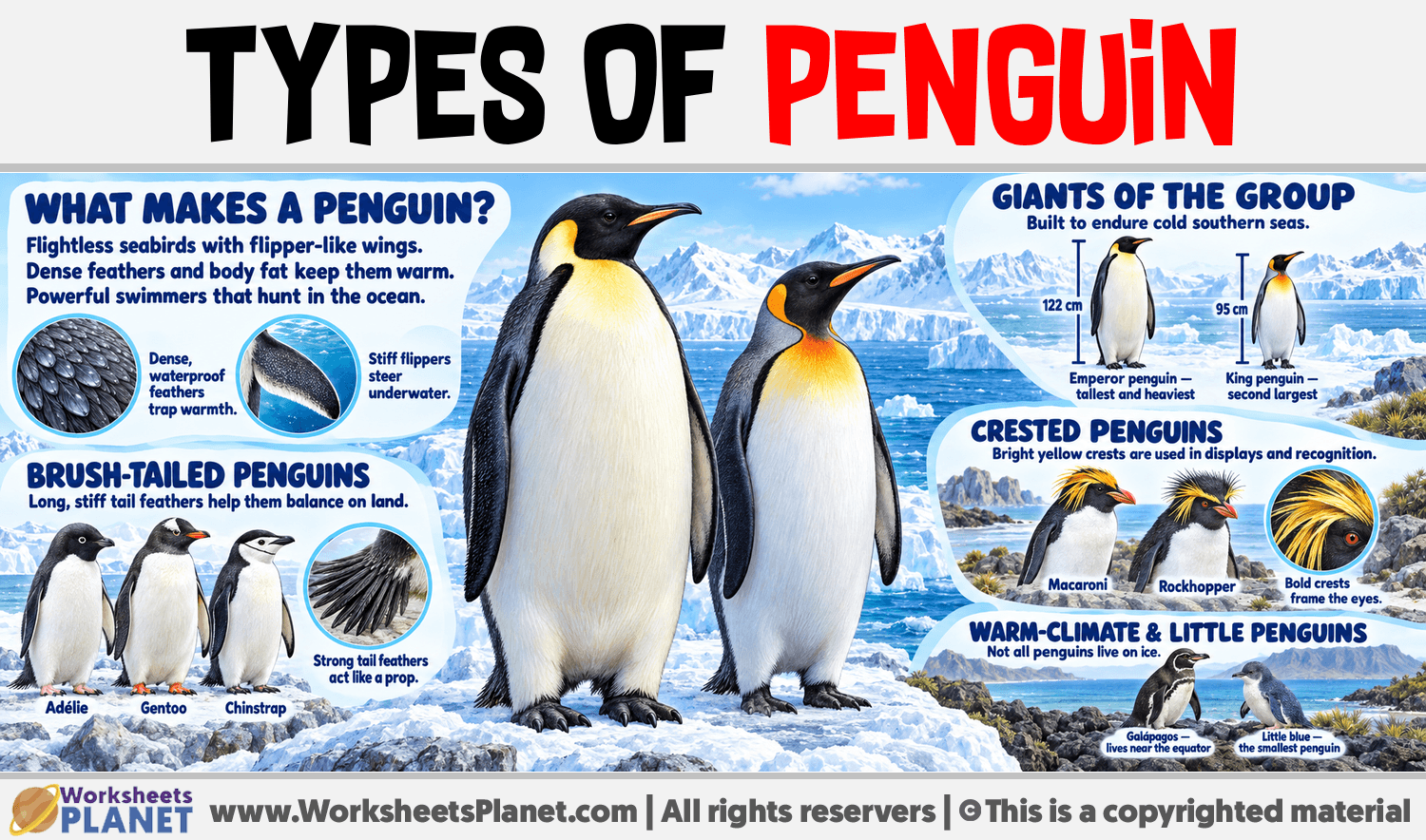
What makes a bird a penguin?
All penguins belong to the bird family Spheniscidae. They have feathers, lay eggs, and breathe air like other birds, but they cannot fly. Instead, their bodies are built for swimming. Their wings have changed into strong flippers, which help them move through water quickly and gracefully.
Penguins have a streamlined body shape, short legs, and webbed feet. Many species have black backs and white bellies. This coloring is called countershading. From above, their dark backs blend with the deep ocean. From below, their pale bellies blend with the bright surface of the water. This helps hide them from predators and prey.
- Penguins are excellent swimmers, not flying birds.
- They eat mostly fish, squid, and krill.
- They have waterproof feathers that help keep them dry and warm.
- Most penguins live south of the equator, but not all live in snow and ice.
Large penguin species: the giants of the group
The biggest and most famous penguins are the emperor penguin and the king penguin. These large species are often shown in books and documentaries because of their impressive size and unusual breeding habits.
The emperor penguin is the tallest and heaviest type of penguin. It lives in Antarctica, where winter temperatures can be extremely cold. Emperor penguins are known for breeding during the Antarctic winter. The male keeps the egg warm on his feet under a flap of skin while the female travels to the sea to feed.
The king penguin is slightly smaller than the emperor penguin and lives on sub-Antarctic islands. King penguins have bright orange patches on their heads and necks. Their chicks look very different from the adults because they are covered in thick brown down feathers.
- Emperor penguin: the largest penguin, adapted to freezing Antarctic conditions.
- King penguin: the second largest penguin, with colorful orange markings.
- Both species form large colonies and depend on the ocean for food.
Brush-tailed penguins: active penguins with long tail feathers
Some of the best-known types of penguin belong to a group often called brush-tailed penguins. These penguins have stiff tail feathers that stick out behind them. They often use their tails for balance when standing or climbing over rocks.
The Adélie penguin is a small Antarctic species with a black head and a white ring around each eye. It builds nests from stones and is known for its bold, busy behavior. The gentoo penguin is larger and has a white stripe across the top of its head. It is one of the fastest swimming penguins. The chinstrap penguin is easy to recognize because it has a thin black line under its head, almost like a helmet strap.
These species are important in classroom lessons because they show how similar animals can have different markings, sizes, and behaviors even when they live in related environments.
- Adélie penguin: small, energetic, and common around Antarctica.
- Gentoo penguin: has a white head stripe and can swim very fast.
- Chinstrap penguin: named for the black line under its chin.
Crested penguins: penguins with yellow feathers on their heads
Crested penguins are easy to spot because many have bright yellow or orange feather crests above their eyes. These feathers may look decorative, but they also help penguins recognize members of their own species, especially in crowded breeding colonies.
The macaroni penguin has bold yellow-orange crests and is one of the most numerous penguin species. The rockhopper penguin is smaller and famous for hopping across rocky cliffs instead of sliding on ice. There are also several closely related species, including the erect-crested penguin, Snares penguin, royal penguin, and Fiordland penguin.
Many crested penguins nest on islands with steep, rocky coastlines. Their chicks face challenges from weather, predators, and food shortages. Some crested penguin populations are declining, which makes them important for conservation studies.
- Macaroni penguin: has dramatic golden crests and large colonies.
- Rockhopper penguin: jumps across rocks and cliffs with strong feet.
- Fiordland penguin: lives in forested coastal areas of New Zealand.
- Royal penguin: similar to the macaroni penguin but with a lighter face.
Warm-climate and little penguins: not all penguins live on ice
A common misconception is that all penguins live in freezing places. In fact, several types of penguin live in mild or even warm climates. The Galápagos penguin lives near the equator on the Galápagos Islands. It survives there because cool ocean currents bring fish and lower water temperatures.
The African penguin lives along the coasts of southern Africa. It has a loud call that sounds a bit like a donkey, which is why it is sometimes called the jackass penguin. The Humboldt penguin lives along the coasts of Peru and Chile, where it depends on cold, nutrient-rich ocean water. The Magellanic penguin is found in South America and often nests in burrows.
The smallest penguin is the little penguin, also called the fairy penguin. It lives in Australia and New Zealand and is only about 30 to 35 centimeters tall. Its bluish feathers make it different from many black-and-white penguin species.
- Galápagos penguin: one of the rarest penguins and the only one living near the equator.
- African penguin: has a black face mask and pink patches near the eyes.
- Humboldt penguin: lives on the Pacific coast of South America.
- Little penguin: the smallest penguin species, with blue-gray feathers.
Why do different types of penguin matter?
Learning about different penguins helps students understand adaptation. An emperor penguin’s thick body and social huddling help it survive Antarctic cold. A rockhopper penguin’s strong legs help it move across cliffs. A Galápagos penguin’s behavior helps it cope with heat. Each species gives clues about how animals fit into their environments.
Penguins also teach important lessons about ecosystems. They are predators that eat fish, squid, and krill, but they are also prey for seals, orcas, and large seabirds. If penguin numbers change, it can signal changes in the ocean, such as warming water, overfishing, pollution, or loss of nesting space.
For teachers and students, comparing penguin species is a useful way to practice observation and classification. Students can compare height, habitat, markings, diet, and conservation status. This makes the topic more than a list of names; it becomes a way to understand biodiversity and the connections between animals and their habitats.
- Different penguins show different adaptations to climate and habitat.
- Penguin populations can help scientists monitor ocean health.
- Comparing species builds skills in classification, geography, and life science.
- Protecting penguins also means protecting the marine ecosystems they depend on.

Leave A Comment