
The axolotl is a fascinating amphibian best known for its feathery gills, wide smile, and amazing ability to regrow body parts. Native to the lake systems near Mexico City, this animal is often studied in science classes because its body shows many special adaptations for living in water. Learning the parts of an axolotl helps students understand how each structure supports breathing, swimming, sensing the environment, eating, and surviving. Although axolotls look a little like fish or lizards, they are actually salamanders that usually keep their larval features throughout life, a trait called neoteny.
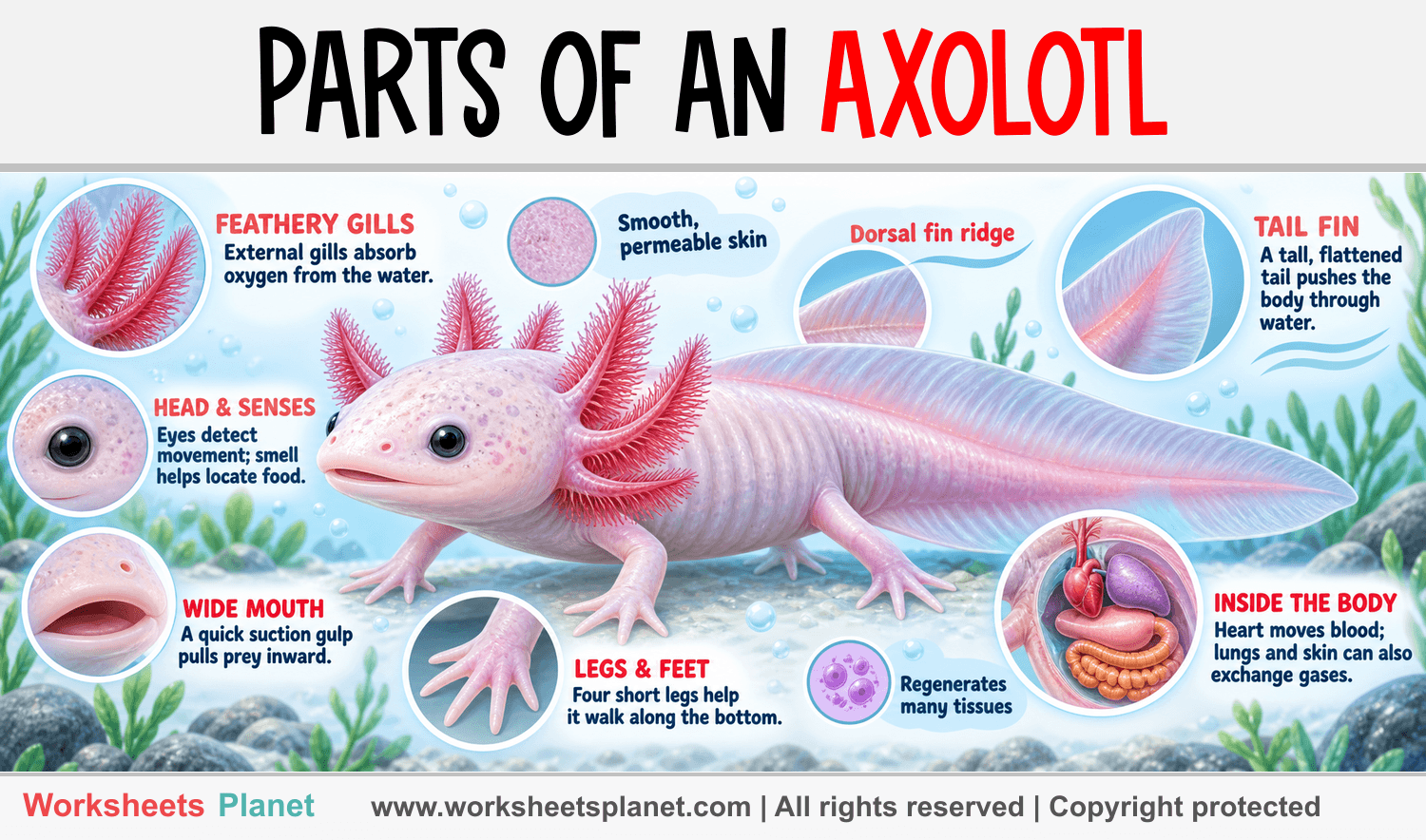
What are the main external parts of an axolotl?
The most noticeable parts of an axolotl are on the outside of its body. These external features make the animal easy to identify and also give clues about how it lives. Unlike many adult amphibians that spend time on land, axolotls are mostly aquatic, so their body is shaped for life underwater.
An axolotl has a long body, a broad head, four limbs, a tail, eyes, mouth, skin, and external gills. Each part has a specific job. For example, the tail helps with swimming, while the gills allow the axolotl to breathe in water. Its soft body and delicate skin also show why axolotls need clean, safe aquatic habitats.
- Head: broad and flat, holding the eyes, mouth, nostrils, and gills.
- Body trunk: the central section that contains many important internal organs.
- Legs and feet: four limbs used for walking along the bottom of the water.
- Tail: long and strong, helping the axolotl move and balance.
- Skin: smooth, moist, and sensitive to water quality and chemicals.
Why do axolotls have feathery gills?
One of the most famous parts of an axolotl is its set of external gills. These gills look like soft, feathery branches growing from both sides of the head. Most axolotls have three main gill stalks on each side, and each stalk has many tiny filaments that increase the surface area for taking in oxygen.
Axolotls breathe mostly through these gills, but they can also take in some oxygen through their skin and sometimes gulp air at the surface. The bright red or pink color often seen in the gills comes from blood vessels. As water passes over the gill filaments, oxygen moves into the bloodstream and carbon dioxide leaves the body.
Healthy gills are usually fluffy and open, not curled tightly or damaged. In a classroom diagram, the gills are important to label because they show how axolotls are different from many other amphibians that lose their gills as they mature.
- Gill stalks hold the delicate gill filaments in place.
- Gill filaments provide a large area for gas exchange.
- Blood vessels inside the gills carry oxygen around the body.
- Gills can become damaged if the water is dirty, too warm, or unsafe.
How do the head, mouth, and senses help an axolotl feed?
The axolotl’s head is wide and rounded, giving it its familiar smiling appearance. However, that “smile” is not an expression like a human smile. It is the natural shape of the mouth. The mouth opens quickly to suck in food, which is useful because axolotls do not chew like humans. Instead, they use a feeding method called suction feeding.
Axolotls eat small aquatic animals such as worms, insect larvae, tiny crustaceans, and small fish. Their eyes are small and do not have eyelids, so vision is not their only way to find food. They also detect movement and vibrations in the water. This helps them notice prey even when visibility is poor.
The nostrils on the head are not mainly for breathing like human noses. They are used for smelling chemicals in the water. Together, the mouth, eyes, nostrils, and sensory abilities help the axolotl locate food and respond to its environment.
- Mouth: opens quickly to pull food in with water.
- Eyes: detect light and movement, though vision is limited.
- Nostrils: help sense smells and chemicals in the water.
- Sensory system: helps detect nearby movement and vibrations.
What do the legs, feet, and tail do?
Axolotls have four legs, with front limbs and back limbs. Their legs are not built for fast running on land. Instead, they help the axolotl move slowly along the bottom of its watery habitat. The front feet usually have four toes, while the back feet often have five toes. These toes are delicate and useful for balance and gentle movement.
The tail is one of the most important body parts for movement. It is long, flattened from side to side, and has a fin-like edge that helps push water backward as the axolotl swims forward. When an axolotl needs to move quickly, it bends its body and tail in a wave-like motion.
A special fact about axolotls is that they can regrow lost limbs and even parts of the tail. This process is called regeneration. Scientists study axolotls because they can regrow complex structures, including bones, muscles, nerves, skin, and blood vessels. This makes them one of the most important animals in regeneration research.
What is inside an axolotl’s body?
Although students often begin by labeling the outside parts, the internal parts of an axolotl are also important. Like other vertebrates, axolotls have a backbone, brain, heart, stomach, intestines, lungs, kidneys, and reproductive organs. Their internal organs work together to keep the animal alive, growing, and active.
The heart pumps blood to the gills and body tissues. The digestive system breaks down food and absorbs nutrients. The lungs are present, even though axolotls rely heavily on gills and skin for breathing. Their backbone supports the body and protects the spinal cord, which carries messages between the brain and the rest of the body.
Because axolotls are amphibians, their skin is more than just a covering. It helps with gas exchange and is very sensitive to changes in water. This is why pollution, poor water conditions, or rough handling can harm them. In science lessons, this connection between body parts and habitat needs is a useful way to show how form and function are linked.
- Brain and spinal cord control movement and responses.
- Heart and blood vessels move oxygen and nutrients.
- Stomach and intestines digest food.
- Lungs, skin, and gills all play roles in breathing.
- Skeleton gives support and helps protect important organs.
Why is it useful to learn the parts of an axolotl?
Studying the parts of an axolotl helps students practice observation, labeling, and comparison. They can compare axolotls with fish, frogs, and other salamanders to see both similarities and differences. For example, axolotls have gills like fish, but they are amphibians, not fish. They have legs like other salamanders, but they usually remain fully aquatic.
Axolotls also teach important biology ideas. Their gills show adaptation to water, their skin shows the importance of clean habitats, and their ability to regenerate shows how living tissues can repair themselves. These features make the axolotl a powerful example for lessons about animal anatomy, ecosystems, endangered species, and scientific research.
In the wild, axolotls are critically endangered, mainly because of habitat loss, pollution, and introduced species. Learning about their body parts can therefore lead to a bigger conversation about conservation. When students understand how an animal’s parts help it survive, they can better understand why protecting its environment matters.

Leave A Comment