
The Paiute Tribe refers to several related Native American peoples who have lived for thousands of years in the Great Basin and nearby regions of the western United States. Paiute communities are not all the same; they include groups with different homelands, languages, histories, and governments. Today, Paiute people continue to preserve their cultures, protect their lands, teach their languages, and participate in modern tribal, local, and national life. Learning about the Paiute Tribe helps students understand the deep history of the American West and the importance of Native nations today.
Who are the Paiute people?
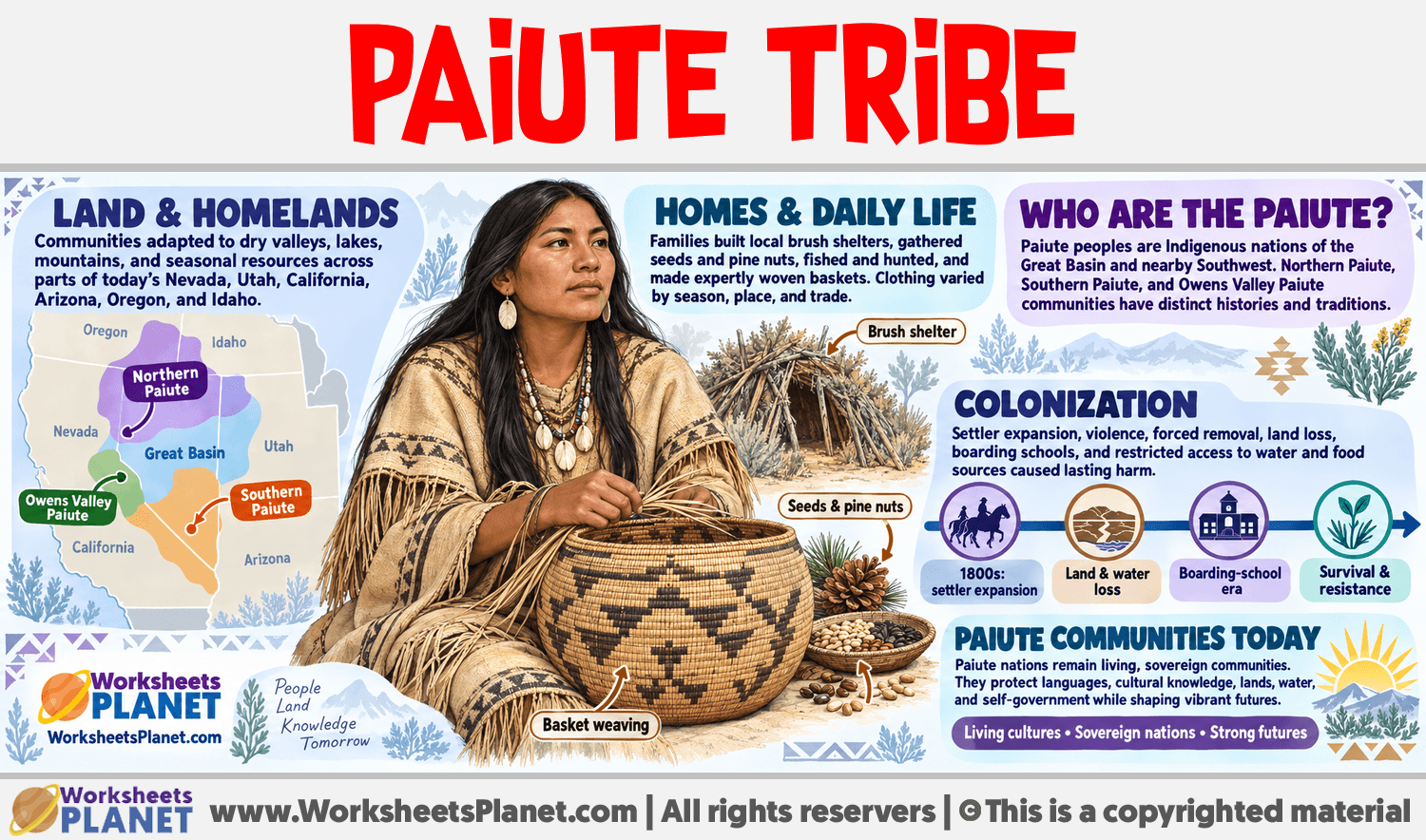
The word “Paiute” is often used to describe three broad groups: Northern Paiute, Southern Paiute, and Owens Valley Paiute. These groups are connected by language families and cultural ties, but each has its own identity and history. Paiute people traditionally lived in areas that are now Nevada, Utah, California, Oregon, Arizona, and Idaho.
Paiute communities adapted to some of the driest environments in North America. Their homelands include deserts, mountains, valleys, lakes, and river areas. Because food and water sources varied by season, many Paiute families traditionally moved within their territories to gather plants, hunt animals, fish, and visit important cultural places.
- Northern Paiute communities are associated especially with Nevada, eastern California, southeastern Oregon, and western Idaho.
- Southern Paiute communities are connected with southern Nevada, southern Utah, northern Arizona, and southeastern California.
- Owens Valley Paiute people have deep roots in the Owens Valley region of eastern California.
Where did the Paiute Tribe live and how did they use the land?
Paiute life was closely connected to the land. In the Great Basin, rainfall is limited, so people developed detailed knowledge of plants, animals, water sources, and seasonal changes. This knowledge helped communities survive in places that outsiders often misunderstood as empty or unlivable.
Traditional Paiute foods included seeds, pine nuts, roots, berries, fish, rabbits, deer, and other local resources. Pinyon pine nuts were especially important in many areas because they could be gathered, stored, and shared. Families used baskets for gathering and carrying food, and Paiute basketry became an important and highly skilled art form.
In some regions, Paiute people also developed irrigation and farming practices. The Owens Valley Paiute, for example, are known for using complex irrigation systems before large-scale American settlement. This shows that Paiute communities were not simply “wandering” through the desert; they managed their environments with skill and purpose.
- Paiute people used seasonal movement to follow food sources and weather patterns.
- They gathered and processed seeds, nuts, and roots with specialized tools and knowledge.
- They hunted and fished where local environments allowed.
- They cared for water sources, plant areas, and travel routes that had cultural and practical importance.
What were Paiute homes, clothing, and daily life like?
Traditional Paiute homes varied by region and season. Many families built shelters from willow, brush, reeds, tule, or other available materials. These homes were practical for the climate and for communities that moved at certain times of the year. In colder seasons or higher elevations, shelters could be made warmer and more protected.
Clothing was also adapted to the environment. Paiute people used materials such as animal hides, plant fibers, and woven items. In warm weather, clothing was lighter; in cold weather, robes, blankets, and moccasins helped protect against low temperatures. Practical design was important, but clothing and personal items could also show artistry and identity.
Daily life included gathering food, preparing meals, making tools, weaving baskets, caring for children, telling stories, and teaching younger generations. Elders played a key role in passing down oral traditions, place-based knowledge, family histories, and cultural values. Stories often taught lessons about respect, survival, humor, and the relationship between people and the natural world.
- Important skills included basket weaving, seed processing, hunting, fishing, tool making, and storytelling.
- Children learned by watching, helping, listening, and practicing with family members.
- Community cooperation was essential, especially during food gathering, ceremonies, and times of hardship.
How did colonization affect the Paiute Tribe?
The arrival of Spanish, Mexican, and later American settlers brought major changes to Paiute lands. During the 1800s, miners, ranchers, farmers, and settlers moved into Paiute territories. This often led to the loss of water sources, hunting areas, plant-gathering places, and sacred sites. Conflict increased as outsiders claimed land that Paiute communities had depended on for generations.
The United States government created reservations and forced many Native peoples onto limited lands. Paiute groups experienced broken promises, violence, disease, and pressure to abandon their languages and traditions. Children from many Native nations, including Paiute children, were affected by boarding school policies that tried to replace Native cultures with Euro-American customs.
Despite these hardships, Paiute people resisted, adapted, and survived. Leaders, families, and communities worked to protect their people and maintain cultural identity. One well-known Northern Paiute figure is Sarah Winnemucca, a writer, speaker, and advocate in the 1800s who spoke publicly about the mistreatment of Native people and called for justice.
- Colonization reduced Paiute access to traditional food and water sources.
- Reservations and government policies disrupted families and communities.
- Boarding schools harmed Native languages, cultures, and family connections.
- Paiute leaders and communities continued to defend their rights and traditions.
What is important to know about Paiute communities today?
Paiute people are still here, and the Paiute Tribe should not be studied only as part of the past. Today, many Paiute citizens belong to federally recognized tribes and tribal governments. These governments manage programs related to education, health, housing, cultural preservation, natural resources, and community services.
Modern Paiute communities work to revitalize languages, protect sacred places, and teach younger generations. Some communities hold cultural events, language classes, basketry workshops, and gatherings that strengthen identity and community ties. Tribal nations also take part in legal and environmental efforts, especially when water rights, land use, and cultural sites are at risk.
For students, one of the most important lessons is that Native nations are sovereign. Tribal sovereignty means that tribes have the right to govern themselves and make decisions for their people, though their relationship with federal and state governments can be complex. Respectful learning means using accurate names, avoiding stereotypes, and recognizing the diversity within Paiute communities.
When studying the Paiute Tribe, it is helpful to ask: Which Paiute community is being discussed? What region is connected to that community? What do Paiute people themselves say about their history and culture? These questions lead to a more accurate and respectful understanding of Paiute life, both past and present.
- Paiute communities today include teachers, artists, leaders, scientists, veterans, parents, students, and many other citizens.
- Language and cultural revitalization are important parts of community life.
- Land, water, and sacred site protection remain major concerns.
- The Paiute Tribe is part of living Native American history, not just history from long ago.

Leave A Comment