
The Ojibwe Tribe, also spelled Ojibway or known as the Chippewa in many United States records, is one of the largest Indigenous peoples in North America. Ojibwe communities have long lived around the Great Lakes, including areas of present-day Michigan, Wisconsin, Minnesota, North Dakota, Ontario, and Manitoba. Today, many Ojibwe people belong to federally recognized Tribal Nations in the United States or First Nations in Canada, while continuing to maintain important cultural traditions, languages, governments, and community life.
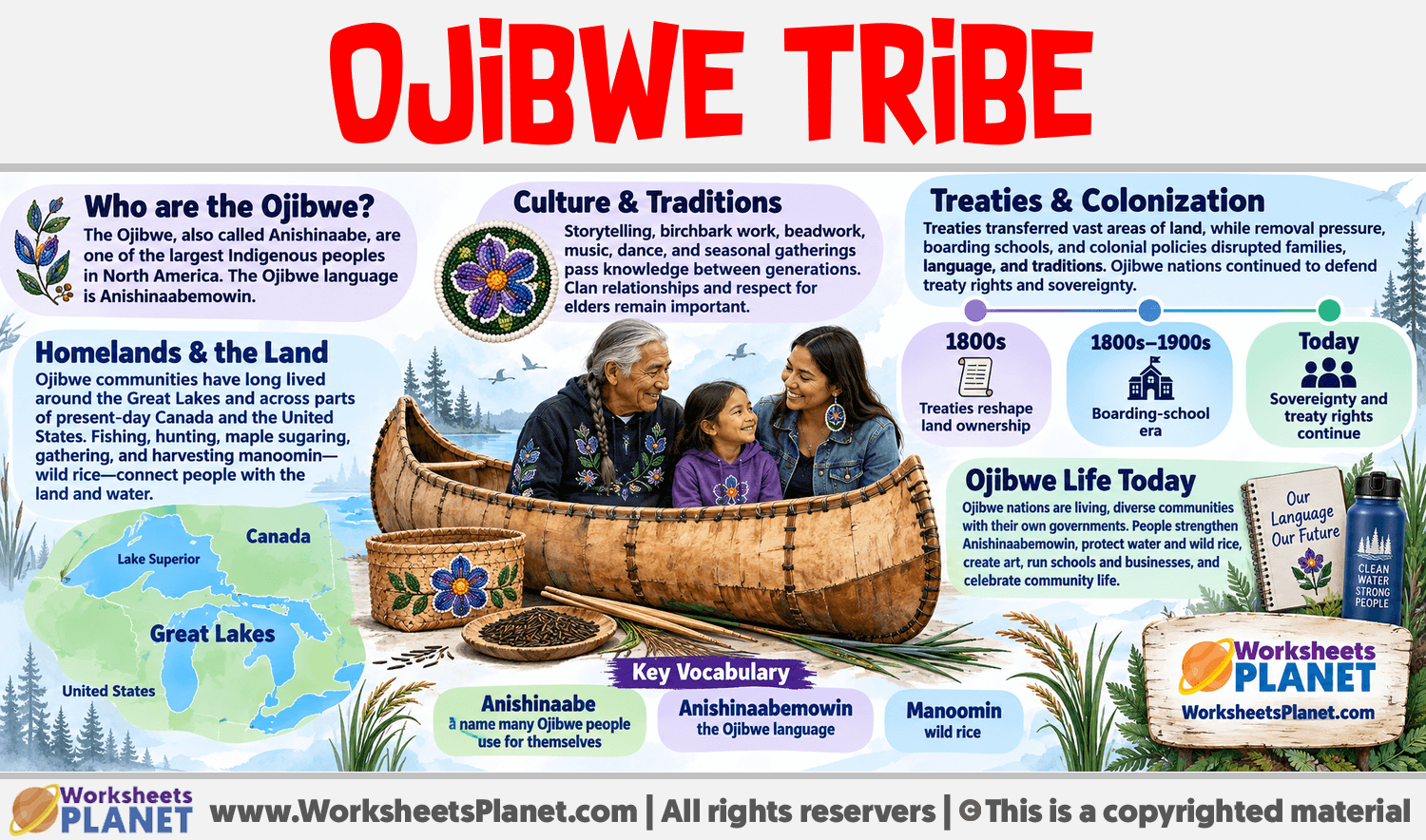
Who are the Ojibwe people?
The Ojibwe are part of the larger Anishinaabe group of peoples. The word Anishinaabe is often translated as “Original People” or “the people.” Related Anishinaabe nations include the Odawa and Potawatomi, who share close historical, cultural, and linguistic connections with the Ojibwe.
The name “Chippewa” became common because of English and French attempts to write the word “Ojibwe.” Both names may appear in books, maps, and government documents, but many communities and educators prefer Ojibwe or the specific name of a Tribal Nation or First Nation. It is always respectful to use the name a community uses for itself.
Ojibwe communities are not all exactly the same. Their histories, governments, ceremonies, and local customs can differ from one place to another. Still, many share cultural values such as respect for elders, responsibility to family, care for the land, and the importance of storytelling and language.
- The Ojibwe are one of the largest Native peoples in North America.
- They are part of the Anishinaabe cultural and language family.
- The name Chippewa is often used in U.S. legal and historical documents.
- Ojibwe communities exist in both the United States and Canada.
Where did the Ojibwe live, and how did they use the land?
Historically, many Ojibwe people lived in woodlands and near lakes and rivers. The Great Lakes region offered rich resources, including fish, wild rice, deer, maple trees, berries, birch bark, and medicinal plants. Ojibwe life was shaped by the seasons, with families moving or adjusting their work according to the time of year.
One of the most important foods for many Ojibwe communities is manoomin, often called wild rice in English. Manoomin grows naturally in shallow lakes and rivers. It is not only a food source but also a sacred gift connected to Ojibwe migration stories, identity, and responsibilities to the natural world.
Birch bark was another important material. Ojibwe people used it to make canoes, baskets, containers, and coverings for wigwams. Birch bark can be strong, flexible, and lightweight, which made it especially useful for people living in forest and lake environments.
- In spring, families collected maple sap and made maple sugar.
- In summer, people fished, gardened, gathered berries, and repaired tools.
- In late summer and fall, many communities harvested manoomin.
- In winter, families hunted, trapped, told stories, and made clothing or tools.
What are important Ojibwe cultural traditions?
Ojibwe culture includes many traditions that teach history, values, and relationships. Oral storytelling has always been important. Stories may explain how the world works, teach respectful behavior, or share lessons about courage, humor, humility, and balance. Some stories are told only during certain seasons, depending on community tradition.
The Ojibwe language, called Anishinaabemowin, is central to culture because it carries ideas that can be hard to translate into English. Language programs, immersion schools, community classes, and digital resources are helping more children and adults learn and use Anishinaabemowin today.
Many Ojibwe communities also participate in powwows, ceremonies, feasts, and other gatherings. A powwow may include dancing, singing, drumming, regalia, food, and visiting with relatives and friends. However, not every cultural practice is public. Some ceremonies are private or sacred, and respectful learners should understand that not all knowledge is meant to be shared outside the community.
- Storytelling teaches history, values, and life lessons.
- Anishinaabemowin connects people to identity and traditional knowledge.
- Drumming and singing are important in many gatherings and ceremonies.
- Respect for elders is a key value because elders often carry community knowledge.
How did treaties and colonization affect the Ojibwe Tribe?
Like many Indigenous nations, the Ojibwe were deeply affected by European colonization and later by United States and Canadian government policies. Ojibwe leaders signed treaties that often involved land cessions, or giving up large areas of land, while reserving certain rights such as hunting, fishing, and gathering. These agreements remain important today because treaties are legal promises between governments.
In the United States, some Ojibwe people were moved onto reservations, while in Canada many communities were placed on reserves. Government boarding schools and residential schools tried to force Indigenous children to stop speaking their languages and practicing their cultures. These policies caused great harm to families and communities, and their effects are still felt today.
At the same time, Ojibwe people resisted, adapted, and continued to protect their nations. Many Ojibwe communities have fought in courts and through political action to defend treaty rights, especially the right to fish, hunt, gather manoomin, and care for traditional lands and waters. These efforts show that Ojibwe history is not only about hardship, but also about strength, survival, and leadership.
What is Ojibwe life like today?
Today, the Ojibwe Tribe is not a single government but many Tribal Nations and First Nations with their own leaders, laws, services, and community priorities. Some Ojibwe citizens live on reservations or reserves, while others live in towns and cities. Many people move between communities for school, work, family, ceremonies, or cultural events.
Ojibwe governments may operate schools, health clinics, courts, natural resource departments, language programs, cultural centers, and businesses. Environmental protection is especially important for many communities because clean water, healthy forests, fish, and manoomin beds are connected to both daily life and cultural responsibility.
For students, one of the most important things to remember is that the Ojibwe people are living nations, not only figures from the past. Their histories are ancient, but their communities continue to shape the present and future through education, art, leadership, science, language revitalization, and protection of the land.
- Modern Ojibwe nations have their own governments and community institutions.
- Many Ojibwe artists, teachers, scientists, veterans, writers, and leaders contribute to society today.
- Language and cultural revitalization are major priorities in many communities.
- Treaty rights and environmental stewardship remain important contemporary issues.

Leave A Comment