
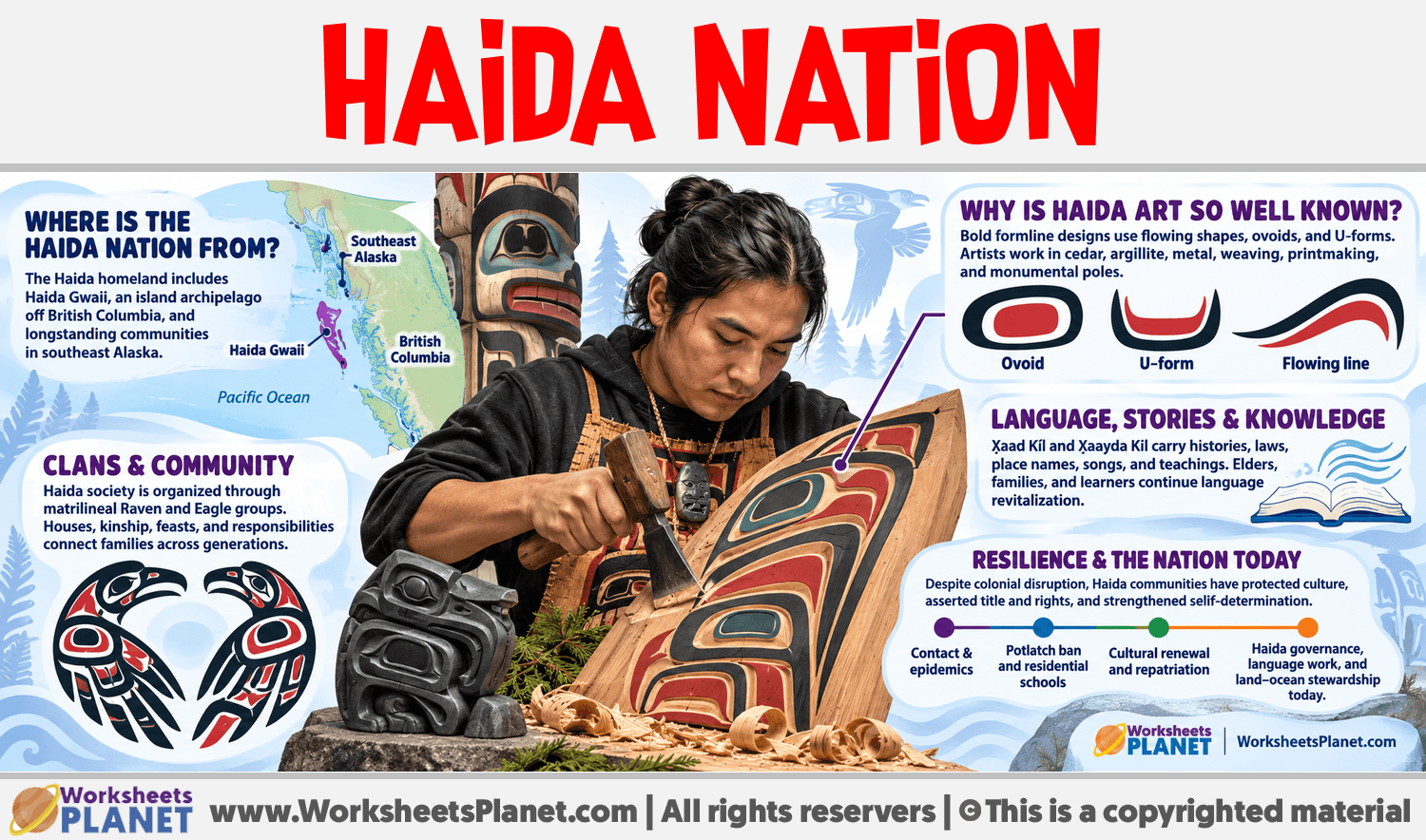
The Haida Nation is an Indigenous nation from the Pacific Northwest Coast of North America, especially connected to Haida Gwaii, an archipelago off the coast of what is now British Columbia, Canada. Haida people also have communities in southeastern Alaska, including areas around Prince of Wales Island. For thousands of years, the Haida have lived with deep knowledge of the ocean, forests, rivers, animals, and seasons. Their history, art, governance, and language are important parts of understanding Indigenous peoples of the Northwest Coast. Learning about the Haida Nation helps students see how culture, land, identity, and rights are connected, both in the past and today.
Where is the Haida Nation from?
The homeland of the Haida Nation is called Haida Gwaii, which means “Islands of the People.” These islands lie in the Pacific Ocean, west of mainland British Columbia. The area includes rich forests, rocky shores, beaches, rivers, and ocean waters filled with marine life. Because of this environment, Haida communities developed strong skills in fishing, canoe travel, woodworking, harvesting, and caring for natural resources.
Haida territory also extends into parts of present-day Alaska. In English, the term “Haida Nation” often refers to the people, their government, their culture, and their continuing relationship with their lands and waters. It is important to remember that the Haida are not only a historical people. They are a living nation with modern communities, leaders, artists, students, teachers, and families.
- Haida Gwaii is the main homeland of the Haida people in Canada.
- Some Haida communities are also located in southeastern Alaska.
- The ocean and forest have shaped Haida food, travel, art, stories, and daily life.
- Haida people continue to protect and care for their lands and waters today.
Haida culture, clans, and community life
Traditional Haida society is organized through family lines, clans, and houses. Two major social groups, often called moieties, are the Raven and the Eagle. These groups are connected to identity, marriage rules, responsibilities, stories, and crests. Crests may include animals or beings such as Raven, Eagle, Bear, Beaver, Frog, Killer Whale, or other important figures. They are not simply decorations; they show family history and rights.
Community life has long included ceremonies, feasts, teaching, and the passing down of knowledge from Elders to younger generations. In many Indigenous cultures, including Haida culture, Elders are respected for their wisdom, memory, language knowledge, and experience. Stories, songs, dances, and names can carry teachings about behavior, respect, family, and the natural world.
Food has also been central to Haida life. Salmon, halibut, herring, seaweed, shellfish, berries, and plants are examples of traditional foods. Harvesting these foods is not only about eating; it also teaches patience, timing, teamwork, and respect for the environment.
Why is Haida art so well known?
Haida art is famous around the world for its beauty, precision, and meaning. Many people recognize Haida art through totem poles, carved masks, bentwood boxes, argillite carvings, jewelry, woven hats, and painted designs. These works often use strong shapes, balanced forms, and traditional design elements known as formline art.
Totem poles are sometimes misunderstood. They are not objects of worship. Instead, they can tell stories, honor ancestors, mark important events, show family crests, or welcome people. A pole may include figures such as Raven, Eagle, Bear, or Killer Whale, each connected to histories and teachings. The meaning of a pole depends on the family, artist, and community connected to it.
The Haida are also known for their large ocean-going canoes, traditionally carved from massive cedar trees. Cedar is a very important tree in Northwest Coast cultures because it can be used for canoes, houses, boxes, clothing, baskets, ropes, and ceremonial items. For this reason, cedar is sometimes called the tree of life by Northwest Coast peoples.
- Haida art often communicates family identity, history, and inherited rights.
- Totem poles can honor ancestors, tell stories, or mark important events.
- Traditional materials include cedar wood, argillite, copper, shell, and plant fibers.
- Many modern Haida artists combine traditional knowledge with contemporary forms.
Language, stories, and knowledge
The Haida language is a central part of Haida identity. Like many Indigenous languages, it was seriously harmed by colonization, including government policies and residential schools that punished children for speaking their own languages. Today, Haida communities are working to strengthen language learning through classes, recordings, immersion programs, songs, apps, books, and family teaching.
Language carries ways of thinking that are difficult to translate fully into English. Place names, for example, often describe local history, geography, animals, or events. Traditional stories may explain relationships between people, animals, and the supernatural world. They can also teach values such as humility, generosity, courage, careful listening, and respect.
One famous figure in many Haida stories is Raven. Raven may be clever, curious, powerful, selfish, helpful, or humorous, depending on the story. These stories are not just entertainment. They can help listeners think about choices and consequences.
Colonization, resilience, and the Haida Nation today
The arrival of European traders, settlers, and governments brought enormous changes to Haida communities. Diseases such as smallpox caused devastating population loss. Colonial governments also restricted ceremonies, took lands, removed cultural objects, and forced many Indigenous children into residential schools. These actions caused deep harm to families, languages, and cultural transmission.
Even with these challenges, the Haida Nation has shown great resilience. Haida people have continued to protect their culture, rebuild language learning, create powerful art, and defend their rights. The Council of the Haida Nation represents Haida interests in many political and legal matters, including land, marine protection, and self-governance.
A major example is the protection of areas in Haida Gwaii, including Gwaii Haanas, a region of islands, forests, and ocean that is jointly managed by the Haida Nation and the Government of Canada. This cooperation recognizes that conservation is not only scientific but also cultural. The land and sea are connected to Haida law, history, food, and identity.
For students, the Haida Nation offers an important lesson: Indigenous nations are not only part of the past. They continue to shape the present and future through leadership, education, art, environmental stewardship, and cultural renewal. Studying the Haida Nation helps us understand why respect for Indigenous rights, languages, and homelands matters.
- The Haida Nation continues to practice self-governance and protect its territory.
- Language revitalization is a major priority for many Haida families and educators.
- Haida artists, carvers, and weavers keep cultural knowledge visible and active.
- Environmental stewardship is closely connected to Haida law, identity, and responsibility.

Leave A Comment