
The Dalton Atomic Model was one of the first scientific explanations of what matter is made of. Proposed by the English scientist John Dalton in the early 1800s, it helped chemistry move from simple observation to a more organized science. Before Dalton, people knew that substances could react and form new materials, but they did not have a clear model to explain why this happened. Dalton suggested that all matter is made of tiny particles called atoms, and that these atoms combine in specific ways to form compounds. Although modern science has changed some parts of Dalton’s ideas, his model remains an important starting point for understanding atoms, elements, compounds, and chemical reactions.
What Is the Dalton Atomic Model?
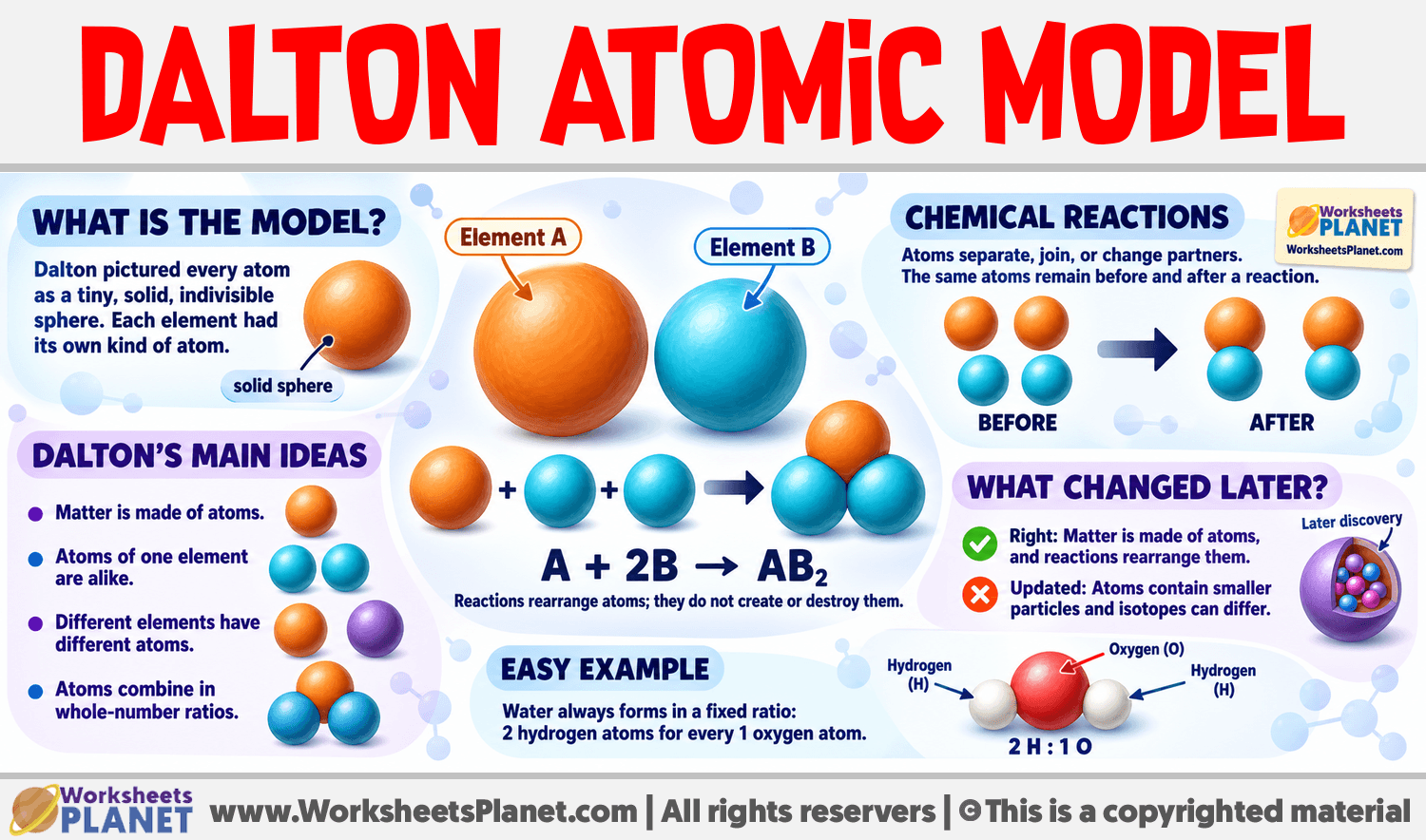
The Dalton Atomic Model is a scientific theory that describes matter as being made of very small, solid, indivisible particles called atoms. Dalton imagined atoms as tiny hard spheres, similar to miniature balls. Because of this, his model is sometimes called the solid sphere model or the billiard ball model.
According to Dalton, each element is made of only one kind of atom. For example, carbon is made of carbon atoms, oxygen is made of oxygen atoms, and iron is made of iron atoms. He also believed that atoms of different elements have different masses and properties. This idea helped explain why substances behave differently in chemical reactions.
Dalton’s model was important because it gave scientists a simple way to understand the difference between elements and compounds. An element contains only one type of atom, while a compound forms when atoms of different elements join together in fixed ratios.
John Dalton’s Main Ideas About Atoms
Dalton developed his atomic theory by studying gases, chemical reactions, and patterns in how substances combine. His ideas were based on evidence available at the time, especially the way elements seemed to combine in simple, whole-number ratios.
The main points of the Dalton Atomic Model can be summarized clearly:
- All matter is made of atoms, which are extremely small particles.
- Atoms cannot be created, destroyed, or divided during ordinary chemical reactions.
- All atoms of the same element are identical in mass and properties, according to Dalton’s original idea.
- Atoms of different elements are different from one another.
- Compounds form when atoms combine in simple, fixed ratios, such as 1:1 or 2:1.
- Chemical reactions rearrange atoms; they do not turn one type of atom into another.
How Dalton’s Model Explained Chemical Reactions
One of the most useful parts of Dalton’s theory was its explanation of chemical reactions. Dalton proposed that a chemical reaction happens when atoms separate, join, or rearrange. The atoms themselves do not disappear; they simply form new combinations.
For example, when hydrogen and oxygen react to form water, Dalton’s model explains that hydrogen atoms and oxygen atoms join in a fixed ratio. Today we write this as H₂O, meaning that each water molecule contains two hydrogen atoms and one oxygen atom. Dalton did not know about molecules in the same way modern scientists do, but his theory helped lead to this understanding.
His model also supported the law of conservation of mass. This law states that matter is not created or destroyed in a chemical reaction. If the same atoms are present before and after the reaction, then the total mass stays the same. This was a major step forward in chemistry because it helped scientists predict and measure reactions more accurately.
Examples That Make Dalton’s Atomic Theory Easier to Understand
Dalton’s ideas can be easier to understand with everyday examples. Imagine atoms as different types of building blocks. Blocks of the same color and shape represent atoms of the same element. Blocks of different colors represent different elements. When these blocks connect in specific patterns, they form compounds.
For instance, common table salt forms from sodium and chlorine. Sodium atoms and chlorine atoms combine in a fixed ratio to make sodium chloride. This supports Dalton’s idea that compounds are made when different atoms join in definite proportions.
Another example is carbon dioxide, a gas that plants use during photosynthesis and humans exhale when breathing. Carbon dioxide contains carbon and oxygen. In modern symbols, it is written as CO₂, showing that each molecule has one carbon atom and two oxygen atoms. This matches Dalton’s general idea that atoms combine in simple ratios.
- Water is made from hydrogen and oxygen atoms.
- Carbon dioxide is made from carbon and oxygen atoms.
- Table salt is made from sodium and chlorine atoms.
- Rust forms when iron atoms react with oxygen atoms.
- Sugar contains carbon, hydrogen, and oxygen atoms combined in a specific arrangement.
What Dalton Got Right and What Later Scientists Changed
The Dalton Atomic Model was a powerful idea, but it was not perfect. Later discoveries showed that atoms are not solid, indivisible spheres. Scientists found that atoms contain smaller particles, including protons, neutrons, and electrons. This means atoms can be divided into subatomic particles, which Dalton did not know.
Dalton also believed that all atoms of the same element were exactly identical. Modern science has shown that this is not always true. Atoms of the same element can have different numbers of neutrons. These are called isotopes. For example, carbon atoms always have six protons, but some carbon atoms have different numbers of neutrons, making them different isotopes of carbon.
Even with these changes, Dalton’s model remains important because many of its central ideas are still useful. Matter is made of atoms, elements contain specific kinds of atoms, and chemical reactions involve the rearrangement of atoms. These ideas are still taught because they form the foundation for more advanced atomic models.
Why the Dalton Atomic Model Is Still Important in School Science
Students learn about the Dalton Atomic Model because it shows how scientific knowledge develops over time. Dalton did not have modern equipment, but he used careful observation, measurement, and reasoning to create a theory that explained many facts about matter. His work reminds us that science often improves step by step.
The model is also a helpful introduction to chemistry vocabulary. Words such as atom, element, compound, and chemical reaction become easier to understand when connected to Dalton’s ideas. Even though students later study more detailed atomic models, Dalton’s theory provides a simple and logical beginning.
In the classroom, teachers often compare Dalton’s model with later models, such as Thomson’s plum pudding model, Rutherford’s nuclear model, and Bohr’s planetary model. This comparison helps students see that scientific models are not final answers. They are explanations based on evidence, and they change when new evidence appears.
- It introduced a clear explanation of matter as being made of atoms.
- It helped explain why elements combine in fixed ratios.
- It supported the idea that mass is conserved in chemical reactions.
- It gave chemistry a stronger scientific foundation.
- It prepared the way for later atomic discoveries and models.

Leave A Comment