
The Cree Nation is one of the largest groups of Indigenous Peoples in North America. Cree communities have deep connections to the lands, waters, animals, languages, and traditions of what is now Canada and parts of the northern United States. For students, learning about the Cree Nation is a way to understand history from Indigenous perspectives, not only through past events but also through living cultures, modern governments, and strong communities today.
Who are the Cree people?
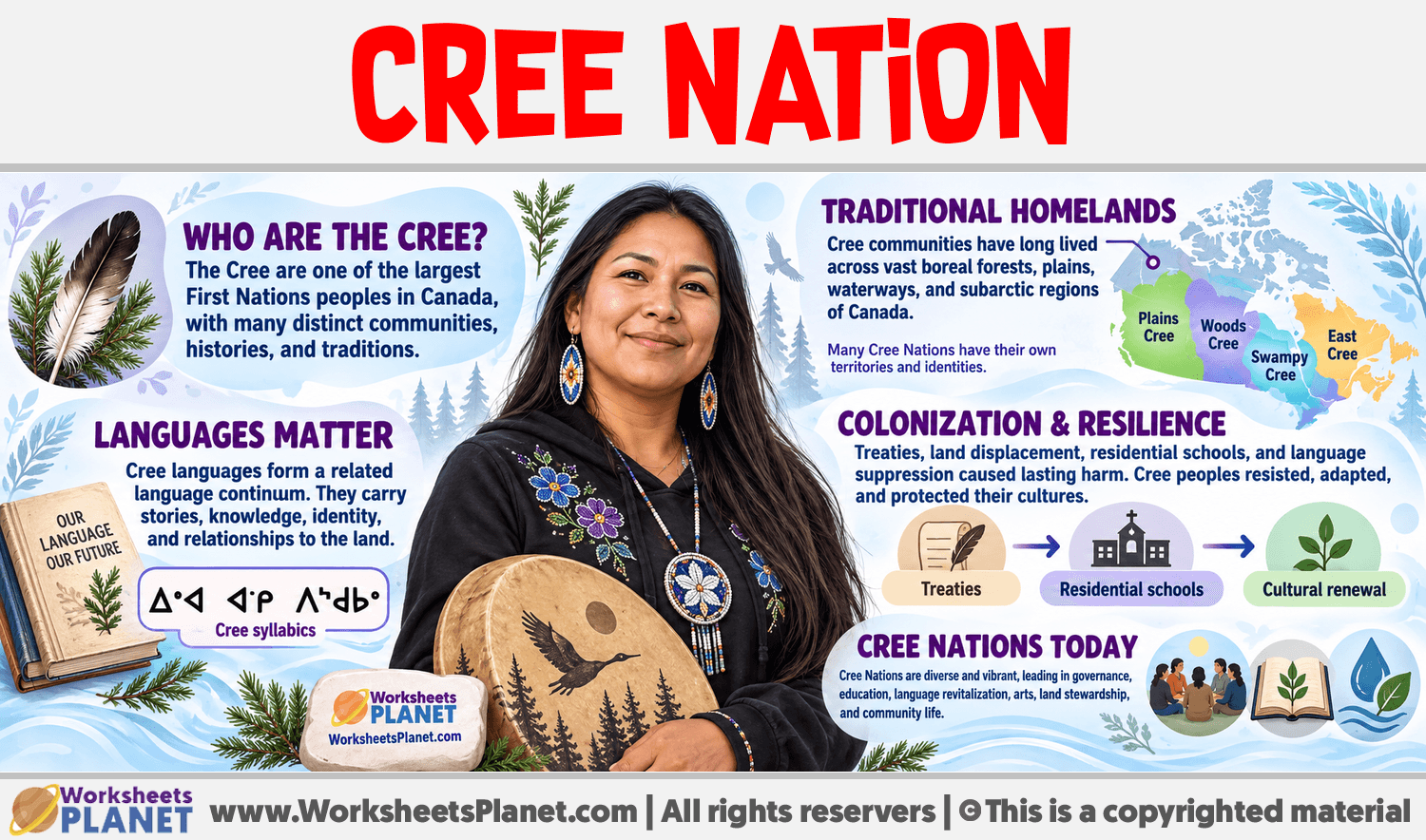
The Cree are an Indigenous people whose homelands stretch across a very large area, including parts of present-day Quebec, Ontario, Manitoba, Saskatchewan, Alberta, British Columbia, and the Northwest Territories. Some Cree people also live in the northern United States. Because the Cree Nation covers such a wide region, Cree communities are not all exactly the same. They have different local histories, environments, dialects, and ways of life.
The word “Cree” comes from a shortened French form of a longer Indigenous name used in early records. Many Cree people call themselves Nehiyawak, Eeyou, Ininiw, Ililiw, or other names depending on their language and region. These names often mean “the people.” This is important because it reminds us that Indigenous nations have their own names for themselves, not only the names used by outsiders.
- The Cree are among the largest First Nations groups in Canada.
- Cree communities include Plains Cree, Woods Cree, Swampy Cree, Moose Cree, and James Bay Cree, among others.
- Cree identity is connected to family, language, land, community, and culture.
Where have Cree communities traditionally lived?
Cree homelands include forests, plains, rivers, lakes, and coastal areas. The environment shaped how different Cree groups lived. For example, Cree communities in forested regions often depended on hunting, fishing, trapping, and gathering plants. Plains Cree communities had close connections with the buffalo and later became known for skilled horsemanship and trade across the prairies.
In eastern regions such as Eeyou Istchee, the James Bay Cree have long lived with the seasonal rhythms of the land. Families moved through hunting territories, following animal patterns and weather changes. In many Cree worldviews, land is not simply property. It is a living relationship involving responsibility, respect, and care.
Rivers and lakes were especially important. They served as travel routes, food sources, and meeting places. Canoes, snowshoes, sleds, and later horses helped Cree people move through different landscapes. These technologies show practical knowledge developed over many generations.
- Forests provided animals such as moose, caribou, beaver, and birds.
- Rivers and lakes supported fishing, travel, and trade.
- Prairie areas supported buffalo hunting and wide trade networks.
- Seasonal movement helped families use resources carefully throughout the year.
What are Cree languages and why do they matter?
Cree languages belong to the Algonquian language family. There are several Cree dialects, and pronunciation and spelling can differ by region. Some communities use syllabics, a writing system made of symbols that represent syllables. Cree syllabics are an important part of reading, teaching, and preserving language in many places.
Language is more than a way to communicate. It carries stories, laws, humor, place names, values, and knowledge about the natural world. For example, words connected to animals, snow, water, and family relationships can show how closely language is tied to daily life and the environment.
Like many Indigenous languages, Cree languages were harmed by colonial policies, including residential schools, where many children were punished for speaking their language. Today, many Cree families, schools, and cultural programs are working to strengthen language learning. Students may hear Cree spoken in classrooms, on radio stations, in community events, and in online lessons.
- Cree may be written using Roman letters or Cree syllabics.
- Different regions have different dialects and spellings.
- Language revitalization helps protect cultural knowledge for future generations.
How did colonization affect the Cree Nation?
European contact brought major changes to Cree communities. The fur trade created new economic relationships, and Cree traders often became important partners because of their knowledge of land routes and local networks. However, trade also brought pressures, including competition, disease, and changes in animal populations.
Colonization deeply disrupted Cree life. Treaties were signed between Cree leaders and the Crown in many regions, but Indigenous and government understandings of these agreements were often very different. Many Cree leaders viewed treaties as agreements to share land and protect ways of life. Governments often treated them as land surrender documents. This difference remains important in legal and political discussions today.
Residential schools caused serious harm by separating children from families, languages, and cultures. These schools are part of a painful history that affected many Indigenous nations, including Cree communities. At the same time, Cree people have shown resilience by maintaining ceremonies, rebuilding language programs, defending land rights, and teaching younger generations.
- Colonization affected land use, governance, education, and family life.
- Treaties remain important legal and historical agreements.
- Residential schools caused lasting harm, but Cree communities continue to heal and rebuild.
- Cree leaders have played major roles in defending Indigenous rights.
What is the Cree Nation like today?
Today, the Cree Nation is modern, diverse, and active in many areas of life. Cree people are teachers, artists, hunters, lawyers, health workers, leaders, athletes, language keepers, scientists, and students. Many live in First Nations communities, while others live in towns and cities. Being Cree today can include both traditional knowledge and contemporary life.
Cree governments and organizations work on education, health, housing, economic development, child welfare, environmental protection, and language revitalization. In northern Quebec, for example, the Cree Nation Government represents the James Bay Cree and plays an important role in regional decision-making. In other provinces, Cree First Nations have their own councils, treaty organizations, and community governments.
Cree culture is also widely expressed through music, beadwork, storytelling, dance, literature, ceremonies, and land-based education. Land-based learning is especially important because it teaches practical skills and values at the same time. Students may learn how to set nets, prepare food, identify plants, travel safely, or listen to Elders. These lessons connect knowledge, responsibility, and identity.
A respectful way to learn about the Cree Nation is to remember that it is not only a subject from the past. Cree peoples are living nations with their own voices, rights, and futures. When studying the Cree Nation, students should pay attention to specific communities, use accurate names when possible, and listen to Cree authors, Elders, educators, and leaders.
- Cree communities continue to protect languages, lands, and traditions.
- Modern Cree life includes both cultural continuity and new opportunities.
- Learning from Cree voices helps students avoid stereotypes and understand real experiences.

Leave A Comment