
Inverse operations are pairs of mathematical actions that undo each other. They help students understand how numbers are connected, how equations work, and how to check whether an answer makes sense. When a child learns that addition and subtraction are opposites, or that multiplication and division reverse one another, they are learning one of the most useful ideas in arithmetic and early algebra. Understanding inverse operations builds confidence because it gives students a practical way to solve problems, find missing numbers, and explain their thinking clearly.
What are inverse operations?
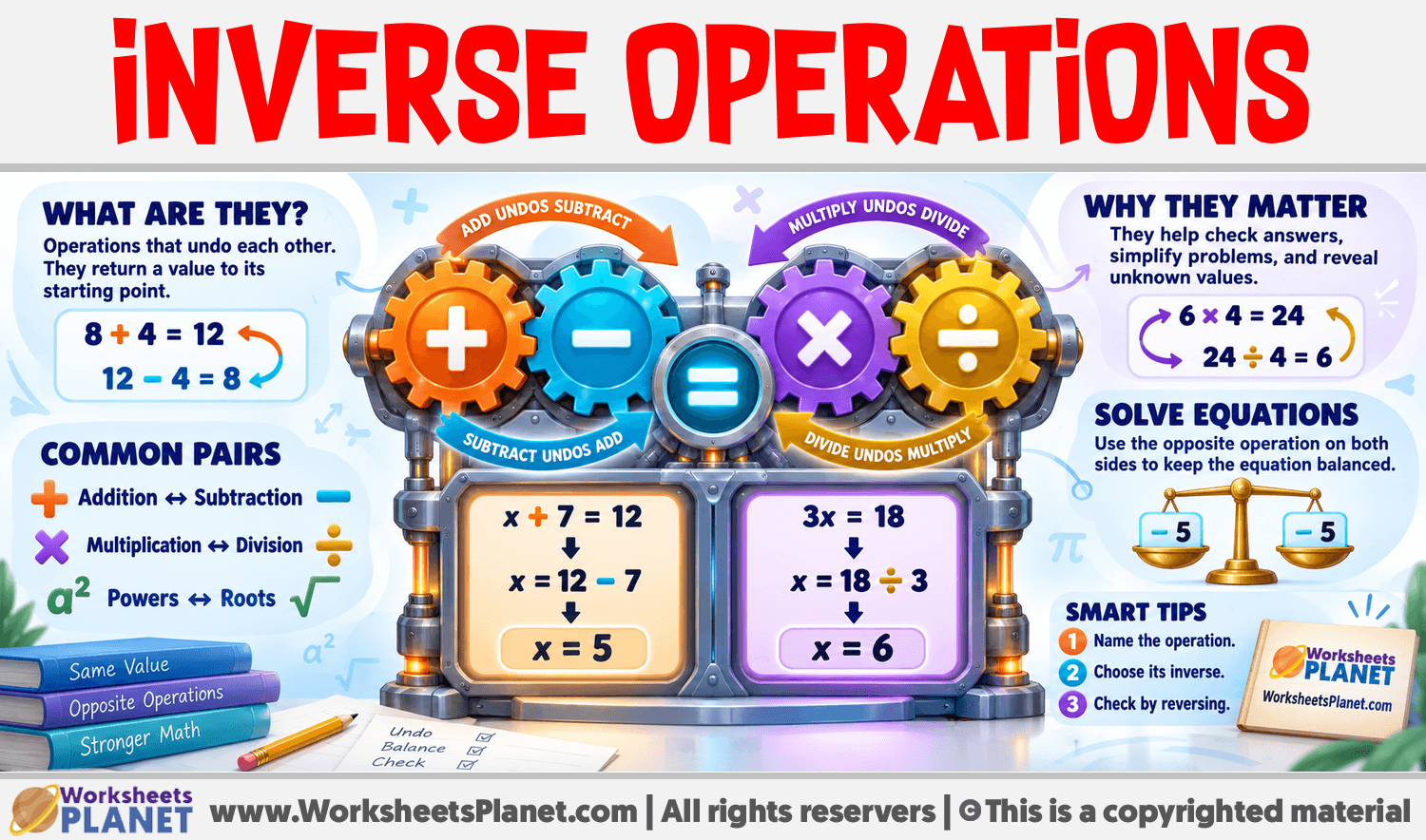
An inverse operation is an operation that reverses the effect of another operation. If one operation changes a number, its inverse brings the number back to where it started. For example, if you begin with 8 and add 5, you get 13. If you then subtract 5, you return to 8. This shows that addition and subtraction are inverse operations.
The same idea applies to multiplication and division. If you multiply 6 by 4, the result is 24. If you divide 24 by 4, you get back to 6. In this case, division undoes multiplication. These relationships are not just facts to memorize; they are tools students can use to reason through math problems.
- Addition is undone by subtraction: 9 + 3 = 12, so 12 – 3 = 9.
- Subtraction is undone by addition: 15 – 7 = 8, so 8 + 7 = 15.
- Multiplication is undone by division: 5 × 6 = 30, so 30 ÷ 6 = 5.
- Division is undone by multiplication: 42 ÷ 7 = 6, so 6 × 7 = 42.
Why are inverse operations important in math?
Inverse operations are important because they help students see mathematics as a system of relationships, not just a list of rules. When learners understand that operations can be reversed, they can solve problems more flexibly. This is especially helpful when working with missing numbers, word problems, and equations.
They also support mental math. For example, a student who knows that 38 + 27 = 65 can quickly understand that 65 – 27 = 38. This saves time and encourages number sense. Instead of calculating every problem from the beginning, students can use what they already know to find related answers.
Another important use is checking work. If a student solves 144 ÷ 12 = 12, they can check by multiplying 12 × 12. Since the answer is 144, the division is correct. This habit teaches students to become independent problem solvers rather than simply relying on an adult or answer key.
How do inverse operations help solve equations?
Inverse operations are one of the first steps toward algebra. In an equation, the goal is often to find the value of an unknown number. To do this, students must keep the equation balanced while using an inverse operation to isolate the unknown.
For example, in the equation x + 9 = 20, the number 9 is being added to x. To undo the addition, subtract 9 from both sides: x + 9 – 9 = 20 – 9. This leaves x = 11. The key idea is that whatever is done to one side of an equation must be done to the other side.
The same process works with multiplication and division. In 4x = 28, x is being multiplied by 4. To undo this, divide both sides by 4. The result is x = 7. Students who understand this process are better prepared for more advanced algebra because they understand the purpose behind each step.
- Identify what operation is being used with the unknown number.
- Choose the inverse operation to undo it.
- Apply the same operation to both sides of the equation.
- Simplify and check the answer by substituting it back into the original equation.
Common examples students should know
Students usually meet inverse operations first with basic facts. These examples are powerful because they show how one fact can create several related facts. A fact family is a group of number sentences using the same numbers. For example, the numbers 4, 6, and 10 can form 4 + 6 = 10, 6 + 4 = 10, 10 – 4 = 6, and 10 – 6 = 4.
Multiplication and division fact families work in a similar way. With 3, 8, and 24, students can write 3 × 8 = 24, 8 × 3 = 24, 24 ÷ 3 = 8, and 24 ÷ 8 = 3. These examples help learners understand that operations are connected. They also make it easier to remember division facts by using known multiplication facts.
Inverse operations also appear in real-life situations. If someone spends $12 from $50, adding $12 back returns the total to $50. If a recipe is doubled by multiplying each ingredient by 2, returning to the original recipe means dividing by 2. These everyday connections make the idea more meaningful.
- A number line can show adding 5 as moving forward and subtracting 5 as moving backward.
- Arrays can show that multiplication groups objects, while division separates them into equal groups.
- Balance scales can show why both sides of an equation must stay equal.
- Fact families help students connect related addition, subtraction, multiplication, and division facts.
Tips for teaching and learning inverse operations
The best way to teach inverse operations is to connect them to actions students can see and describe. Young learners benefit from using counters, cubes, drawings, number lines, and real situations before moving to abstract symbols. For example, a teacher might show 7 counters, add 4 more, and then remove the same 4 to demonstrate how the starting amount returns.
Language matters too. Phrases such as undo, reverse, opposite operation, and bring it back help students build meaning. However, it is also important to explain that inverse operations are not just opposites in a casual sense; they are operations that return a value to its previous state when used correctly.
Students should also practice checking their answers with inverse operations. After solving a subtraction problem, they can use addition to check. After solving a division problem, they can use multiplication. This reinforces accuracy and helps students notice mistakes. Over time, inverse operations become a dependable strategy for problem solving in arithmetic, algebra, and everyday math.
- Use small numbers first so students can focus on the relationship between operations.
- Ask students to explain how they know one operation undoes another.
- Encourage checking answers with the inverse operation, not just recalculating the same way.
- Connect examples to money, measuring, sharing, recipes, and classroom materials.

Leave A Comment