
Fact families are groups of related math facts that use the same numbers. They help students see how addition and subtraction are connected, and later how multiplication and division work together. Instead of memorizing each number sentence separately, children learn that numbers have relationships. This makes mental math easier, builds number sense, and supports problem-solving in everyday situations. For example, if a student knows that 4 + 5 = 9, they can also understand that 9 – 5 = 4 and 9 – 4 = 5. A fact family turns one idea into several connected facts.
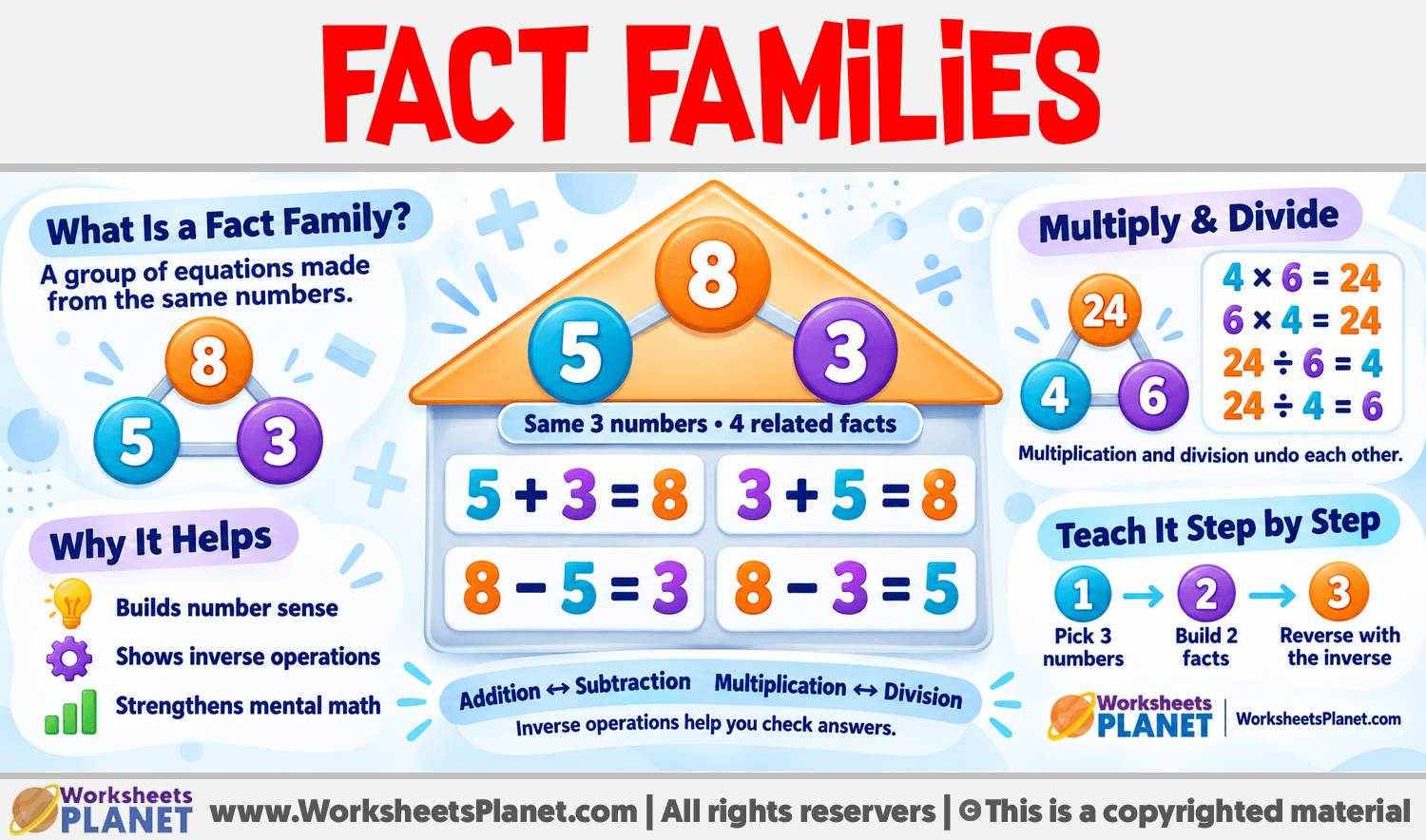
What Is a Fact Family in Math?
A fact family is a set of number sentences made from the same three numbers. These number sentences show how the numbers are related. In early elementary math, fact families usually focus on addition and subtraction. Later, students learn multiplication and division fact families.
For an addition and subtraction fact family, the largest number is usually the whole, and the two smaller numbers are the parts. For example, in the fact family with 3, 6, and 9, the number 9 is the whole because 3 and 6 combine to make it.
A complete addition and subtraction fact family often has four facts: two addition facts and two subtraction facts. However, if both smaller numbers are the same, such as 5, 5, and 10, there may be fewer unique facts because some number sentences repeat.
- 3 + 6 = 9
- 6 + 3 = 9
- 9 – 3 = 6
- 9 – 6 = 3
Why Fact Families Help Students Understand Numbers
Fact families are useful because they show that math facts are not isolated. Students begin to notice that if they know one fact, they can use it to find another. This supports flexible thinking and reduces the pressure to memorize without understanding.
They also help children understand the meaning of the equal sign. In a fact family, the equal sign shows that both sides of the number sentence have the same value. This is important because some students think the equal sign only means “the answer comes next.” Fact families give them repeated practice seeing equality in different ways.
Another important benefit is that fact families prepare students for missing-number problems. If a child sees 7 + __ = 12, they can think about the related subtraction fact: 12 – 7 = 5. This makes fact families a bridge between basic arithmetic and early algebraic thinking.
- They build number sense by showing relationships between numbers.
- They support mental math because students can use known facts to solve unknown facts.
- They strengthen understanding of inverse operations, such as addition and subtraction.
- They help students solve missing-addend and word problems more confidently.
Addition and Subtraction Fact Families
The most common fact families in the primary grades involve addition and subtraction. These fact families use three numbers: two parts and one total. The addition facts put the parts together, while the subtraction facts take one part away from the total.
For example, consider the numbers 8, 2, and 10. Students can see that 8 and 2 combine to make 10. Then they can reverse the thinking: if 10 is the total and 8 is removed, 2 remains. If 10 is the total and 2 is removed, 8 remains.
This relationship helps students understand that subtraction is not just “taking away.” It can also mean finding the missing part. This is especially helpful in word problems such as, “There are 10 apples. Some are red and 2 are green. How many are red?” A student who understands the fact family can use 10 – 2 = 8.
- 8 + 2 = 10
- 2 + 8 = 10
- 10 – 8 = 2
- 10 – 2 = 8
Multiplication and Division Fact Families
As students move into multiplication and division, fact families continue to be helpful. A multiplication and division fact family also uses three numbers. The two smaller numbers are factors, and the largest number is the product. Division facts then show how the product can be split into equal groups.
For example, the numbers 4, 7, and 28 make a multiplication and division fact family. If students know that 4 × 7 = 28, they can use that knowledge to understand that 28 ÷ 7 = 4 and 28 ÷ 4 = 7. This makes division feel less like a brand-new skill and more like the inverse of multiplication.
These fact families are especially useful when students learn times tables. Instead of learning multiplication facts and division facts separately, children can connect them. A strong understanding of multiplication facts makes division faster and more meaningful.
- 4 × 7 = 28
- 7 × 4 = 28
- 28 ÷ 4 = 7
- 28 ÷ 7 = 4
How to Teach Fact Families Step by Step
Fact families are easiest to learn when students can see and touch the numbers. Counters, blocks, ten-frames, number bonds, and drawings all help children understand that the same numbers can be arranged in different ways. A number bond is especially useful because it clearly shows the whole and the parts.
Teachers and parents can begin with simple numbers and ask students to build the total. For example, give a child 5 red counters and 3 blue counters. Ask how many there are altogether. Then cover one group and ask how many are hidden. This turns fact families into a concrete experience before students write equations.
It is also helpful to encourage students to explain their thinking aloud. Instead of only writing 5 + 3 = 8, they might say, “Five and three make eight, so eight minus five leaves three.” This language strengthens understanding and helps students connect the facts.
- Choose three related numbers, such as 5, 3, and 8.
- Identify the whole and the two parts.
- Write the two addition facts or multiplication facts.
- Write the two related subtraction facts or division facts.
- Check that every number sentence uses the same three numbers.
Common Mistakes and Simple Practice Ideas
One common mistake is choosing three numbers that do not belong in the same fact family. For example, 4, 6, and 12 do not make an addition and subtraction fact family because 4 + 6 does not equal 12. However, they also do not make a multiplication and division fact family because 4 × 6 does not equal 12. Students need practice checking whether the numbers truly work together.
Another mistake is forgetting that the largest number usually comes first in subtraction and division facts. In the fact family 3, 4, and 7, students should write 7 – 3 = 4 and 7 – 4 = 3, not 3 – 7 = 4. With multiplication and division, the product is divided by one factor to find the other factor.
Practice does not need to be complicated. Students can sort number cards into fact families, complete missing equations, or use dominoes to create addition and subtraction facts. For multiplication, arrays are very effective because they show equal groups clearly. With regular practice, fact families become a powerful tool for understanding how math facts connect.
- Use dominoes to form two addition facts and two subtraction facts.
- Give students three numbers and ask, “Do these make a fact family? How do you know?”
- Create number bonds and write the related equations.
- Use arrays to connect multiplication and division facts.

Leave A Comment