
Subtraction is more than “taking away.” In the classroom and at home, children use subtraction to find a difference, compare quantities, count back, or discover a missing part. Learning several subtraction strategies helps students choose a method that makes sense for the numbers in front of them. Instead of memorizing one rigid procedure, students build number sense, improve accuracy, and gain confidence when solving problems mentally, with drawings, or on paper.
What are subtraction strategies?
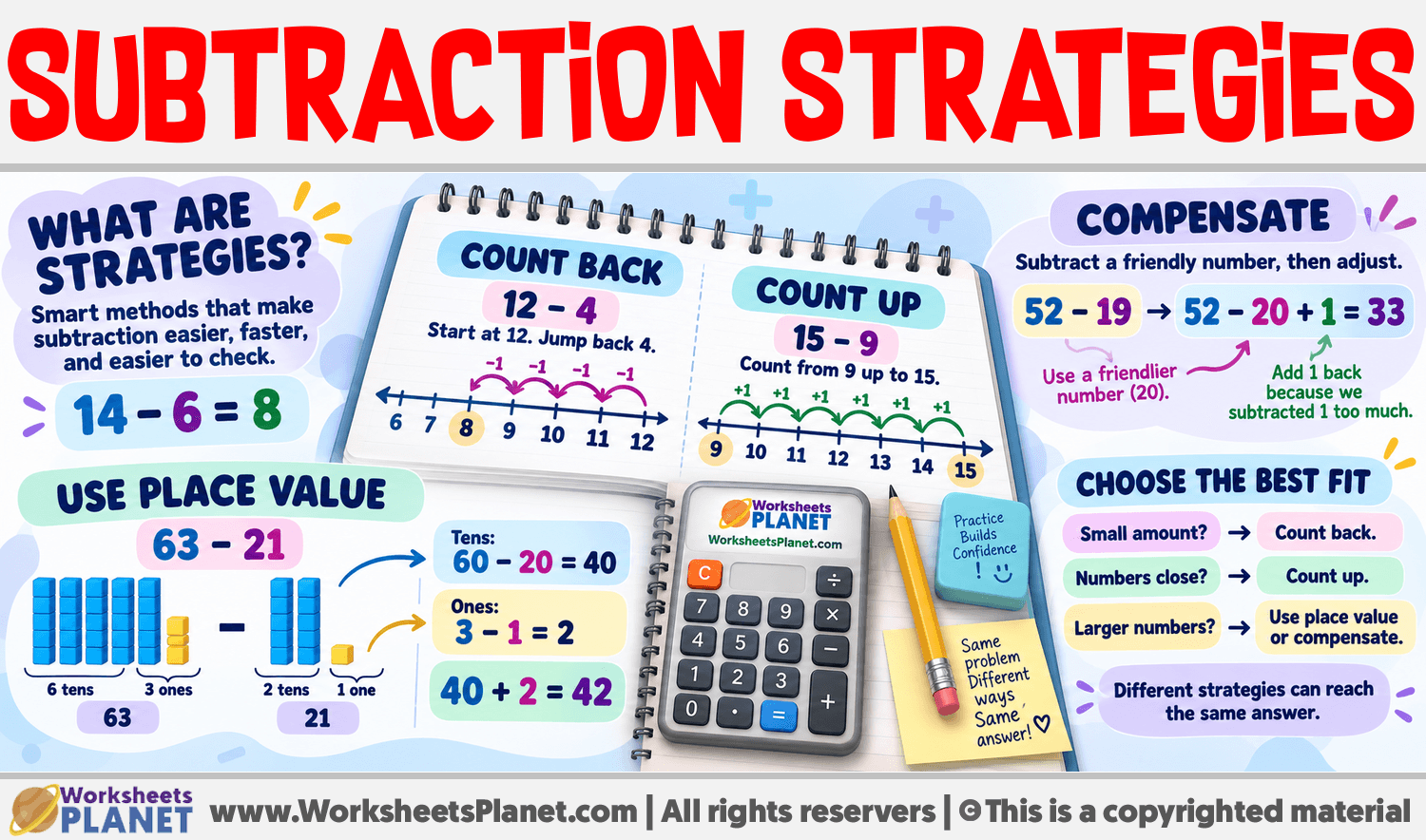
Subtraction strategies are different ways to solve subtraction problems. They give students flexible tools for thinking about numbers. For example, 52 − 29 can be solved by counting up from 29 to 52, subtracting 30 and adding 1 back, or using the standard written algorithm. Each method reaches the same answer, but each method highlights a different mathematical idea.
Good subtraction instruction helps students understand what is happening, not just what steps to follow. When children know that subtraction can mean taking away, finding the difference, or finding a missing addend, they can match the strategy to the problem. This is especially helpful when word problems use phrases such as “how many more,” “how many are left,” or “how many fewer.”
- Taking away: 15 apples, 6 are eaten. How many are left?
- Comparing: Mia has 15 stickers and Leo has 6. How many more does Mia have?
- Missing part: A box holds 15 crayons. There are 6 inside. How many are missing?
Counting back and counting up
Counting back is often one of the first subtraction strategies children learn. To solve 12 − 3, a student may start at 12 and count back: 11, 10, 9. This works well for small numbers, especially when subtracting 1, 2, 3, or 4. It also connects strongly to number lines and finger counting in early grades.
Counting up is a powerful related strategy. Instead of counting backward from the larger number, students count forward from the smaller number to the larger number. For 52 − 48, it is much easier to think, “48 to 50 is 2, and 50 to 52 is 2, so the difference is 4.” Counting up is especially useful for problems where the numbers are close together.
Teachers and parents can support these strategies with open number lines. Students draw jumps and label them, which makes their thinking visible. This helps children move from concrete counting to more efficient mental math.
- Use counting back when the number being subtracted is small, such as 18 − 2.
- Use counting up when the numbers are close, such as 71 − 68.
- Ask students to explain each jump on the number line to strengthen reasoning.
Using place value to subtract larger numbers
Place value is one of the most important foundations for subtraction. Students need to understand that a two-digit number is made of tens and ones, and a three-digit number is made of hundreds, tens, and ones. Without this understanding, subtraction can become a set of confusing steps.
A place value strategy breaks numbers apart by their value. For example, 76 − 34 can be thought of as 70 − 30 = 40 and 6 − 4 = 2, so the answer is 42. This works smoothly when no regrouping is needed. When regrouping is needed, students can still use place value, but they must understand how one ten can be exchanged for ten ones.
Consider 82 − 47. A student might subtract 40 first: 82 − 40 = 42. Then subtract 7: 42 − 7 = 35. This method keeps the number whole and often feels more natural than splitting both numbers apart at once. It also prepares students for mental math and supports the written algorithm later.
- Break numbers into tens and ones to see their structure.
- Subtract in parts, such as tens first and then ones.
- Use base-ten blocks or drawings when students need a visual model for regrouping.
Compensation and making friendly numbers
Compensation is a flexible subtraction strategy that changes a number slightly to make the problem easier, then adjusts the answer. It is based on the idea that numbers close to 10, 100, or 1,000 are often easier to work with. These are sometimes called friendly numbers.
For example, 63 − 29 can feel tricky. A student can subtract 30 instead: 63 − 30 = 33. Since 30 is 1 more than 29, the student subtracted 1 too many, so they add 1 back. The answer is 34. This strategy helps students calculate efficiently without needing to write every step vertically.
Compensation also works when adjusting the starting number. For 198 − 56, a student might think of 200 − 56 = 144, then adjust because 198 is 2 less than 200. The answer is 142. This kind of reasoning shows strong number sense because the student is not just following a rule; they are controlling the numbers.
- Use compensation when a number is close to a multiple of 10 or 100.
- After changing a number, always ask: “Did I subtract too much or too little?”
- Encourage students to say the adjustment aloud so they do not lose track of it.
Choosing the best strategy for the problem
There is no single best subtraction strategy for every problem. The best method depends on the numbers, the student’s understanding, and the situation. A worksheet may invite written practice, while a real-life problem at a store may call for quick mental math. Students become stronger mathematicians when they can compare strategies and choose one that is efficient and accurate.
For 90 − 45, counting up may be simple: 45 to 50 is 5, and 50 to 90 is 40, so the difference is 45. For 407 − 198, compensation may be easier: 407 − 200 = 207, then add 2 back to get 209. For 648 − 315, place value subtraction works well because hundreds, tens, and ones can be subtracted clearly.
A helpful classroom habit is asking, “Why did you choose that strategy?” This question encourages students to think mathematically rather than guess. It also allows teachers to spot misconceptions, such as confusing when to add back after compensation or counting one extra number on a number line.
- If the numbers are close, try counting up.
- If one number is near 10, 100, or 1,000, try compensation.
- If the numbers separate neatly into hundreds, tens, and ones, try a place value strategy.
- If accuracy is most important and numbers are large, use the standard algorithm with understanding.

Leave A Comment