
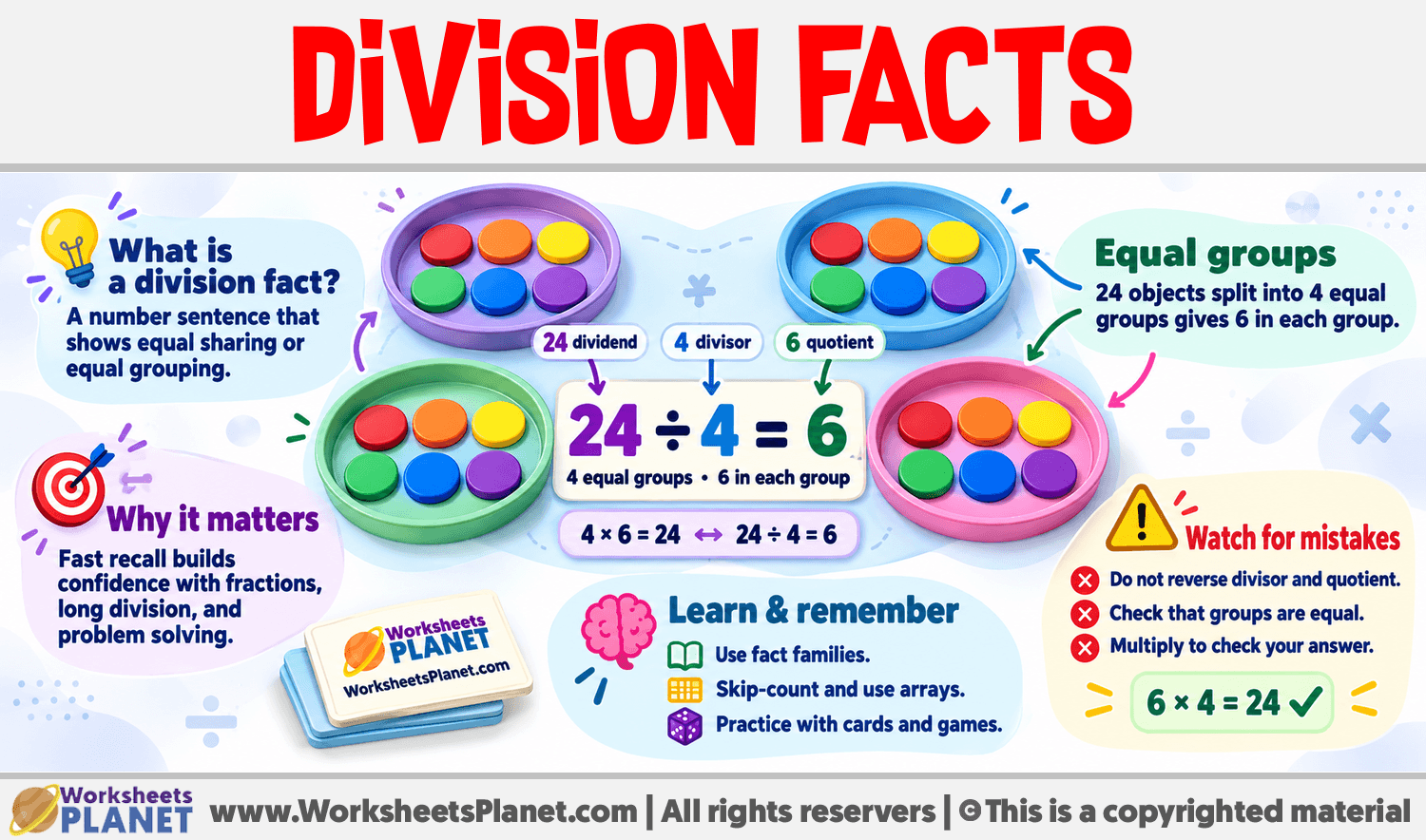
Division facts are the basic division equations students learn so they can divide numbers quickly and accurately. Just as multiplication facts help children know that 6 × 4 = 24, division facts help them know that 24 ÷ 4 = 6 and 24 ÷ 6 = 4. These facts are usually connected to the multiplication tables from 1 to 12, making them an important bridge between repeated addition, equal groups, fractions, and later math skills. When students understand division facts, they do more than memorize answers; they learn how numbers are related, how to share quantities equally, and how to check their work using multiplication.
What are division facts?
A division fact is a division sentence that uses whole numbers and gives an exact answer with no remainder. For example, 18 ÷ 3 = 6 is a division fact because 18 can be split into 3 equal groups of 6. Another related fact is 18 ÷ 6 = 3. Both facts come from the same multiplication relationship: 3 × 6 = 18.
Division facts are often taught as part of a fact family. A fact family is a group of related multiplication and division facts that use the same three numbers. For the numbers 5, 7, and 35, the fact family includes 5 × 7 = 35, 7 × 5 = 35, 35 ÷ 5 = 7, and 35 ÷ 7 = 5. Seeing these connections helps students understand that division is the inverse operation of multiplication.
- 12 ÷ 3 = 4 is a division fact because 3 × 4 = 12.
- 40 ÷ 8 = 5 is a division fact because 8 × 5 = 40.
- 63 ÷ 9 = 7 is a division fact because 9 × 7 = 63.
Why division facts matter in elementary math
Learning division facts gives students a stronger number sense. Instead of counting one by one or drawing every problem, students can recognize number patterns and solve problems efficiently. This confidence is especially helpful when they begin multi-digit division, fractions, measurement problems, and word problems.
Division facts also support mental math. A student who knows that 56 ÷ 7 = 8 can quickly solve questions such as “If 56 pencils are shared equally among 7 students, how many pencils does each student get?” The fact becomes useful in a real situation, not just as an isolated equation.
Strong division fact knowledge can reduce frustration. When children do not know basic facts, more complex division problems become harder because too much attention is spent on simple calculations. Knowing facts automatically frees up working memory so students can focus on problem-solving steps, place value, and reasoning.
- They help students solve word problems faster.
- They prepare students for long division and fractions.
- They strengthen the connection between multiplication and division.
- They build accuracy in everyday math situations, such as sharing, grouping, and comparing quantities.
How division facts connect to equal groups and sharing
Division has two common meanings: sharing equally and making equal groups. In sharing problems, the total is divided among a certain number of people or groups. For example, 24 cookies shared equally among 6 children means 24 ÷ 6 = 4. Each child gets 4 cookies.
In grouping problems, students know the size of each group and find how many groups can be made. For example, if 24 cookies are placed into bags with 4 cookies in each bag, the problem is 24 ÷ 4 = 6. There will be 6 bags. Both problems use the same total, but they ask different questions.
Understanding these meanings helps students avoid treating division as only a memorized rule. They learn that the dividend is the total amount, the divisor tells how the total is being divided, and the quotient is the answer. In 24 ÷ 6 = 4, 24 is the dividend, 6 is the divisor, and 4 is the quotient.
- Sharing example: 30 stickers shared by 5 students means 30 ÷ 5 = 6 stickers each.
- Grouping example: 30 stickers placed in groups of 5 means 30 ÷ 5 = 6 groups.
- Related multiplication check: 6 × 5 = 30, so the division fact is correct.
Practical ways to learn and remember division facts
Students usually learn division facts best when they connect them to multiplication instead of memorizing them separately. If a child knows 8 × 6 = 48, then 48 ÷ 8 = 6 and 48 ÷ 6 = 8 become easier to remember. This strategy turns one multiplication fact into two useful division facts.
Visual models can also make division facts clearer. Arrays, number lines, counters, and equal-group drawings show what division means. For example, an array with 4 rows of 7 dots shows 4 × 7 = 28, but it also shows 28 ÷ 4 = 7 and 28 ÷ 7 = 4. These models are especially helpful for students who need to see the relationship before they can recall it mentally.
Short, regular practice is more effective than long memorization sessions. Five to ten minutes of focused practice can help students build fluency without feeling overwhelmed. Teachers and parents can mix oral questions, flashcards, games, and real-life examples to keep practice meaningful.
- Use fact families to connect multiplication and division.
- Practice with arrays, counters, or drawings before moving to mental recall.
- Start with easier facts such as ÷1, ÷2, ÷5, and ÷10, then build toward harder facts.
- Ask students to explain how they know an answer, not only say the answer.
- Review missed facts often, but in small sets.
Common mistakes students make with division facts
One common mistake is reversing the numbers incorrectly. For example, a student may know that 6 × 4 = 24 but write 6 ÷ 24 = 4. It helps to remind students that the largest number usually comes first in basic division facts because it is the total being divided.
Another difficulty is confusing multiplication and division symbols. Young learners may see 36 ÷ 6 and think of 36 × 6 if they are rushing. Careful reading of the symbol is important, especially in mixed practice where addition, subtraction, multiplication, and division problems appear together.
Some students rely on skip counting for every division fact. Skip counting is a useful strategy, but it can become slow for larger facts. The goal is to move gradually from counting to recognizing known relationships. For example, instead of counting by 9s to solve 72 ÷ 9, students can remember the related fact 9 × 8 = 72.
It is also important to discuss remainders at the right time. Basic division facts usually have no remainder, but students will later meet problems such as 25 ÷ 4. Knowing exact division facts first gives them a strong foundation for understanding why some numbers divide evenly and others do not.
- Check division facts by multiplying the quotient and divisor.
- Look for the total, or dividend, before solving.
- Use known multiplication facts to avoid guessing.
- Practice similar facts together, such as 42 ÷ 6 and 42 ÷ 7.

Leave A Comment