
Number properties are rules that help us understand how numbers behave when we add, subtract, multiply, divide, compare, or group them. In mathematics, these properties are useful because they make calculations easier and help students explain why an answer makes sense. Instead of memorizing every possible problem, learners can use number properties to see patterns, choose efficient strategies, and build confidence with arithmetic, algebra, and problem solving.
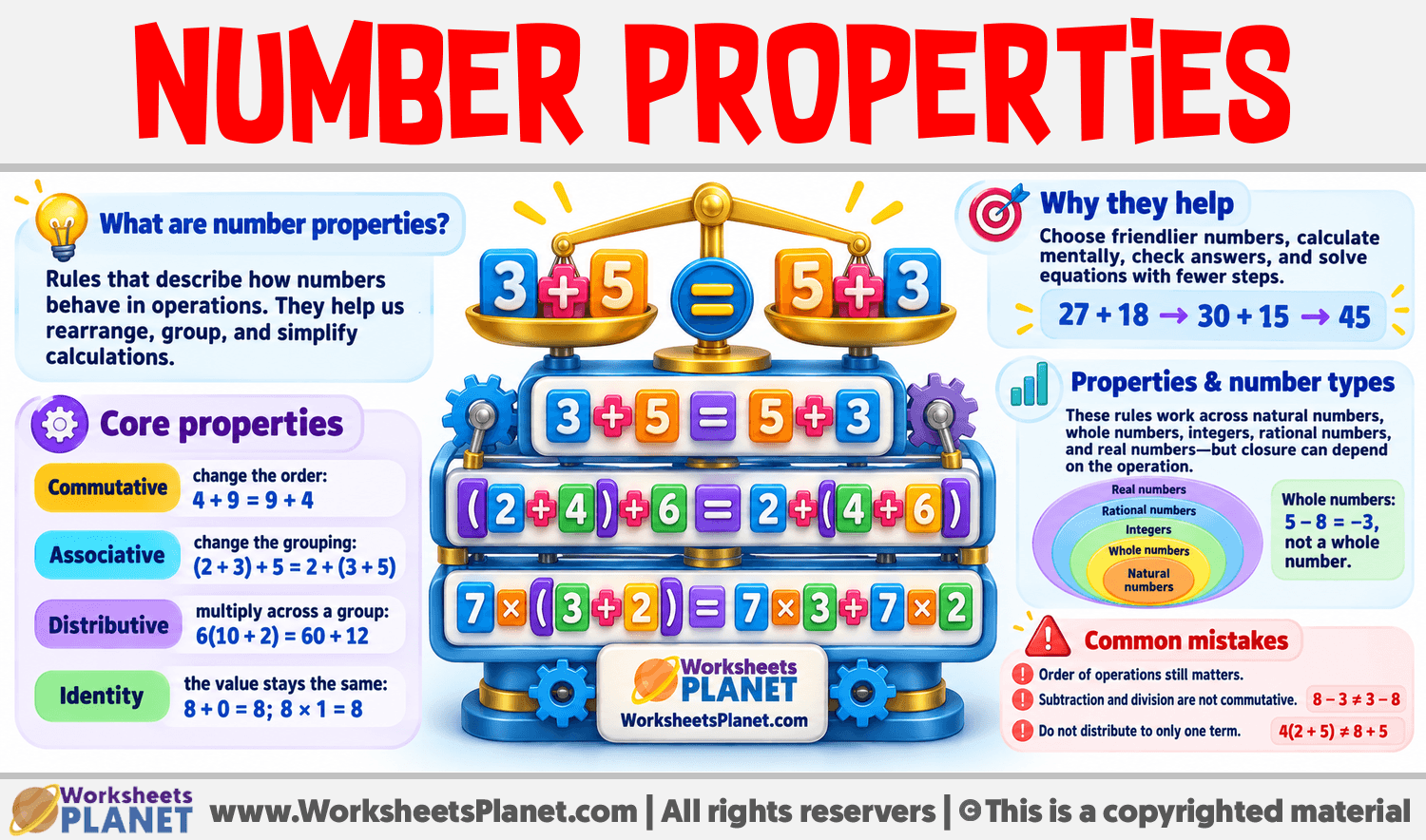
What are number properties?
Number properties are facts or rules that are true for whole groups of numbers. For example, when you add two numbers, you can sometimes change their order without changing the sum. That idea is a property. These rules are not shortcuts without meaning; they describe how numbers work.
Students often meet number properties first through simple arithmetic, such as 3 + 5 = 5 + 3. Later, the same ideas appear in algebra, such as a + b = b + a. This connection is important because properties of numbers help students move from concrete examples to more abstract thinking.
A strong understanding of number properties also supports mental math. If a child sees 25 × 8, they may think of 25 × 4 × 2, or 100 × 2, which equals 200. That flexible thinking comes from understanding how numbers can be grouped and rearranged.
Common number properties students should know
Several number properties are especially important in elementary and middle school mathematics. Each one explains a different way numbers can be used in operations. These properties are most often connected to addition and multiplication, although students should also learn that subtraction and division do not always follow the same rules.
- Commutative property: The order of numbers can change in addition or multiplication. For example, 7 + 2 = 2 + 7 and 4 × 6 = 6 × 4.
- Associative property: The grouping of numbers can change in addition or multiplication. For example, (3 + 4) + 6 = 3 + (4 + 6).
- Distributive property: A number outside parentheses can be multiplied by each number inside. For example, 5 × (10 + 2) = (5 × 10) + (5 × 2).
- Identity property: Adding 0 keeps a number the same, and multiplying by 1 keeps a number the same. For example, 9 + 0 = 9 and 12 × 1 = 12.
- Zero property of multiplication: Any number multiplied by 0 equals 0. For example, 45 × 0 = 0.
How number properties make calculations easier
Number properties are not just vocabulary words. They help students solve problems in faster and clearer ways. For example, the commutative property allows a student to rewrite 2 + 19 as 19 + 2, which may feel easier to count or calculate. The associative property helps students group friendly numbers, such as turning 6 + 8 + 4 into 6 + 4 + 8, then 10 + 8 = 18.
The distributive property is especially powerful because it breaks difficult multiplication into simpler parts. A student solving 7 × 14 can think of 14 as 10 + 4. Then 7 × 14 becomes 7 × (10 + 4), or 70 + 28, which equals 98. This method also prepares students for algebra, where expressions like 3(x + 5) must be expanded correctly.
Teachers and parents can encourage students to explain which property they used. Saying “I made a ten” or “I broke 14 into 10 and 4” shows real mathematical thinking. The goal is not only to get the correct answer, but to understand the reasoning behind the calculation.
Number properties and types of numbers
Number properties are closely connected to different types of numbers. Students usually begin with natural numbers, such as 1, 2, 3, and 4. Then they learn about whole numbers, which include 0, and later integers, fractions, decimals, rational numbers, and irrational numbers. Each group of numbers has features that help us classify and compare them.
For example, even and odd numbers are properties related to divisibility by 2. An even number can be divided into two equal whole-number groups, such as 12 ÷ 2 = 6. An odd number cannot be divided into two equal whole-number groups without a remainder, such as 13 ÷ 2. Understanding even and odd helps with patterns, multiplication, and divisibility tests.
Prime and composite numbers are another important area. A prime number has exactly two factors: 1 and itself. Examples include 2, 3, 5, 7, and 11. A composite number has more than two factors, such as 12, because it can be divided evenly by 1, 2, 3, 4, 6, and 12. These ideas become useful when students work with factors, multiples, fractions, and simplifying ratios.
- Natural numbers: Counting numbers such as 1, 2, 3, 4, and so on.
- Whole numbers: Natural numbers plus 0.
- Integers: Whole numbers and their opposites, such as -3, -2, -1, 0, 1, 2, 3.
- Rational numbers: Numbers that can be written as fractions, including many decimals.
- Irrational numbers: Numbers that cannot be written as simple fractions, such as π and √2.
Common mistakes when learning number properties
One common mistake is applying a property to the wrong operation. Addition and multiplication are commutative, but subtraction and division are not. For example, 10 – 4 is not the same as 4 – 10, and 12 ÷ 3 is not the same as 3 ÷ 12. This is why students should test properties with examples before assuming they always work.
Another mistake is confusing the identity property with the zero property. In addition, 0 is the identity because it does not change the number: 8 + 0 = 8. In multiplication, 1 is the identity because 8 × 1 = 8. But multiplying by 0 changes the number to 0, so it follows a different rule.
Students may also memorize property names without understanding them. To avoid this, it helps to connect each property to a visual model or real-life example. Arrays can show the commutative property of multiplication, number lines can show addition, and area models can show the distributive property. These models make abstract rules more concrete.
Practical ways to teach and practice number properties
Number properties are best learned through repeated use, not through definitions alone. Students need chances to notice patterns, discuss strategies, and compare different ways of solving the same problem. A worksheet might ask students to identify a property, complete an equation, or explain why two expressions are equal.
For younger students, simple number sentences are useful: 5 + 0 = 5, 6 + 3 = 3 + 6, or 4 × 0 = 0. Older students can work with larger numbers, fractions, decimals, and variables. For example, they might use the distributive property to solve 9 × 27 by writing it as 9 × (20 + 7).
A helpful classroom habit is asking, “What property did you use?” or “Can you solve it another way?” These questions encourage students to become flexible thinkers. When learners understand number properties, they do more than calculate; they begin to see mathematics as a system of connected ideas.
- Use color coding to show changed order, changed grouping, or distributed multiplication.
- Ask students to write their own examples and non-examples of each property.
- Connect properties to mental math strategies, such as making tens or breaking numbers apart.
- Use arrays, counters, and area models to show why the properties work.
- Review subtraction and division separately so students understand their special rules.

Leave A Comment