
Jupiter is the largest planet in our Solar System and one of the easiest planets to recognize because of its colorful bands and giant storm called the Great Red Spot. Learning Jupiter facts for kids helps students understand how planets can be very different from Earth. Jupiter is not a rocky planet we could stand on. It is a gas giant, made mostly of hydrogen and helium, the same main gases found in the Sun. This huge planet has many moons, powerful winds, and an important role in shaping the Solar System.
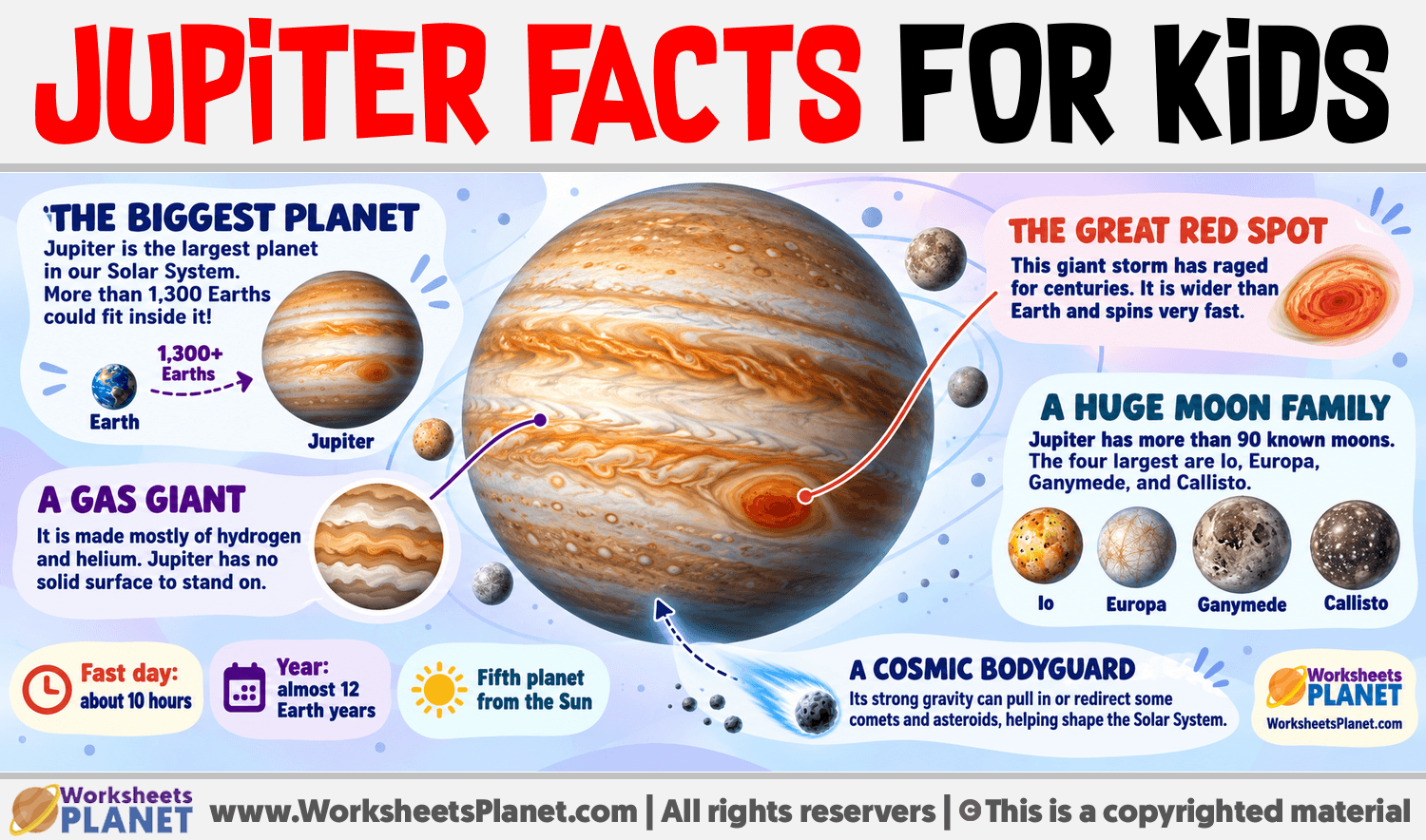
What is Jupiter like?
Jupiter is the fifth planet from the Sun. It comes after Mercury, Venus, Earth, and Mars. Even though it is far away, Jupiter is so large and bright that people can sometimes see it in the night sky without a telescope. Ancient astronomers knew about Jupiter long before modern space science existed.
Jupiter is enormous compared with Earth. More than 1,300 Earths could fit inside it by volume. However, Jupiter does not have a solid surface like our planet. If a spacecraft tried to travel down through Jupiter’s clouds, it would move through thicker and thicker layers of gas and liquid until the pressure became extreme.
- Jupiter is the largest planet in the Solar System.
- It is about 778 million kilometers from the Sun on average.
- A day on Jupiter lasts only about 10 hours.
- A year on Jupiter lasts almost 12 Earth years.
- Jupiter is made mostly of hydrogen and helium.
Why is Jupiter called a gas giant?
Jupiter is called a gas giant because it is mostly made of gases instead of rock. The outer layers are thick clouds and gas, but deeper inside, the gas is squeezed by strong pressure. Scientists think some of Jupiter’s hydrogen may behave like a strange liquid metal deep inside the planet.
This is very different from Earth. Earth has a solid crust, oceans, mountains, and land. Jupiter has no solid ground where people could walk, build houses, or plant trees. Its atmosphere is also not safe for humans because it has no breathable oxygen and has violent storms, extreme cold in the upper clouds, and crushing pressure deeper down.
Jupiter’s fast rotation helps create its striped appearance. The planet spins more quickly than any other planet, even though it is so large. This rapid spinning stretches clouds into long bands that wrap around the planet.
- The light-colored bands are called zones.
- The darker bands are called belts.
- The bands are made from moving clouds and winds.
- Some winds on Jupiter can reach hundreds of kilometers per hour.
What is the Great Red Spot?
One of the most famous Jupiter facts for kids is that the planet has a giant storm called the Great Red Spot. This storm looks like a reddish oval on Jupiter’s surface, although it is really located in the planet’s cloudy atmosphere. It has been observed for hundreds of years, making it one of the longest-lasting storms ever studied.
The Great Red Spot is much larger than most storms on Earth. In the past, it was wide enough to fit several Earths across, but scientists have noticed that it has been shrinking over time. Even so, it is still an enormous storm with powerful winds moving around its edges.
The storm’s red color is not fully understood. Scientists think chemicals in Jupiter’s clouds may change color when sunlight hits them. Spacecraft and telescopes continue to study the Great Red Spot so we can learn more about weather on other planets.
How many moons does Jupiter have?
Jupiter has many moons. Scientists have discovered over 90 moons orbiting the planet, and more may be found as telescopes improve. Some of these moons are small and irregular, but four of them are very famous because they were first observed by Galileo Galilei in 1610.
These four large moons are called the Galilean moons: Io, Europa, Ganymede, and Callisto. Each one is different and interesting. Ganymede is the largest moon in the entire Solar System. It is even bigger than the planet Mercury. Europa is especially exciting to scientists because it may have a salty ocean under its icy surface.
Jupiter’s moons help children see that planets can have their own small “systems” around them. In some ways, Jupiter and its moons look like a mini version of the Solar System, with many objects orbiting a huge central planet.
- Io has many active volcanoes.
- Europa may have an ocean beneath its ice.
- Ganymede is the largest moon in the Solar System.
- Callisto is covered with many impact craters.
Why is Jupiter important in the Solar System?
Jupiter is important because its gravity is extremely strong. Since it is the most massive planet, it affects the paths of many objects, including asteroids and comets. Sometimes Jupiter’s gravity can pull objects toward it. Other times, it can change their direction and send them elsewhere in the Solar System.
This strong gravity may have helped protect the inner planets, including Earth, from some space objects. However, Jupiter does not work like a perfect shield. It can also push some comets or asteroids into new paths. Scientists study Jupiter to better understand how the Solar System formed and how planets influence one another.
Space missions have taught us many Jupiter facts. NASA’s Galileo spacecraft orbited Jupiter in the 1990s and early 2000s. The Juno spacecraft, which arrived in 2016, studies Jupiter’s clouds, gravity, magnetic field, and deep interior. These missions help scientists answer questions that telescopes on Earth cannot fully solve.
Quick Jupiter facts for kids to remember
Jupiter is a fascinating planet because it is huge, stormy, and very different from Earth. It teaches students that not all planets are rocky worlds with solid surfaces. Some planets are giant balls of gas with complex weather, many moons, and powerful magnetic fields.
When comparing Jupiter with Earth, the differences are easy to notice. Earth is small, rocky, and suitable for life. Jupiter is massive, gaseous, and dangerous for humans. Still, both planets are part of the same Solar System and orbit the same Sun. Studying Jupiter helps us understand our cosmic neighborhood and the many kinds of worlds that exist beyond Earth.
- Jupiter is the biggest planet in our Solar System.
- It has a giant storm called the Great Red Spot.
- It has many moons, including the four Galilean moons.
- It spins very fast, so its day is short.
- It is a gas giant, not a rocky planet like Earth.

Leave A Comment