
Neptune is the eighth planet from the Sun and the farthest planet in our solar system. It is a cold, windy, blue world that is much too far away for people to visit with current spacecraft. Even so, scientists have learned many exciting Neptune facts for kids by using telescopes and space missions. Neptune is known for its deep blue color, powerful storms, faint rings, and many moons. It is a great planet to study when learning how different the outer planets are from Earth.
What is Neptune like?
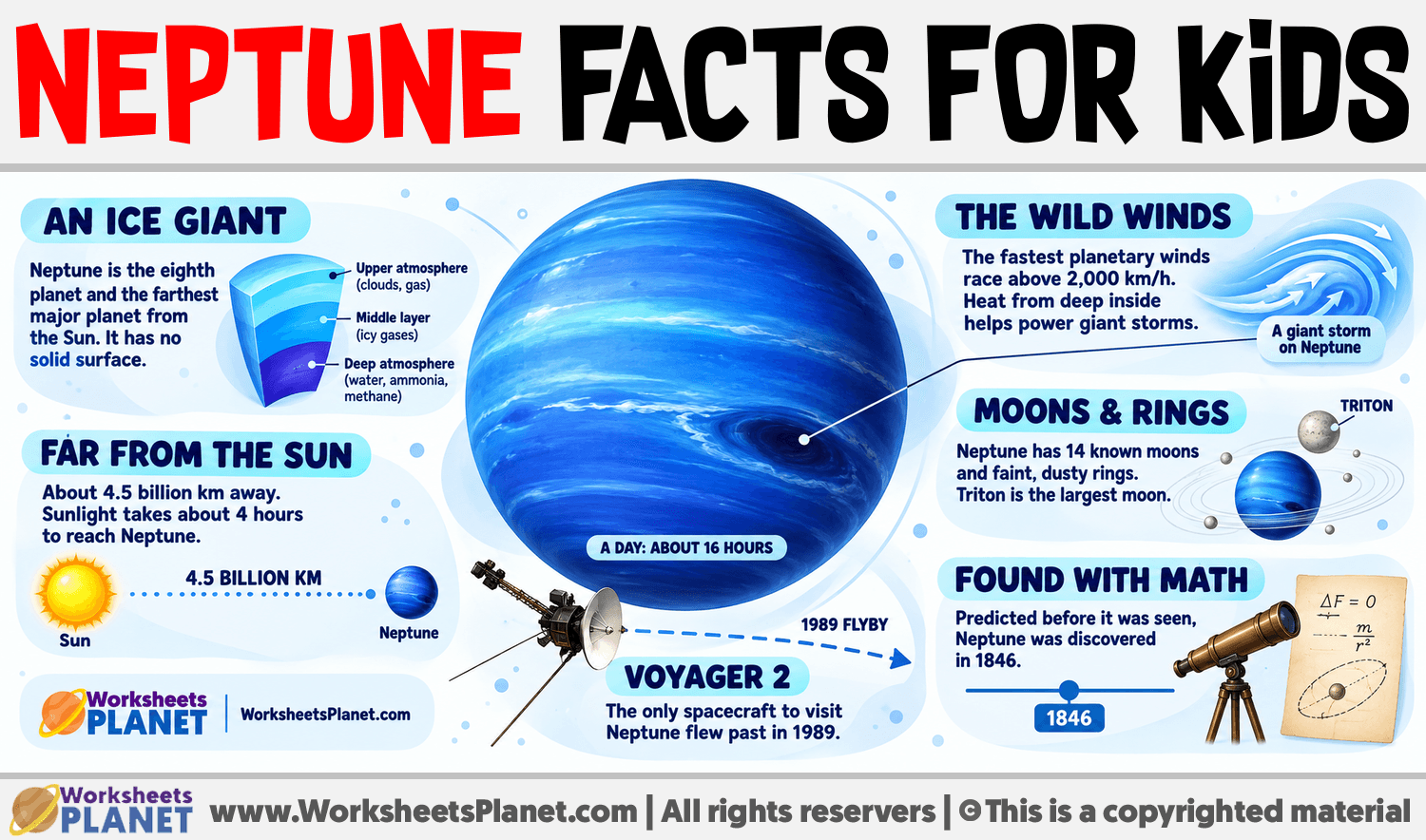
Neptune is a gas giant, more specifically an ice giant, which means it does not have a solid surface like Earth. If a spacecraft tried to land there, it would sink deeper and deeper into thick layers of gas and slushy materials. Neptune is made mostly of hydrogen, helium, and icy substances such as water, ammonia, and methane.
The planet looks blue because methane gas in its atmosphere absorbs red light and reflects blue light. Scientists also think there may be another unknown chemical that makes Neptune’s color especially rich and bright. Although Neptune may look calm from far away, it is actually one of the most active and stormy planets in the solar system.
- Neptune is the eighth planet from the Sun.
- It is about four times wider than Earth.
- It is an ice giant, not a rocky planet.
- Its blue color comes partly from methane gas.
- Neptune has no solid surface where humans could stand.
How far away is Neptune from the Sun?
Neptune is extremely far from the Sun. On average, it is about 2.8 billion miles, or 4.5 billion kilometers, away. Because it is so distant, sunlight is much weaker there than it is on Earth. At Neptune, the Sun would look like a very bright star rather than the large glowing disk we see in our sky.
This great distance affects Neptune’s year. A year is the time it takes a planet to travel once around the Sun. Neptune moves slowly along its huge orbit, so one Neptune year lasts about 165 Earth years. That means Neptune has not completed many orbits since it was discovered in 1846.
However, a day on Neptune is shorter than a day on Earth. Neptune spins quickly, taking only about 16 hours to rotate once. So if you could somehow float safely above Neptune, the Sun would rise and set faster than it does on Earth.
- Distance from the Sun: about 4.5 billion kilometers.
- Length of one Neptune year: about 165 Earth years.
- Length of one Neptune day: about 16 Earth hours.
Why is Neptune so windy and stormy?
One of the most surprising Neptune facts for kids is that Neptune has the fastest winds ever measured on any planet in our solar system. Winds can race through its atmosphere at more than 1,200 miles per hour, or about 2,000 kilometers per hour. That is faster than the speed of sound on Earth.
Scientists are still studying why Neptune’s winds are so powerful. Even though Neptune gets very little energy from the Sun, it gives off more heat than it receives. This heat from inside the planet may help drive its wild weather. The planet’s fast rotation also helps create huge wind bands and spinning storms.
In 1989, NASA’s Voyager 2 spacecraft saw a giant storm called the Great Dark Spot. It looked a little like Jupiter’s Great Red Spot, but it did not last forever. Later observations showed that the storm had disappeared, and new dark storms appeared in other places. This tells scientists that Neptune’s atmosphere is always changing.
- Neptune has extremely fast winds.
- Its storms can be as large as Earth.
- Some storms appear, change, and disappear over time.
- Heat from inside the planet may help power the weather.
Does Neptune have moons and rings?
Neptune has 14 known moons. The largest moon is called Triton, and it is one of the most interesting moons in the solar system. Triton is very cold and covered with frozen nitrogen. It also has geysers that can shoot dark material into space. Scientists think Triton may once have been a separate object that Neptune’s gravity captured.
Triton is unusual because it orbits Neptune in the opposite direction from Neptune’s rotation. This is called a retrograde orbit. Most large moons orbit in the same direction that their planet spins, so Triton’s backward orbit gives scientists clues about its mysterious past.
Neptune also has rings, but they are much fainter than Saturn’s famous rings. They are made of dust, ice, and small rocky pieces. From far away, Neptune’s rings are hard to see, but spacecraft and powerful telescopes have helped scientists study them.
- Largest moon: Triton.
- Number of known moons: 14.
- Neptune’s rings are thin, dark, and faint.
- Triton may be a captured object from the outer solar system.
How did scientists discover and explore Neptune?
Neptune was discovered in a special way. Scientists noticed that Uranus was not moving exactly as expected. They guessed that the gravity of another planet might be pulling on it. Using mathematics, astronomers predicted where the unknown planet should be. In 1846, Neptune was observed through a telescope near the predicted location.
This discovery is an important example of how math and science work together. Neptune was not found just by looking randomly through the sky. It was found because scientists used careful observations, calculations, and predictions.
Only one spacecraft has visited Neptune: Voyager 2. It flew past the planet in 1989 and sent back the first close-up images of Neptune, its rings, and its moons. Since then, scientists have continued to study Neptune using telescopes on Earth and space telescopes such as the Hubble Space Telescope and the James Webb Space Telescope.
Learning about Neptune helps students understand that planets can be very different from Earth. Neptune is cold, distant, windy, and mysterious, but it is also an important part of our solar system. For kids, Neptune shows how much there is still to discover beyond the familiar inner planets.
- Neptune was discovered in 1846.
- Its location was predicted using mathematics.
- Voyager 2 is the only spacecraft that has flown past Neptune.
- Modern telescopes continue to reveal new details about the planet.

Leave A Comment