
Black widows are among the most recognized spiders in the world, partly because of their shiny dark bodies and the famous red hourglass marking found on many females. Although they have a frightening reputation, black widows are usually shy, hidden spiders that bite people only when they feel trapped or threatened. Learning accurate black widow facts helps students understand how these animals live, why they matter in nature, and how to stay safe around them.
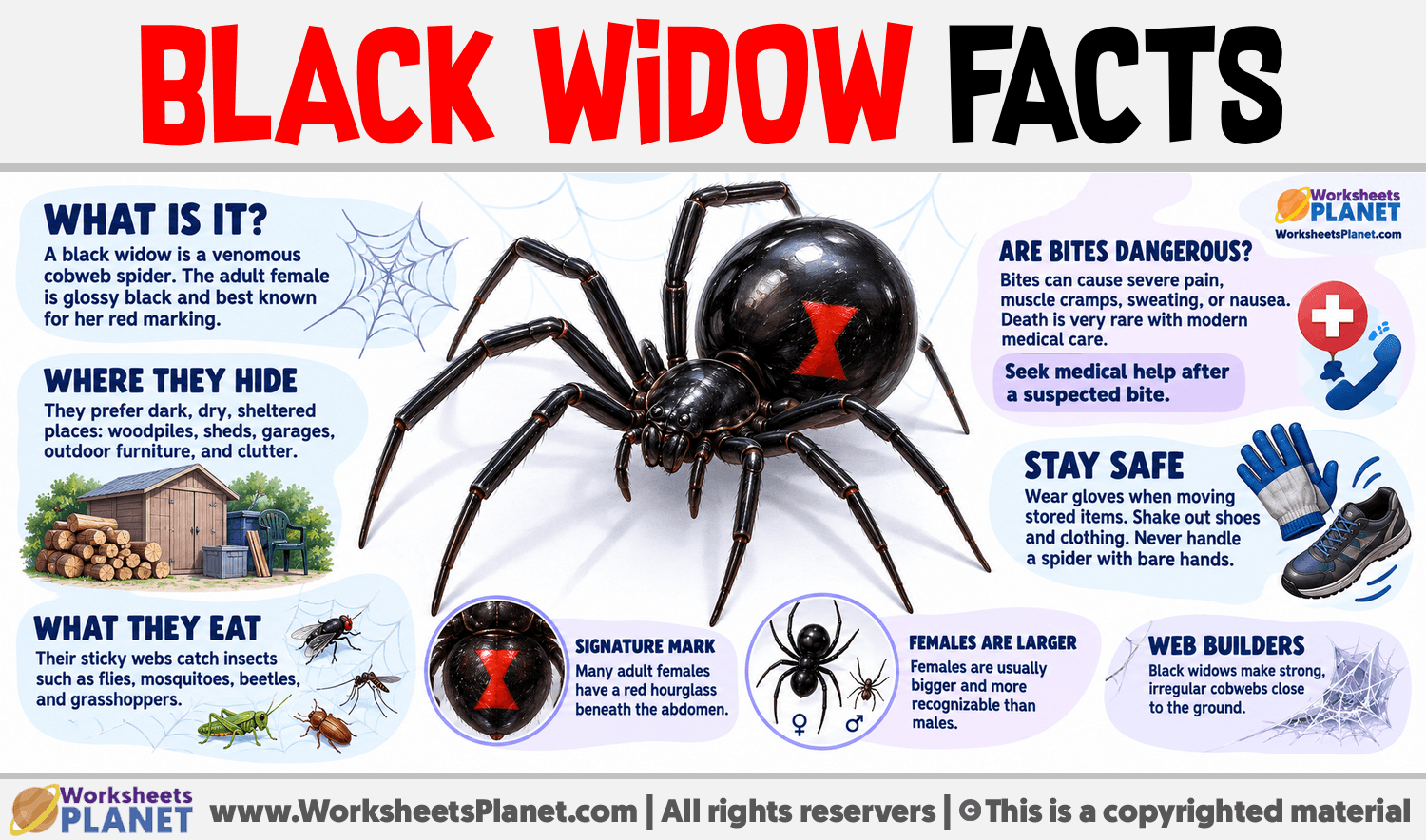
What is a black widow spider?
A black widow is a type of spider in the genus <em>Latrodectus</em>. These spiders belong to the cobweb spider family, which means they build irregular, tangled webs rather than neat circular webs like some garden spiders. Black widows are found in many parts of North America and in other regions around the world, depending on the species.
The name “black widow” is most often used for the adult female, which is usually the easiest to identify. Females are typically glossy black and may have a red or orange hourglass shape on the underside of the abdomen. Males are usually smaller, lighter in color, and less noticeable. Young black widows may have stripes or spots before they develop adult coloring.
- Adult females are usually about 1.5 inches long including the legs.
- They have eight legs, two main body parts, and no wings or antennae.
- Their webs are sticky, messy-looking, and often built close to the ground.
- The red hourglass marking is helpful for identification, but markings can vary.
Where do black widows live and hide?
Black widows prefer places that are quiet, dark, and undisturbed. Outdoors, they may live under rocks, logs, patio furniture, flowerpots, woodpiles, sheds, or outdoor toys that have not been moved for a while. In dry areas, they may be especially common in protected corners where insects also gather.
Indoors, black widows are not usually found in busy rooms. They are more likely to hide in garages, basements, crawl spaces, storage boxes, or corners where clutter remains untouched. Because they avoid disturbance, most encounters happen when someone reaches into a hidden space without looking first.
Their web is an important clue. A black widow web is not a flat, beautiful web in the open air. It is usually tangled and strong, with silk threads arranged in a messy pattern. The spider often waits in or near the web for prey to become trapped.
What do black widows eat?
Black widows are predators, and their diet mainly includes small insects and other tiny animals. They do not chase prey like a wolf spider. Instead, they depend on their sticky web. When an insect gets caught, the spider senses the vibration and moves toward it.
A black widow may wrap its prey in silk and use venom to help immobilize it. Like other spiders, it cannot chew food the way humans do. It releases digestive fluids and then consumes the liquefied parts of the prey. This may sound unusual, but it is a normal part of spider feeding.
Black widows help control insect populations. In this way, they play a useful role in ecosystems, even though people may not want them living close to homes or classrooms. They may eat flies, mosquitoes, beetles, grasshoppers, caterpillars, and other spiders.
Are black widow bites dangerous?
Black widows are venomous, but they are not aggressive hunters of people. A bite usually happens when the spider is accidentally pressed against skin, such as when someone puts on a shoe, glove, or piece of clothing where the spider is hiding. The female’s venom is stronger than the male’s, and most serious bites are linked to females.
A black widow bite can cause pain, swelling, muscle cramps, nausea, sweating, or weakness. Symptoms may spread beyond the bite area because the venom affects nerves and muscles. However, deaths from black widow bites are extremely rare, especially when medical care is available. Children, older adults, and people with certain health conditions may be at higher risk and should be watched carefully.
If a black widow bite is suspected, it is best to stay calm, wash the area with soap and water, apply a cool pack wrapped in cloth, and contact a doctor or poison control center for advice. People should seek medical help quickly if there is severe pain, trouble breathing, spreading muscle cramps, or other serious symptoms.
- Do not try to handle or squeeze the spider.
- If possible, safely take a photo for identification instead of capturing it by hand.
- Keep the bitten person still and comfortable while waiting for advice.
- Call emergency services if symptoms are severe or the person is very young, elderly, or medically vulnerable.
How can people stay safe around black widows?
The best way to avoid black widow bites is to reduce surprise contact. Students and families can learn to be careful in places where spiders may hide. This does not mean panicking when a spider is seen. It means using smart habits around storage areas, outdoor equipment, and dark corners.
Before picking up firewood, moving boxes, or reaching into a shed, look carefully. Wearing gloves is helpful when working in garages, gardens, or woodpiles. Shoes and sports gear left outside should be checked before use. Around the home, reducing clutter and sealing cracks can make hiding places less inviting.
If black widows are found often, adults may remove webs with caution, move storage items away from walls, and keep outdoor areas tidy. In schools, teachers should remind students not to touch unknown spiders and to tell an adult if they find one. Respecting wildlife while keeping a safe distance is an important science lesson.
- Shake out gloves, shoes, and jackets that were stored in garages or outdoors.
- Use a flashlight when looking into dark corners, sheds, or crawl spaces.
- Store boxes in sealed containers when possible.
- Keep woodpiles, leaves, and clutter away from doors and play areas.
- Teach children the rule: look, do not touch.
Interesting black widow facts for students
One famous black widow fact is that females sometimes eat males after mating. This can happen, but it is not as common in the wild as many people think. The “widow” name came from this behavior, but real spider behavior depends on the species, the situation, and whether the male can escape.
Another interesting point is that black widow silk is very strong. Their webs may look messy, but the silk is built for catching struggling insects. Scientists study spider silk because it combines strength and flexibility in a remarkable way.
Black widows may look scary, but they are part of the balance of nature. They reduce insect numbers, provide food for some predators, and show how animals adapt to survive. The most important lesson is not to fear them blindly, but to recognize them, respect them, and know what to do if one is found.
- Black widows are arachnids, not insects.
- They have eight legs, while insects have six.
- Females are larger and more recognizable than males.
- They usually bite only in self-defense.
- Their tangled webs are designed for trapping prey, not for decoration.

Leave A Comment