
Flowers are more than colorful decorations in gardens and fields. They are the reproductive parts of flowering plants, helping plants make seeds so new plants can grow. Learning the parts of the flower helps students understand how plants survive, reproduce, and provide food for people, animals, and insects. A flower may look simple at first, but each part has a special job. Some parts protect the flower, some attract pollinators, and others help form seeds and fruit. By observing real flowers, students can connect science vocabulary with something they can see, touch, and investigate.
What Are the Main Parts of the Flower?
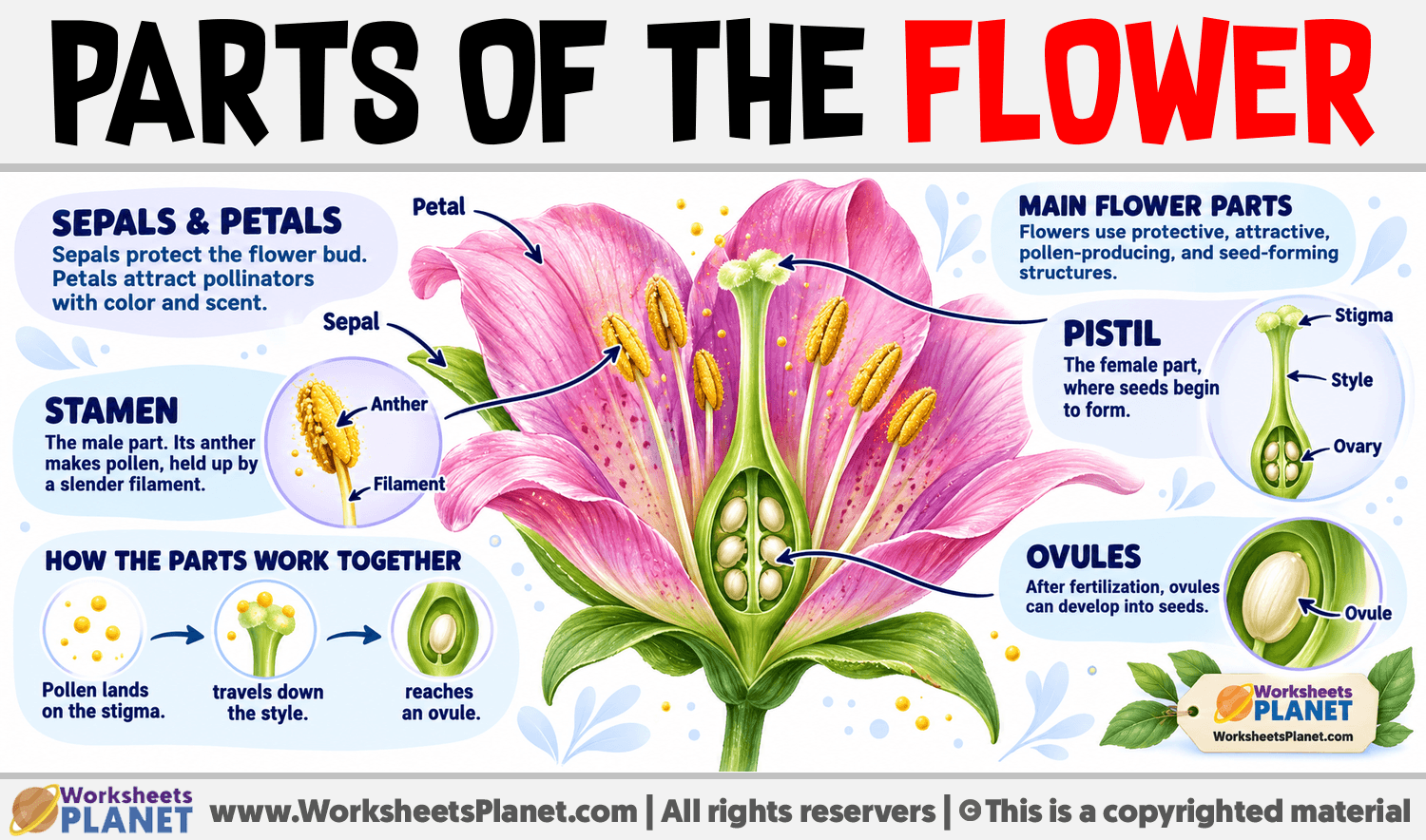
Most complete flowers have four main groups of parts: sepals, petals, stamens, and pistils. These parts are often arranged in circles, or whorls, around the center of the flower. Not every flower has all four groups, but these are the parts commonly taught when studying flower structure.
The outer parts usually protect and attract, while the inner parts are involved in reproduction. Understanding these basic parts makes it easier to explain how pollination, seed formation, and fruit development happen.
- Sepals: small leaf-like parts that protect the flower bud before it opens.
- Petals: often colorful parts that help attract bees, butterflies, birds, and other pollinators.
- Stamens: the male reproductive parts that produce pollen.
- Pistil: the female reproductive part where seeds begin to form after fertilization.
Sepals and Petals: The Protective and Attractive Parts
The sepals are found at the base of the flower. They usually look green and leaf-like, though in some plants they may be colorful. Their main job is to protect the developing flower while it is still a bud. When the flower opens, the sepals may remain underneath the petals like a small green cup.
The petals are the parts many people notice first. They can be bright red, yellow, purple, white, or many other colors. Petals may also have patterns, shapes, or scents that guide pollinators toward the center of the flower. For example, a bee may follow lines on a petal that lead to nectar. In this way, petals help the plant by increasing the chance of pollination.
Not all petals are large or showy. Grass flowers, for example, have tiny, plain parts because they often depend on wind rather than insects for pollination. This shows that the appearance of a flower is closely connected to how it reproduces.
Stamen: The Part That Produces Pollen
The stamen is the male reproductive part of the flower. It usually has two main parts: the anther and the filament. The filament is a thin stalk that holds up the anther. The anther produces and releases pollen, which looks like fine yellow, orange, or white dust in many flowers.
Pollen is important because it carries the male reproductive cells of the plant. For seeds to form, pollen must reach the female part of a flower. This can happen in different ways. Bees and butterflies may carry pollen on their bodies as they move from flower to flower. Wind can also blow pollen through the air, especially in plants such as corn, grasses, and many trees.
- Anther: produces pollen grains.
- Filament: supports the anther and positions it where pollinators or wind can reach it.
- Pollen: contains male reproductive cells needed for seed formation.
Pistil: The Part Where Seeds Begin to Form
The pistil is the female reproductive part of the flower. It is usually found in the center of the flower and may look like a small tube or vase-shaped structure. A pistil has three main parts: the stigma, the style, and the ovary.
The stigma is often sticky or feathery, which helps it catch pollen. Once pollen lands on the stigma, it can grow a tiny tube down through the style. This tube leads to the ovary, where the ovules are located. If fertilization happens, the ovules develop into seeds. In many flowering plants, the ovary later becomes a fruit that protects the seeds.
For example, in an apple blossom, the ovary eventually becomes the apple. The seeds inside the apple began as ovules inside the flower. This helps students see that fruits are closely connected to flowers, even when the flower is no longer visible.
- Stigma: receives pollen.
- Style: connects the stigma to the ovary.
- Ovary: contains ovules and may develop into fruit.
- Ovules: become seeds after fertilization.
How the Parts of the Flower Work Together
The parts of the flower work as a team during pollination and seed production. First, petals may attract a pollinator with color, scent, or nectar. As the pollinator visits the flower, it may brush against the anthers and pick up pollen. When it visits another flower of the same kind, some pollen may stick to the stigma.
After pollen reaches the stigma, fertilization can occur inside the ovary. Then seeds begin to develop. The flower may wilt, petals may fall off, and the ovary may grow into a fruit or seed pod. This process allows the plant to make the next generation.
A simple classroom activity is to examine a lily, tulip, hibiscus, or another large flower. Students can gently identify the petals, sepals, stamens, and pistil. Drawing and labeling the flower helps reinforce vocabulary and observation skills. Teachers can also compare different flowers to show that plant structures may look different but often perform similar functions.
- Flowers help plants reproduce by making seeds.
- Pollinators such as bees, butterflies, moths, birds, and bats help move pollen.
- Some plants use wind pollination instead of animal pollinators.
- A fruit often develops from the flower’s ovary after fertilization.
- Studying real flowers helps students understand the connection between structure and function.

Leave A Comment