
The Mohawk Tribe is one of the original nations of the Haudenosaunee, also known as the Iroquois Confederacy. Mohawk people call themselves Kanien’kehá:ka, which is often translated as “People of the Flint.” Their homelands are in what is now northeastern North America, especially parts of present-day New York and southern Canada. Learning about the Mohawk Tribe helps students understand Indigenous history, government, culture, language, and the continuing presence of Native nations today.
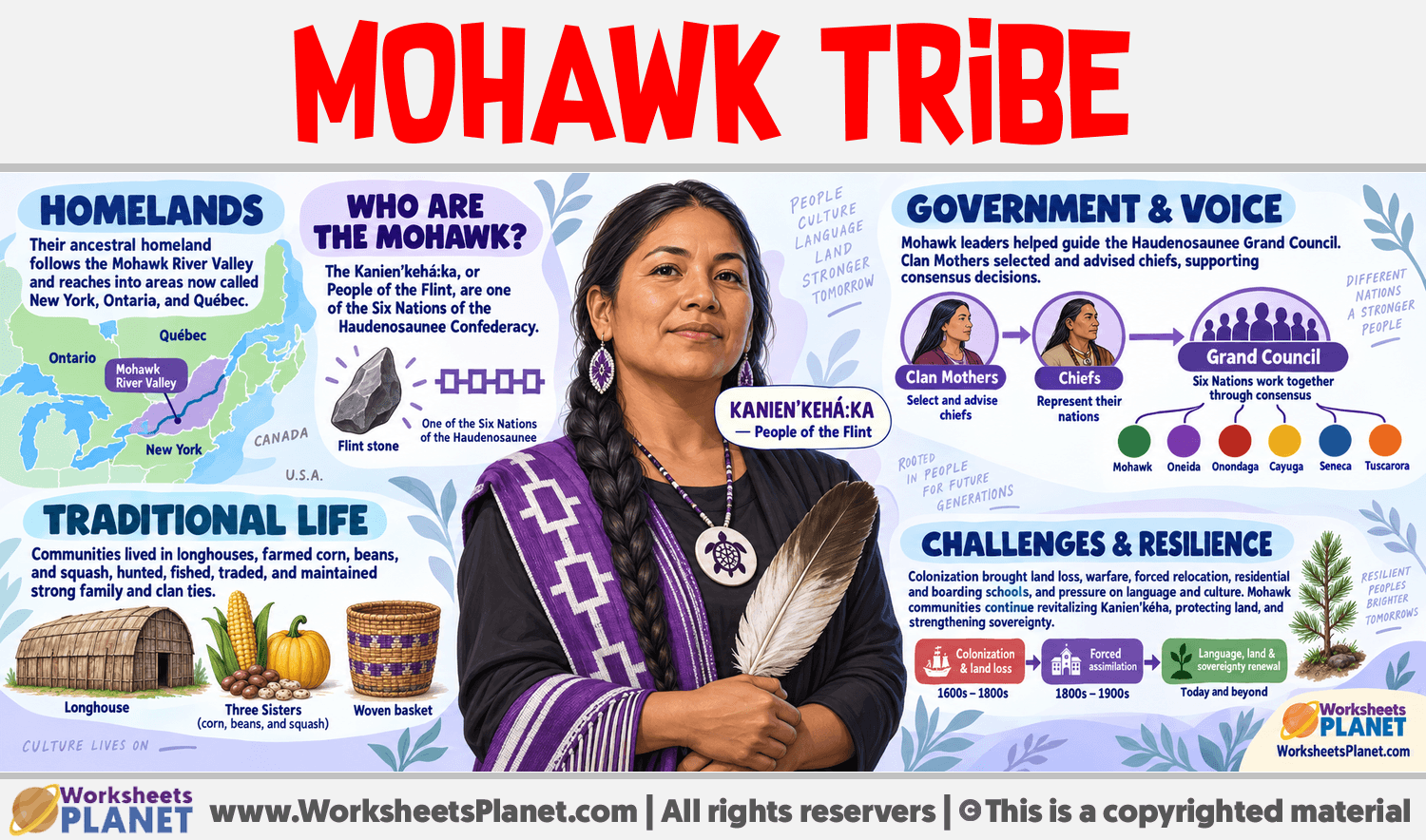
Who are the Mohawk people?
The Mohawk people are an Indigenous nation with a long history in the northeastern woodlands. They are one of the six nations of the Haudenosaunee Confederacy, along with the Oneida, Onondaga, Cayuga, Seneca, and Tuscarora. The Haudenosaunee are sometimes called the Iroquois, but many people prefer the name Haudenosaunee, which means “People of the Longhouse.”
The Mohawk were traditionally known as the “Keepers of the Eastern Door” because their communities were located on the eastern side of Haudenosaunee territory. This role was both geographic and symbolic. It meant they helped protect the eastern entrance to the confederacy and took part in important political decisions.
Today, Mohawk communities continue to exist in several places, including Akwesasne, Kahnawà:ke, Kanesatake, Tyendinaga, Wahta, and Six Nations of the Grand River. Some Mohawk communities are in the United States, some are in Canada, and some, like Akwesasne, are located across modern national borders.
Where did the Mohawk Tribe live?
The traditional Mohawk homeland was centered in the Mohawk Valley of present-day New York. This area had rivers, forests, fertile soil, and travel routes that supported village life, farming, hunting, fishing, and trade. The Mohawk River was especially important because it connected communities and made movement across the region easier.
Mohawk villages were often built near waterways and farmland. Families lived in longhouses, large wooden homes covered with bark. A longhouse could hold several related families, usually connected through the mother’s line. The longhouse was not only a building; it also represented the Haudenosaunee idea of different nations living together under one shared roof.
Over time, wars, treaties, colonization, and pressure from European settlers changed where many Mohawk people lived. Some communities moved north into what is now Canada, while others remained connected to homelands in New York. Despite these disruptions, Mohawk people have maintained strong cultural and political ties to their territories.
- Traditional Mohawk lands included parts of the Mohawk Valley in present-day New York.
- Rivers supported travel, trade, fishing, and communication between communities.
- Forests provided materials for homes, tools, canoes, and fires.
- Fields were used to grow important crops such as corn, beans, and squash.
What was traditional Mohawk life like?
Traditional Mohawk life was organized around family, community, farming, and shared responsibilities. Women played a central role in society. In Haudenosaunee culture, clans are matrilineal, meaning clan identity is passed through the mother. Clan mothers helped choose and advise male chiefs, showing that leadership was balanced by responsibility to the community.
Farming was very important. Mohawk people grew the “Three Sisters”: corn, beans, and squash. These crops grow well together. Corn provides a stalk for beans to climb, beans help add nutrients to the soil, and squash leaves help keep moisture in the ground and reduce weeds. People also hunted deer and other animals, fished in rivers, gathered berries and nuts, and used natural materials carefully.
Children learned by watching, listening, helping, and practicing. Boys and girls were taught skills needed for daily life, but education also included stories, ceremonies, values, and community history. Oral traditions helped pass knowledge from one generation to the next.
- Longhouses sheltered extended families and showed the importance of kinship.
- Clan systems connected people to identity, duties, and community relationships.
- Agriculture, hunting, fishing, and gathering all supported food needs.
- Stories and ceremonies taught values such as respect, gratitude, and responsibility.
How did the Mohawk Tribe take part in Haudenosaunee government?
The Mohawk Tribe was an important member of the Haudenosaunee Confederacy, one of the oldest continuing systems of representative government in the world. The confederacy was formed to promote peace among nations that had once been in conflict. Its guiding principles are often connected to the Great Law of Peace.
Decision-making in the confederacy was based on discussion and consensus. Leaders did not simply command others. They were expected to listen, speak carefully, and consider the well-being of future generations. Clan mothers had the authority to help select leaders and remove them if they failed in their duties.
The Haudenosaunee system influenced later political thinkers, and some historians discuss its relationship to ideas of democracy and federalism. However, it is important to understand it as its own Indigenous system, not just as a comparison to European or American government. The Mohawk role within this system shows how diplomacy, responsibility, and community voice shaped political life.
What challenges have Mohawk people faced?
Like many Indigenous nations, the Mohawk people faced major challenges after European colonization. Land loss, disease, warfare, forced relocation, and unfair treaties affected Mohawk communities. Colonial governments often tried to weaken Indigenous nations by taking land and limiting self-government.
In the United States and Canada, Native children were also sent to boarding schools or residential schools where they were often punished for speaking their languages or practicing their cultures. These policies caused deep harm to families and communities. Even so, Mohawk people continued to protect their identity, ceremonies, and rights.
Mohawk communities have also been involved in important struggles over land and sovereignty. For example, the 1990 conflict known as the Oka Crisis in Quebec brought attention to Mohawk land rights and the defense of sacred and community spaces. These events remind students that Indigenous history is not only in the distant past; it connects directly to present-day issues.
- Colonization led to loss of land and pressure on traditional ways of life.
- Assimilation policies tried to erase Mohawk language and culture.
- Mohawk communities have continued to defend treaty rights, land rights, and sovereignty.
- Historical events should be studied with respect for Native perspectives and experiences.
How do Mohawk culture and identity continue today?
The Mohawk Tribe is not only a historical topic. Mohawk people are present-day communities with governments, schools, artists, speakers, families, and leaders. Many people work to strengthen the Mohawk language, called Kanien’kéha. Language programs, immersion schools, and community classes help younger generations learn words, stories, and ways of thinking connected to Mohawk identity.
Mohawk culture can be seen in ceremonies, social dances, beadwork, lacrosse, ironworking, environmental knowledge, and community events. Mohawk ironworkers became well known for helping build bridges and skyscrapers, especially in cities such as New York. This work is an example of how Mohawk people adapted to new economic opportunities while maintaining community ties.
For students, one of the most important lessons is that Native nations are diverse and living cultures. The Mohawk Tribe has a deep past, but it also has a modern present and future. Studying the Mohawk people with accuracy and respect helps learners understand North American history in a fuller and more honest way.
- Use the name Kanien’kehá:ka when discussing how Mohawk people refer to themselves.
- Remember that Mohawk communities have their own governments and rights.
- Avoid stereotypes, such as treating all Native nations as the same.
- Learn from Native-created books, websites, museums, and community resources whenever possible.

Leave A Comment