
The modern atomic model is the scientific explanation of what atoms are like based on today’s evidence from physics and chemistry. It does not picture electrons as tiny planets moving in neat circles around a nucleus. Instead, it describes atoms as having a small, dense nucleus surrounded by regions where electrons are likely to be found. This model helps students understand chemical reactions, the periodic table, electricity, light, and the properties of matter.
What does the modern atomic model say about atoms?
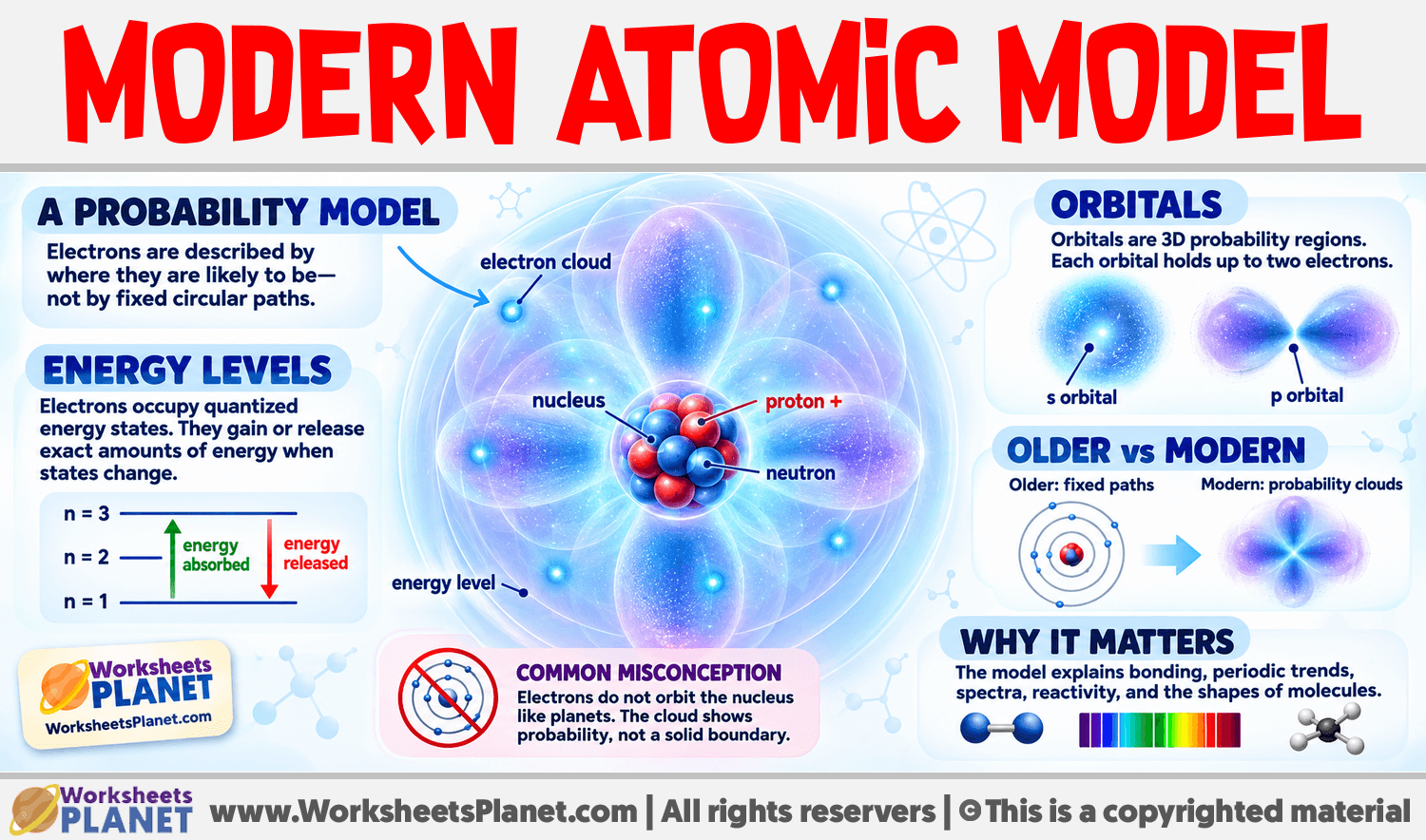
The modern atomic model explains that every atom has a central nucleus made of protons and neutrons. Protons have a positive electric charge, neutrons have no charge, and most of the atom’s mass is located in this tiny center. Around the nucleus are electrons, which have a negative charge and occupy areas called orbitals.
Unlike older drawings that show electrons traveling on fixed paths, the modern model uses probability. This means scientists cannot point to an exact path an electron follows at all times. Instead, they describe where an electron is most likely to be found. These probability regions are often called electron clouds, although they are not clouds of gas. They are mathematical descriptions of electron behavior.
- The nucleus contains protons and neutrons.
- Electrons are found in orbitals around the nucleus.
- Atoms are mostly empty space.
- The number of protons identifies the element.
- Electron arrangement affects how atoms bond and react.
How is the modern atomic model different from older models?
The idea of the atom changed many times as scientists collected better evidence. John Dalton described atoms as solid, indivisible spheres. J. J. Thomson discovered the electron and suggested that atoms had negatively charged particles inside a positive material. Ernest Rutherford showed that atoms have a tiny, dense nucleus. Niels Bohr then proposed that electrons move in fixed energy levels around the nucleus.
The modern atomic model keeps some ideas from these earlier models but improves them. It agrees that atoms have a nucleus and that electrons have specific energies, but it rejects the idea of simple circular electron paths. Instead, it uses ideas from quantum mechanics, a branch of science that explains the behavior of very small particles. This is why the modern model is sometimes called the quantum mechanical model of the atom.
- Dalton: atoms were solid indivisible particles.
- Thomson: atoms contained electrons.
- Rutherford: atoms had a small central nucleus.
- Bohr: electrons had fixed energy levels.
- Modern model: electrons occupy orbitals described by probability.
What are energy levels and orbitals?
In the modern atomic model, electrons do not all have the same amount of energy. They are arranged in energy levels, sometimes called shells. Electrons closer to the nucleus usually have lower energy, while electrons farther away usually have higher energy. However, these levels are not like steps on a ladder that electrons sit on physically; they are allowed energy states.
Within energy levels are orbitals. An orbital is a region where an electron is likely to be found. Orbitals have different shapes, such as spherical or dumbbell-shaped regions. Students often see letters such as s, p, d, and f used to describe types of orbitals. These orbitals help explain why elements in the same group of the periodic table often behave in similar ways.
For example, sodium reacts strongly with chlorine because sodium has one outer electron that it can lose easily, while chlorine needs one more electron to have a more stable arrangement. The modern atomic model helps explain this transfer of electrons and the formation of an ionic bond.
- Energy levels describe the allowed energies of electrons.
- Orbitals describe the most likely locations of electrons.
- Outer electrons are called valence electrons.
- Valence electrons are especially important in chemical bonding.
Why is the modern atomic model important in chemistry?
The modern atomic model is useful because it connects the invisible structure of atoms to visible properties of substances. For example, it helps explain why metals conduct electricity, why noble gases are usually unreactive, and why some substances form crystals while others form molecules. Without a good model of the atom, the patterns in the periodic table would be much harder to understand.
Chemical reactions involve changes in the arrangement of electrons, especially valence electrons. The nucleus usually stays the same during ordinary chemical reactions. When hydrogen and oxygen form water, for instance, the atoms share electrons in covalent bonds. The modern model explains why this sharing happens and why a water molecule has its particular shape.
The model also helps explain light and color. When electrons absorb energy, they may move to a higher energy level. When they return to a lower energy level, they can release energy as light. This is why certain elements produce specific colors in flame tests or in glowing signs.
- It explains chemical bonding and reactions.
- It helps predict element behavior on the periodic table.
- It explains electrical conductivity in metals.
- It helps scientists understand light emitted by atoms.
- It connects atomic structure to real materials and their properties.
Common misconceptions about the modern atomic model
One common misconception is that electrons move around the nucleus exactly like planets orbit the Sun. This picture is easy to draw, but it is not accurate. Electrons behave differently from large objects. Their locations are described using probability, not fixed tracks.
Another misconception is that an atom is filled with solid material. In reality, an atom is mostly empty space. The nucleus is extremely small compared with the total size of the atom, but it contains nearly all the atom’s mass. If the nucleus were enlarged to the size of a small marble, the electron cloud would extend far away by comparison.
Students may also think scientific models are guesses. In science, a model is a tested explanation that helps describe and predict real observations. The modern atomic model is supported by many kinds of evidence, including spectroscopy, experiments with particles, chemical behavior, and advanced imaging techniques.
- Electrons do not follow neat circular paths.
- The electron cloud is not a physical cloud of smoke or gas.
- Atoms are mostly empty space, not solid balls.
- Scientific models can change when new evidence appears.
- The modern model is useful because it makes accurate predictions.

Leave A Comment