
The Rutherford Atomic Model was a major turning point in the history of science. Before Ernest Rutherford’s work, many scientists thought the atom was like a soft, positively charged sphere with electrons scattered inside it. Rutherford’s experiments showed something very different: the atom has a tiny, dense, positively charged center called the nucleus, and most of the atom is actually empty space. This idea helped scientists understand atomic structure in a new way and prepared the path for modern atomic theory.
What is the Rutherford Atomic Model?
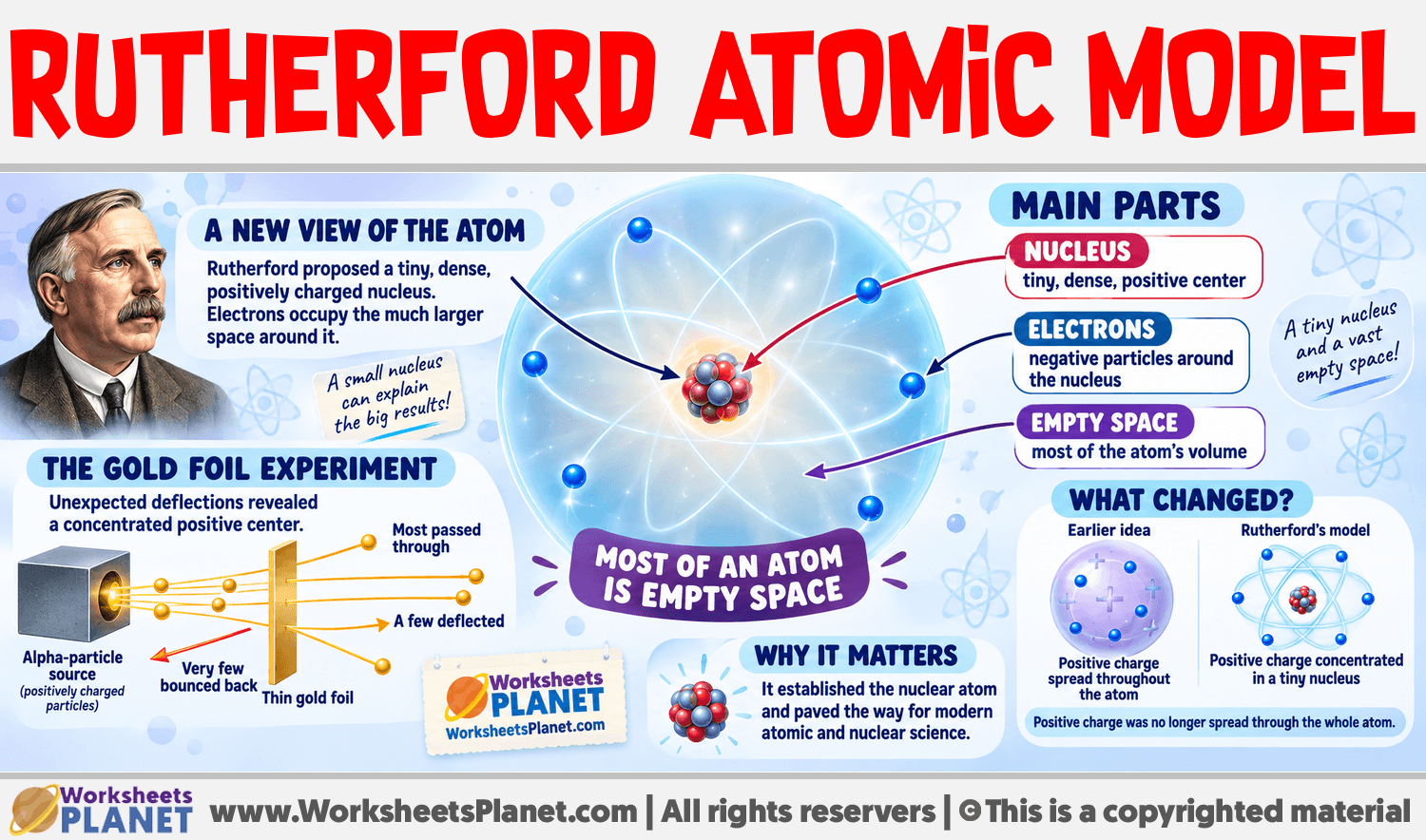
The Rutherford Atomic Model is a scientific model that describes the atom as having a small, central nucleus surrounded by electrons. Rutherford proposed this model in 1911 after studying the results of his famous gold foil experiment. His model is sometimes called the nuclear model of the atom because it introduced the idea of a nucleus at the center.
In this model, nearly all the atom’s mass is concentrated in the nucleus. The nucleus has a positive charge, while the electrons carry a negative charge and move around the nucleus. Rutherford’s idea was very different from earlier models because it showed that atoms are not solid all the way through. Instead, they are mostly open space with a very small but important center.
- The atom contains a tiny, dense nucleus at its center.
- The nucleus is positively charged.
- Electrons move around the nucleus.
- Most of the atom is empty space.
- Almost all of the atom’s mass is found in the nucleus.
How did the gold foil experiment lead to the model?
Rutherford did not simply guess his atomic model. He based it on evidence from an experiment carried out by his team, especially Hans Geiger and Ernest Marsden. In the experiment, they fired tiny positively charged particles, called alpha particles, at a very thin sheet of gold foil. They expected the particles to pass through with only slight changes in direction.
Most alpha particles did pass straight through the gold foil. This showed that the atom must be mostly empty space. However, a small number of particles were deflected at large angles, and a few even bounced back. Rutherford found this surprising. He later explained that this could only happen if the positive charge and mass of the atom were packed into a very small central region.
This result helped Rutherford reject the older plum pudding model. If positive charge had been spread evenly throughout the atom, the alpha particles would not have been strongly deflected. The sharp deflections were strong evidence for a small, dense nucleus.
- Most alpha particles went straight through, showing that atoms are mostly empty space.
- Some particles bent slightly, suggesting they passed near a positive center.
- A few particles bounced back, proving the atom had a tiny, dense core.
- The experiment showed that scientific models can change when new evidence appears.
What are the main parts of Rutherford’s atom?
The Rutherford Atomic Model has two main parts: the nucleus and the electrons. The nucleus is located at the center of the atom. It contains nearly all the mass of the atom and has a positive charge. Today, we know the nucleus contains protons and neutrons, although neutrons had not yet been discovered when Rutherford first proposed his model.
The electrons are negatively charged particles outside the nucleus. Rutherford suggested that electrons move around the nucleus, somewhat like planets moving around the Sun. This comparison made the model easier to imagine, but it was not completely accurate. Electrons do not behave exactly like planets, and later scientists had to improve Rutherford’s idea.
One of the most important lessons from this model is scale. If the nucleus were the size of a small marble in the middle of a large stadium, the electrons would be far away, and the space between would be mostly empty. This helps students understand why atoms can be made of particles and still appear as solid objects in everyday life.
- Nucleus: the tiny central region with positive charge and most of the mass.
- Electrons: negatively charged particles located outside the nucleus.
- Empty space: the large region between the nucleus and the electrons.
- Atomic mass: mostly concentrated in the nucleus rather than spread through the atom.
How was Rutherford’s model different from earlier atomic ideas?
Before Rutherford, one of the most accepted atomic models was J. J. Thomson’s plum pudding model. Thomson had discovered the electron, and he suggested that atoms were made of a positively charged material with electrons embedded inside, like raisins in a pudding. In that model, the positive charge was spread throughout the atom.
Rutherford’s model replaced this idea with a much more surprising picture. He showed that the positive charge was not spread out evenly. Instead, it was concentrated in the nucleus. This changed the way scientists thought about matter, because it meant that atoms had an internal structure with a central core.
However, Rutherford’s model was not the final answer. It explained the nucleus, but it could not fully explain how electrons stayed in motion without falling into the nucleus. According to classical physics, moving electrons should lose energy and spiral inward. This problem led to later improvements, especially the Bohr model, which introduced fixed energy levels for electrons.
- Thomson’s model had positive charge spread throughout the atom.
- Rutherford’s model placed positive charge in a central nucleus.
- Rutherford showed that atoms are mostly empty space.
- The model explained experimental results better than the plum pudding model.
- Later models improved Rutherford’s explanation of electron behavior.
Why is the Rutherford Atomic Model important today?
The Rutherford Atomic Model is important because it introduced the basic idea of the nuclear atom. Even though modern atomic theory is more detailed, Rutherford’s central discovery remains true: atoms have a dense nucleus surrounded by electrons. This idea is essential for learning chemistry, physics, and many areas of modern science.
For students, this model is a good example of how science works. Rutherford and his team made observations, noticed results that did not fit the old model, and used evidence to create a better explanation. The model also shows that scientific knowledge is not fixed. It grows and changes when new experiments reveal better information.
In classrooms, the Rutherford model is often used to introduce atomic structure, nuclear science, and the development of scientific theories. It helps explain why atoms have mass, why positive and negative charges matter, and why experiments are so important in building reliable scientific ideas.
- It introduced the modern idea of the atomic nucleus.
- It helped replace an incorrect atomic model with an evidence-based one.
- It prepared the way for the Bohr model and later quantum atomic models.
- It teaches students how experiments can change scientific understanding.
- It remains a key step in the history of atomic theory.

Leave A Comment