
The Chumash Tribe is a Native American people whose traditional homeland is along the coast of what is now Southern and Central California. For thousands of years, Chumash communities lived near the Pacific Ocean, the Channel Islands, and inland valleys, developing a rich culture connected to the sea, local plants, trade, storytelling, and skilled craftsmanship. Learning about the Chumash helps students understand that California history did not begin with Spanish missions or modern cities. It began with Indigenous nations who built strong communities, cared for the land, and continue to live and share their culture today.
Where did the Chumash people live?
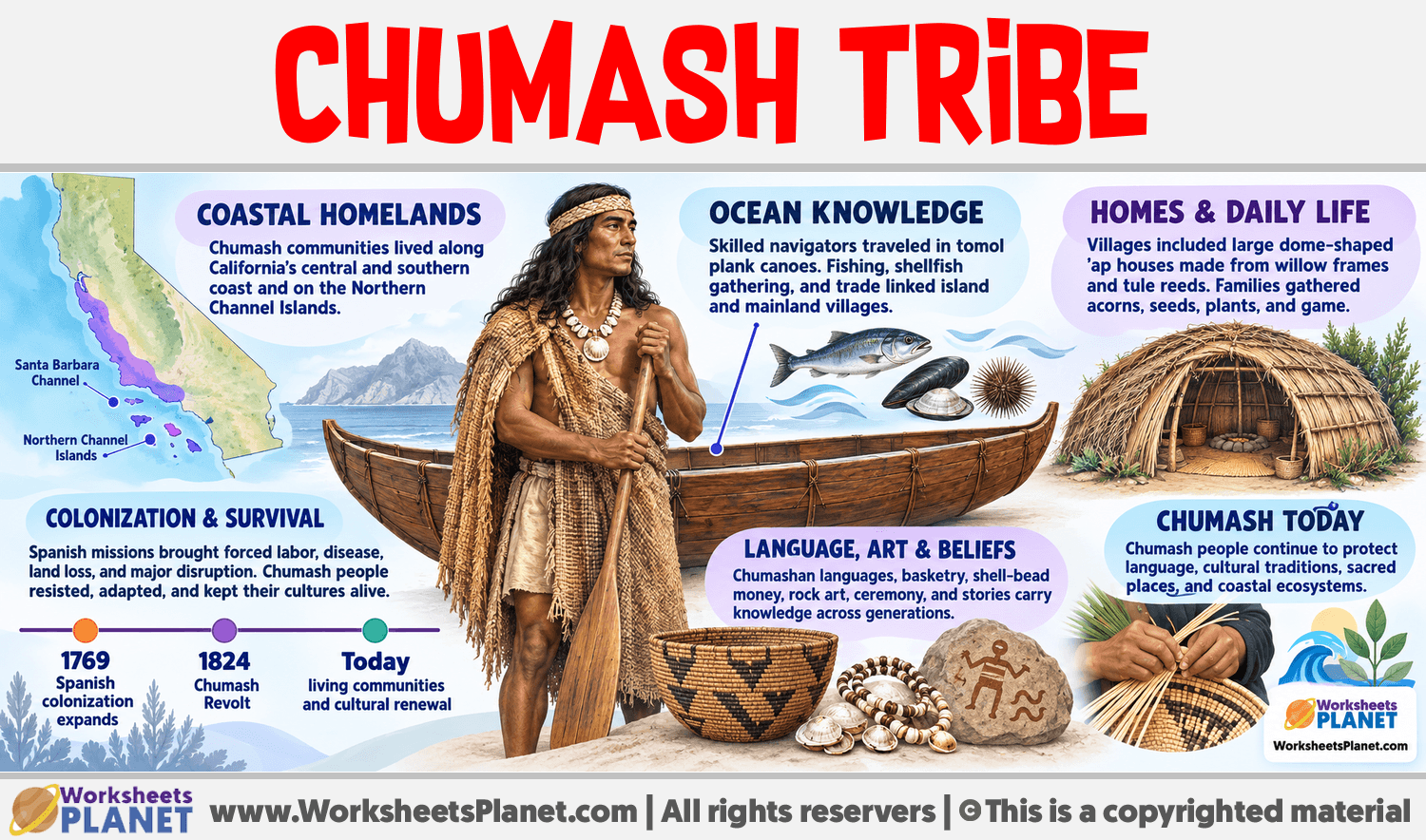
The traditional Chumash homeland stretched across parts of present-day Santa Barbara, Ventura, San Luis Obispo, and northern Los Angeles counties. It also included the northern Channel Islands, such as Santa Cruz, Santa Rosa, and San Miguel Islands. Because this region has beaches, mountains, oak woodlands, rivers, and islands, Chumash communities had access to many different natural resources.
The Chumash did not live in just one village or one single settlement. There were many villages, each with its own leaders and local traditions. Some villages were close to the ocean, while others were farther inland. Coastal villages could gather shellfish and fish, while inland communities collected acorns, seeds, roots, and game. These communities were connected through trade, family relationships, ceremonies, and shared languages.
- Coastal areas provided fish, shellfish, sea mammals, and materials for boats.
- Oak woodlands provided acorns, an important food that could be stored and prepared in many ways.
- The Channel Islands were home to Chumash communities with strong ocean-travel skills.
- Inland valleys offered plants, animals, and trade routes to other Native groups.
How did the Chumash use the ocean and natural resources?
The ocean was central to Chumash life. One of their most impressive achievements was the creation of the tomol, a plank canoe made from wooden boards sewn and sealed together. The tomol allowed Chumash people to travel between the mainland and islands, fish in deeper waters, and trade goods across long distances. Building one required planning, teamwork, and expert knowledge of wood, plant fibers, and natural tar.
Chumash people used resources carefully and creatively. They made baskets from plant materials, tools from stone and bone, and beads from shells. Shell beads were especially important because they were used in trade and as a form of wealth. Food came from many sources, including fish, deer, rabbits, acorns, berries, seeds, and seaweed. Rather than depending on one food, the Chumash used a balanced seasonal food system based on what was available at different times of the year.
This way of life shows how closely the Chumash understood their environment. They knew when certain plants ripened, where animals moved, how tides changed, and which materials were best for tools or houses. Their knowledge was passed down through families, stories, practice, and community teaching.
- The tomol was used for fishing, travel, and trade across the Santa Barbara Channel.
- Shell beads were valuable trade items and were often made from olivella shells.
- Acorns were ground into meal and prepared to remove their bitter taste.
- Baskets were used for gathering, storing, cooking, and carrying food.
What were Chumash homes, villages, and daily life like?
Many Chumash people lived in dome-shaped houses often called ap. These homes were commonly made with willow poles and covered with tule reeds or grasses. A large village might have many houses, a ceremonial area, work spaces, storage areas, and places where people prepared food or made tools. Villages were active places where children learned by watching and helping adults.
Daily life included gathering food, fishing, making baskets, preparing meals, crafting tools, and caring for children. People had different responsibilities, and skilled workers were respected. Basket makers, canoe builders, healers, leaders, and storytellers all played important roles. Children learned practical skills, but they also learned values, manners, songs, and the history of their people.
Chumash society was organized and complex. Some communities had leaders who helped make decisions, settle disagreements, and organize ceremonies or trade. The Chumash also had specialists who understood astronomy, healing plants, and religious traditions. This reminds students that Native societies were not simple or unchanging; they were knowledgeable, organized, and adaptive.
What language, art, and beliefs are important to Chumash culture?
The Chumash people spoke several related languages, often grouped as Chumashan languages. These languages were different from the languages of neighboring Native peoples. Language carried cultural knowledge, including place names, family relationships, stories, songs, and teachings about the natural world. Today, Chumash communities and language workers are involved in efforts to study, teach, and revitalize Chumash language traditions.
Chumash art is especially known for rock paintings, including designs found in caves and rock shelters. These paintings often include circles, lines, animal-like shapes, and other symbols. While not every image can be fully explained today, many are connected to spiritual beliefs, ceremonies, and the observation of the sky. The paintings show careful design and deep meaning, not random decoration.
Storytelling was also an important part of Chumash culture. Stories could teach lessons about behavior, explain features of the natural world, and connect people to ancestors and places. Like many Indigenous traditions, Chumash stories were not just entertainment. They helped preserve memory, identity, and values across generations.
- Chumash culture includes songs, dances, stories, ceremonies, and traditional knowledge.
- Rock art sites are important cultural places and should be treated with respect.
- Language revitalization helps strengthen identity and connect younger generations to their heritage.
How did European colonization affect the Chumash Tribe, and where are they today?
European arrival brought major changes and hardships to Chumash communities. Spanish missions were established in Chumash territory beginning in the late 1700s, including missions at Santa Barbara, San Buenaventura, La Purísima Concepción, and San Luis Obispo. Many Chumash people were forced or pressured into mission life, where disease, labor demands, loss of land, and cultural disruption caused great suffering. Populations declined sharply because of introduced diseases and harsh colonial conditions.
Despite these challenges, the Chumash people survived. Families preserved knowledge, traditions, and identity even when colonization made this extremely difficult. Today, Chumash people live in California and beyond, and several Chumash groups work to protect cultural sites, teach history, support language programs, and educate the public. The Santa Ynez Band of Chumash Indians is a federally recognized tribe, and other Chumash communities continue to seek recognition and maintain cultural connections.
When students learn about the Chumash Tribe, it is important to use respectful language and remember that the Chumash are not only a people from the past. They are living communities with modern lives, cultural responsibilities, and continuing ties to their ancestral homeland. A good classroom understanding includes both ancient achievements, such as the tomol and shell bead trade, and present-day efforts to protect heritage, land, language, and identity.
- The Chumash are Indigenous people of California, not a vanished group.
- Spanish colonization caused disease, land loss, forced labor, and cultural disruption.
- Chumash descendants continue to preserve traditions and educate others today.
- Respect for sacred sites, cultural objects, and Native voices is essential when studying Chumash history.

Leave A Comment