
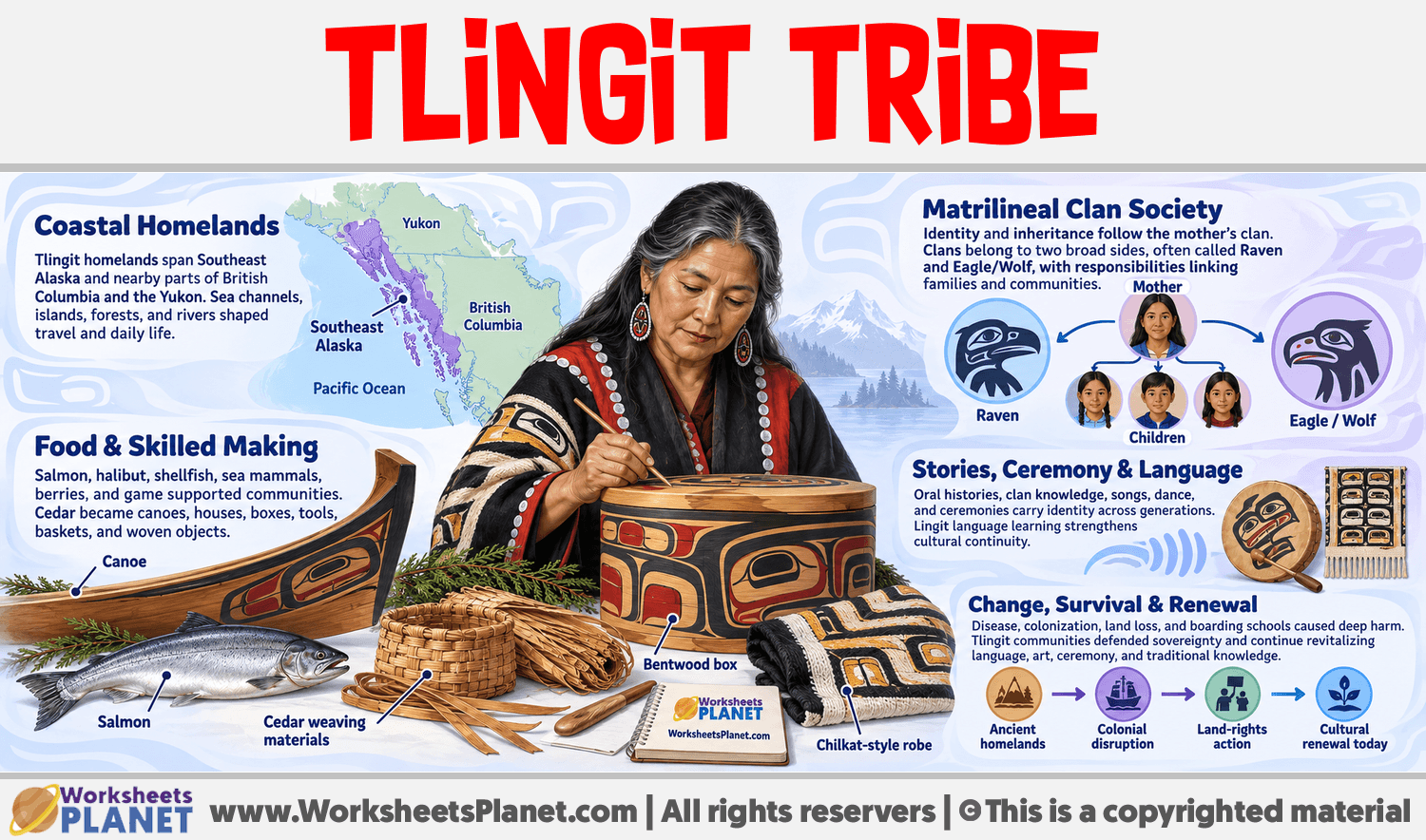
The Tlingit Tribe is an Indigenous people of the Pacific Northwest Coast, especially connected to what is now southeast Alaska and parts of western Canada. The word Tlingit is often translated as “People of the Tides,” which reflects their close relationship with the ocean, rivers, forests, and animals of their homeland. For students, learning about the Tlingit helps explain how geography, culture, government, art, and language can all shape a community over many generations.
Where Have the Tlingit People Lived?
The traditional homeland of the Tlingit includes the islands, coastal areas, and inland waterways of southeast Alaska, including places such as Sitka, Juneau, Yakutat, Hoonah, Angoon, and Wrangell. Some Tlingit communities are also connected to areas of British Columbia and the Yukon in Canada. This region is known for cold ocean waters, thick forests, high mountains, and many rivers filled with salmon.
The environment strongly influenced Tlingit life. The sea provided fish, seals, sea lions, shellfish, and other foods. Forests provided cedar, spruce, and hemlock wood for houses, canoes, tools, and art. Because food resources were rich, Tlingit communities could build permanent villages and develop complex traditions, ceremonies, and trade networks.
- Region: Pacific Northwest Coast, especially southeast Alaska
- Important resources: salmon, halibut, seals, shellfish, berries, cedar, and spruce
- Homes: large wooden plank houses traditionally shared by extended families
- Transportation: carved canoes used for fishing, travel, trade, and visits between villages
How Was Traditional Tlingit Society Organized?
Tlingit society has long been organized around clans, families, and two main social divisions, often called moieties. The two moieties are Raven and Eagle, though in some areas Eagle may be referred to as Wolf. A person belongs to the moiety and clan of their mother, because Tlingit identity is traditionally matrilineal. This means clan membership, property rights, and certain responsibilities are passed through the mother’s line.
Clans are very important in Tlingit culture. Each clan has its own histories, crests, songs, names, and connections to places. Crests may include animals or natural beings such as Raven, Eagle, Bear, Killer Whale, Wolf, Frog, or Beaver. These symbols are not simply decorations; they carry meaning about family history, identity, and rights.
Leadership in Tlingit communities traditionally involved respected clan leaders who were known for wisdom, generosity, knowledge of law, and care for the community. Wealth was not only about owning things. It was also shown through sharing, hosting ceremonies, and helping others.
- Children traditionally belong to their mother’s clan.
- People usually marry someone from the opposite moiety.
- Clan crests help tell family histories and identify important rights.
- Elders play a key role in teaching stories, values, and proper behavior.
What Did the Tlingit Eat and Make?
The Tlingit developed a strong food system based on seasonal harvesting. Salmon was one of the most important foods and was caught, dried, smoked, and stored for winter. People also ate halibut, herring eggs, clams, crab, seaweed, deer, mountain goat, berries, roots, and many other foods from land and sea. Food gathering required detailed knowledge of tides, animal habits, weather, and safe harvesting times.
Tlingit crafts and technology were highly skilled. Artists carved canoes, masks, house posts, boxes, bowls, and ceremonial objects. Woven baskets, mats, and clothing were made from natural materials. The famous Chilkat robe, a complex woven robe often decorated with clan designs, is one of the most recognized Tlingit art forms.
Totem poles are also associated with Tlingit and other Northwest Coast peoples. A totem pole may honor ancestors, remember an event, show clan crests, or mark a house or memorial. It is important to understand that totem poles are not worshiped; they are visual records connected to family, history, and identity.
- Salmon was preserved by drying or smoking so it could be eaten in winter.
- Cedar and other woods were used for houses, canoes, boxes, and carvings.
- Art often included formline designs with bold shapes and symbolic animals.
- Traditional clothing could include woven robes, cedar bark items, and decorated blankets.
Why Are Stories, Ceremonies, and Language Important?
Tlingit oral tradition is a major way knowledge is passed from one generation to another. Stories may teach lessons about respect, courage, cleverness, balance, and responsibility. One of the best-known figures in many Tlingit stories is Raven, who can be a creator, trickster, transformer, and teacher. Raven stories often explain features of the world while also showing how actions have consequences.
Ceremonies have also been central to Tlingit life. A potlatch, or ceremonial gathering, may include speeches, songs, dances, name giving, memorials, gift giving, and the witnessing of important events. Witnesses help remember and confirm what happened, which shows how community memory can work like a living record.
The Tlingit language, called Lingít, is an essential part of cultural identity. Like many Indigenous languages, it was harmed by colonization, boarding schools, and policies that discouraged or punished Native languages. Today, many Tlingit teachers, elders, families, and language programs are working to revitalize Lingít through classes, recordings, books, apps, songs, and community practice.
- Oral stories preserve history, values, and environmental knowledge.
- Songs and dances may belong to specific clans and should be treated with respect.
- Language revitalization helps strengthen identity and connects young people with elders.
- Ceremonies often include witnesses who remember important community events.
What Challenges and Changes Have the Tlingit Faced?
The Tlingit have experienced major changes due to Russian, British, Canadian, and American expansion into their lands. Trade brought new goods but also conflict, disease, and pressure on traditional ways of life. Later, U.S. control of Alaska brought schools, churches, military posts, businesses, and government policies that often ignored Tlingit land rights and culture.
Despite these challenges, the Tlingit have continued to protect their communities, traditions, and political rights. Tlingit leaders were important in the Alaska Native civil rights movement. Elizabeth Peratrovich, a Tlingit civil rights leader, helped fight discrimination and supported the Alaska Anti-Discrimination Act of 1945, one of the first civil rights laws of its kind in the United States.
Today, Tlingit people live in both rural villages and cities. Many are involved in tribal governments, education, fishing, art, language teaching, environmental protection, law, health care, and business. Modern Tlingit life is not only about the past. It includes living cultures, active communities, and ongoing leadership.
- Tlingit people continue to maintain clan traditions, ceremonies, and art.
- Many communities work to protect salmon, forests, and coastal ecosystems.
- Schools increasingly include local Indigenous history and language lessons.
- Tlingit culture today combines ancient knowledge with modern education and civic life.

Leave A Comment