
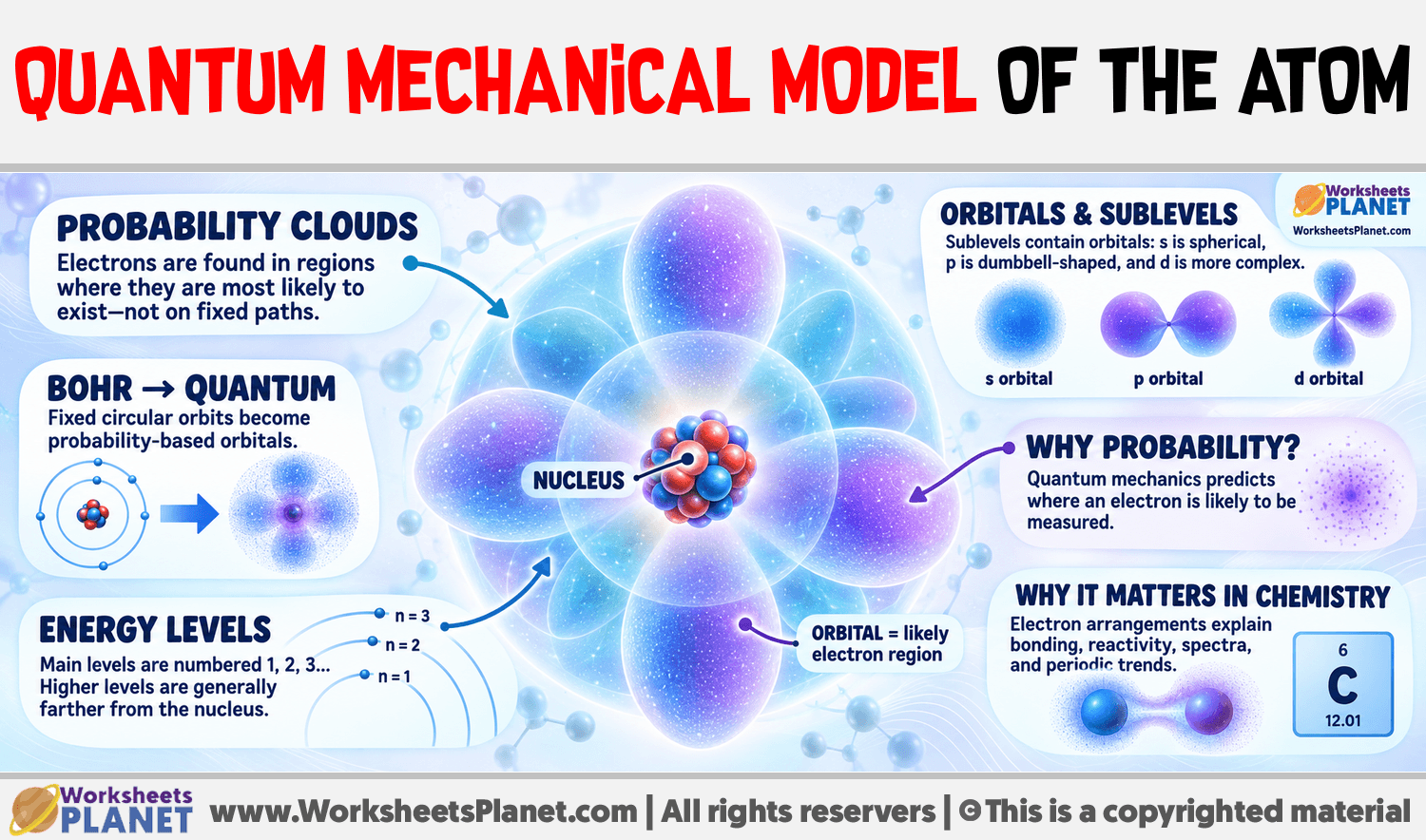
The Quantum Mechanical Model of the Atom is the modern scientific explanation of how electrons behave around the nucleus of an atom. Unlike older models that pictured electrons moving in fixed circular paths, this model shows that electrons are found in regions of probability called orbitals. It is one of the most important ideas in chemistry and physics because it helps explain why atoms bond, why elements have different properties, and how the periodic table is organized. For students, understanding this model is a key step toward seeing atoms not as tiny solar systems, but as systems ruled by energy, probability, and wave behavior.
What does the Quantum Mechanical Model of the Atom describe?
The Quantum Mechanical Model of the Atom describes the arrangement and behavior of electrons in an atom using mathematics, probability, and energy levels. It does not tell us the exact path of an electron. Instead, it predicts the areas where an electron is most likely to be found.
This model was developed in the early 20th century as scientists discovered that very small particles do not always behave like everyday objects. Electrons can act like particles, but they also show properties of waves. Because of this, their motion cannot be described as a simple orbit around the nucleus.
The center of the atom is still the nucleus, which contains protons and neutrons. The major change in this model is the way electrons are represented. They are not drawn as little balls traveling on neat rings. Instead, they occupy orbitals, which are three-dimensional regions around the nucleus.
- The model focuses on electron probability, not exact electron paths.
- Electrons exist in specific energy levels and sublevels.
- Orbitals show where electrons are most likely to be located.
- The model explains atomic structure more accurately than earlier models.
How is this model different from the Bohr model?
The Bohr model is often easier to picture because it shows electrons moving in fixed circular orbits around the nucleus, similar to planets around the Sun. This model was useful because it introduced the idea that electrons have specific energy levels. However, it worked best for hydrogen and could not fully explain atoms with many electrons.
The Quantum Mechanical Model of the Atom improved on Bohr’s idea by replacing fixed orbits with electron clouds and orbitals. In this model, electrons are associated with regions of space rather than simple tracks. This makes the model more realistic, even though it is harder to draw.
A helpful comparison is to imagine trying to find a student in a school. The Bohr model would say the student walks on one exact circular path. The quantum model would say the student is most likely to be found in certain rooms or areas at certain times. The second explanation is less exact in one way, but it gives a more accurate picture of real behavior.
- Bohr model: electrons move in fixed circular orbits.
- Quantum model: electrons are found in orbitals, or probability regions.
- Bohr model: works mainly for simple atoms such as hydrogen.
- Quantum model: explains complex atoms and chemical behavior more successfully.
What are orbitals, energy levels, and sublevels?
In the quantum model, an orbital is not a path. It is a region around the nucleus where there is a high chance of finding an electron. Orbitals can have different shapes. For example, an s orbital is spherical, while a p orbital has a dumbbell-like shape.
Electrons are arranged in energy levels, sometimes called shells. These levels are numbered 1, 2, 3, and so on. Electrons closer to the nucleus usually have lower energy, while electrons farther away generally have higher energy. Within each energy level, there are sublevels, such as s, p, d, and f.
Each orbital can hold a maximum of two electrons. This rule is important for understanding electron configuration, which is the way electrons are arranged in an atom. Electron configurations help explain why elements in the same group of the periodic table often have similar chemical properties.
- s orbitals are spherical and can hold up to 2 electrons.
- p orbitals have three orientations and can hold up to 6 electrons total.
- d orbitals can hold up to 10 electrons total.
- f orbitals can hold up to 14 electrons total.
Why is probability important in the quantum model?
One of the most important ideas in the Quantum Mechanical Model of the Atom is that the exact position and motion of an electron cannot both be known perfectly at the same time. This idea is connected to the Heisenberg uncertainty principle. It means scientists cannot track an electron the way they might track a baseball or a car.
Instead of exact paths, scientists use probability maps. These maps show where an electron is likely to be found. A darker or denser region in an electron cloud usually represents a higher probability of finding an electron there. This does not mean the electron is spread out like fog; it means its location can only be predicted in terms of chances.
This probability-based view may seem strange, but it has been tested many times through experiments. It helps scientists explain patterns of light released or absorbed by atoms, chemical bonding, and the structure of materials. In science, a model is valuable when it makes accurate predictions, and the quantum model does this extremely well.
Why does the Quantum Mechanical Model matter in chemistry?
The Quantum Mechanical Model of the Atom matters because it connects atomic structure to real chemical behavior. The arrangement of electrons determines how atoms interact with each other. Atoms form bonds, gain or lose electrons, and create compounds largely because of their outermost electrons, also called valence electrons.
For example, sodium reacts strongly with chlorine because sodium has one valence electron that it can lose, while chlorine has space to gain one electron. The quantum model helps explain this behavior by showing how electrons fill orbitals and how stable arrangements form.
This model also helps explain the shape of the periodic table. Elements are arranged according to atomic number, but repeating patterns in their properties are caused by repeating patterns in electron configurations. That is why elements in the same column, such as lithium, sodium, and potassium, often behave in similar ways.
In classrooms, the quantum model gives students a deeper understanding of why chemistry works. It explains not only where electrons are likely to be, but also why atoms have different sizes, why ions form, why light is emitted by excited atoms, and why the periodic table has its familiar structure.
- It explains chemical bonding between atoms.
- It helps predict the properties of elements.
- It supports the organization of the periodic table.
- It explains why atoms absorb and emit specific amounts of energy.
- It provides the foundation for modern chemistry, electronics, and materials science.

Leave A Comment