
The Comanche Tribe is one of the most important Native American nations in the history of the Great Plains. Known for their skill with horses, their powerful trade networks, and their strong military leadership, the Comanche shaped life across a huge region of North America for more than a century. Today, the Comanche Nation continues to preserve its language, culture, and government while also participating in modern education, business, and community life. Learning about the Comanche Tribe helps students understand how Native peoples adapted to new environments, defended their homelands, and kept their identity alive through major historical changes.
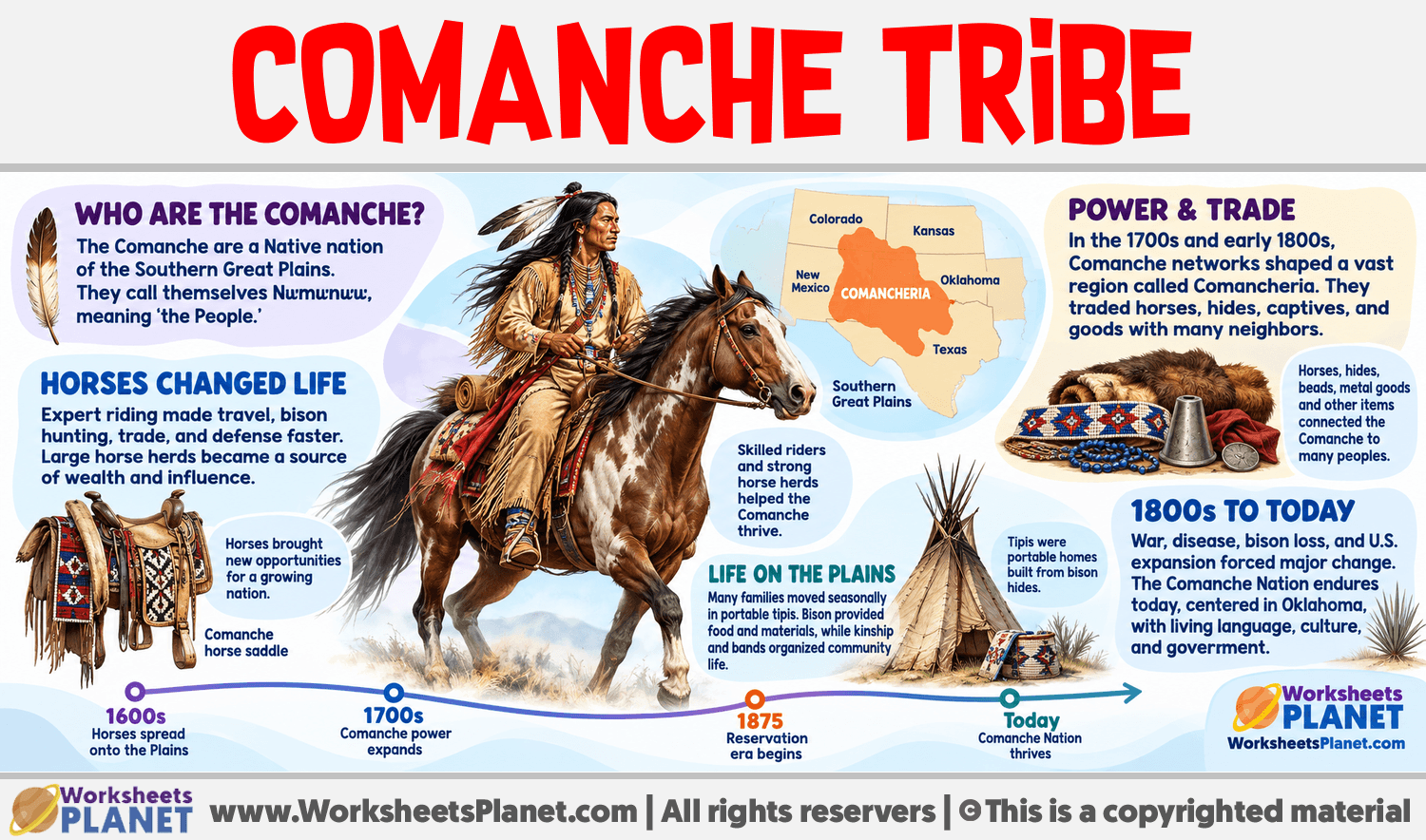
Who Are the Comanche People?
The Comanche people call themselves Nʉmʉnʉʉ, often translated as “the People.” Their ancestors were originally connected to the Shoshone people of the Great Basin, but they moved southward onto the Plains around the 1600s and 1700s. Over time, they developed a distinct culture centered on buffalo hunting, horseback travel, and wide-ranging trade.
The Comanche became especially well known in what is now Texas, Oklahoma, New Mexico, Colorado, and Kansas. Their homeland was sometimes called Comanchería, a large area of the southern Great Plains where Comanche bands lived, hunted, traded, and defended their territory. Rather than one single village or city, Comanche life was organized through mobile groups that followed seasonal resources and opportunities.
- The Comanche are a Native American Plains people.
- Their own name for themselves is Nʉmʉnʉʉ.
- Their historic territory included much of the southern Great Plains.
- Today, the Comanche Nation is headquartered in Lawton, Oklahoma.
Why Were Horses So Important to the Comanche Tribe?
Horses transformed Comanche life. After horses were introduced to North America by the Spanish, the Comanche became among the most skilled horse riders on the continent. Horses allowed them to travel farther, hunt buffalo more effectively, and defend their communities across a wide area. This connection was so strong that the Comanche were sometimes described by outsiders as the “Lords of the Plains.”
The horse was not only a tool for transportation. It was also a sign of wealth, independence, and skill. A family with many horses could move camp more easily, trade more successfully, and support more people. Young people learned riding skills early, and expert riders could guide horses with remarkable speed and control during hunts or battles.
- Horses helped Comanche hunters follow and hunt buffalo herds.
- They made long-distance travel and trade easier.
- They gave Comanche warriors major advantages in speed and mobility.
- Horse ownership became connected to status and leadership.
How Did the Comanche Live on the Great Plains?
Comanche families lived in portable homes called tipis, which were practical for a mobile way of life. Tipis could be taken down, packed, moved, and set up again as families followed buffalo herds or moved to safer areas. This kind of housing matched the open Plains environment, where flexibility was essential.
Buffalo were central to Comanche survival. People used buffalo meat for food, hides for clothing and shelter, bones for tools, and sinew for sewing. Nothing was wasted if it could be useful. Women played a key role in processing hides, preparing food, making clothing, and maintaining the household. Men often hunted, traded, and defended the band, though responsibilities could vary by family and situation.
Comanche society was made up of several bands rather than one single centralized ruler. Bands had respected leaders, but leadership often depended on trust, generosity, bravery, and good judgment. Important decisions were commonly discussed, and leaders needed the support of their people.
- Common foods included buffalo meat, deer, antelope, berries, roots, and traded goods.
- Useful items made from buffalo included robes, tipi covers, containers, tools, and thread-like sinew.
- Comanche bands moved seasonally to find food, water, grazing land, and trade opportunities.
What Was Comanche Power and Trade Like?
By the 1700s and early 1800s, the Comanche had become a powerful force on the southern Plains. They traded with Spanish, Mexican, Native, and later American communities. Their trade included horses, buffalo robes, weapons, tools, and captives. This trade network connected distant regions and made the Comanche influential in the economy and politics of the Southwest.
Comanche power also brought conflict. They fought with rival Native nations, Spanish colonists, Mexican settlers, and later the United States. These conflicts were not simple stories of one side against another. They involved competition over land, horses, hunting areas, trade routes, and survival. The Comanche were defending their independence at a time when colonial and American expansion was putting intense pressure on Native lands.
One important point for students is that the Comanche were not just reacting to others. They were active decision-makers who built alliances, controlled trade routes, negotiated, and fought when necessary. Their history shows the strength and complexity of Native nations before and during the expansion of the United States.
- The Comanche traded horses, buffalo products, and other goods across long distances.
- They formed alliances when useful and fought when their interests were threatened.
- Their influence affected Spanish, Mexican, American, and Native communities across the region.
What Happened to the Comanche Tribe in the 1800s and Today?
During the 1800s, the Comanche faced major challenges. The expansion of the United States, the building of forts and settlements, military campaigns, and the destruction of buffalo herds all threatened their way of life. As buffalo numbers collapsed, it became much harder for Plains peoples to survive in the traditional manner.
After years of conflict and pressure, many Comanche people were forced onto reservations in Indian Territory, which is now Oklahoma. This change brought hardship, including loss of land, limits on movement, and attempts by the U.S. government to suppress Native languages and traditions. Like many Native nations, the Comanche endured boarding school policies and other efforts at forced assimilation.
Despite these challenges, the Comanche Nation survived. Today, the Comanche Nation is a federally recognized tribe with its own government, cultural programs, and community services. Many Comanche people work to preserve the Comanche language, teach traditional songs and dances, honor veterans, and pass history to younger generations. Annual events, museums, language classes, and family teachings all help keep Comanche identity strong.
For students, the Comanche Tribe is an important example of adaptation, resistance, and cultural continuity. Their history includes hardship, but it also includes creativity, leadership, and survival. Understanding the Comanche means recognizing them not only as people of the past, but as a living nation with a present and a future.
- The near-destruction of the buffalo deeply affected Comanche life.
- Many Comanche families were forced to live in Indian Territory.
- The Comanche Nation today continues to protect language, history, and cultural traditions.

Leave A Comment