
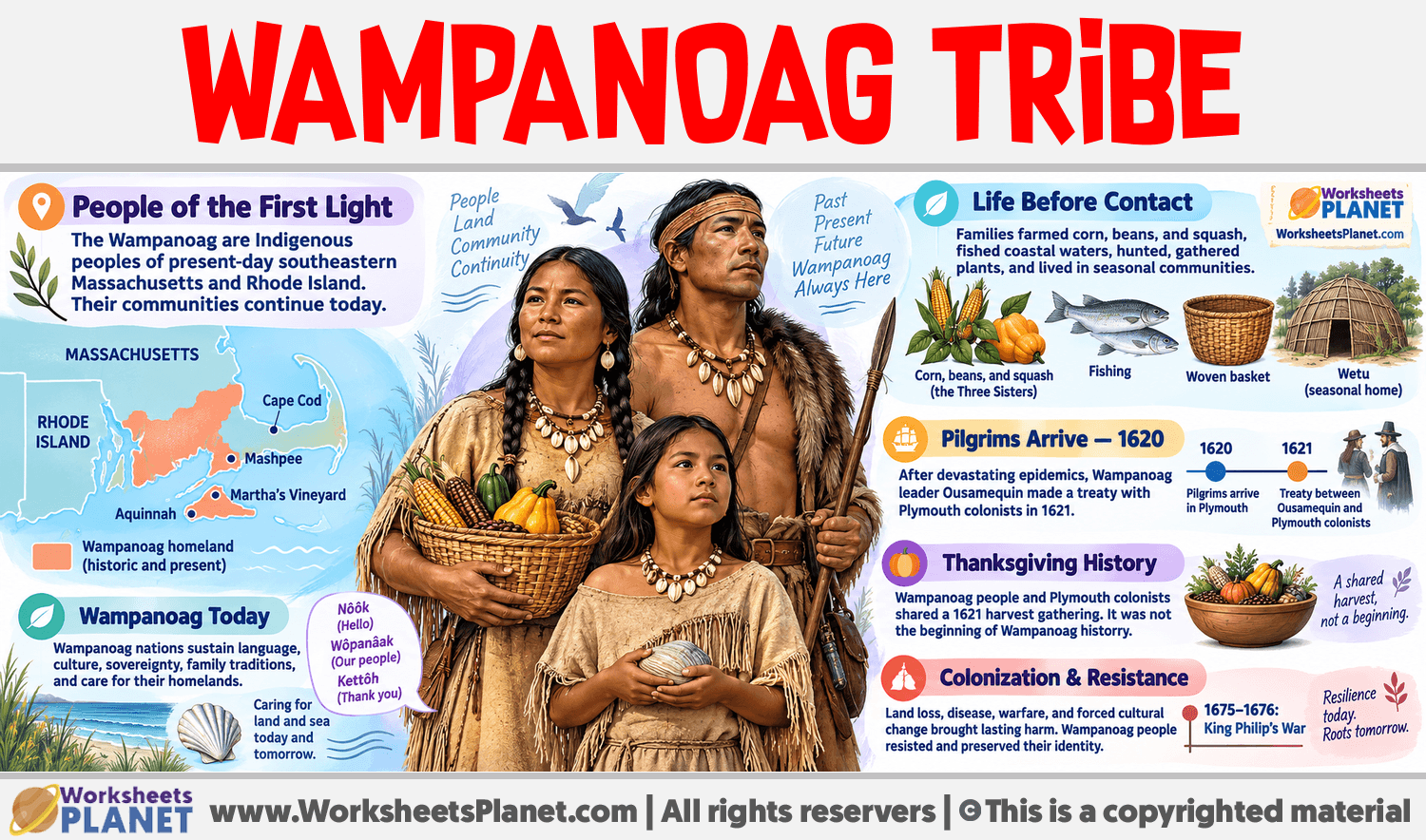
The Wampanoag Tribe is one of the Indigenous peoples of what is now southeastern Massachusetts and eastern Rhode Island, including Cape Cod, Martha’s Vineyard, and Nantucket. The name Wampanoag is often translated as “People of the First Light” or “People of the Dawn,” because their homelands are among the first places in North America to see the sunrise. Learning about the Wampanoag means looking beyond a single Thanksgiving story. Their history includes thousands of years of community life, skilled farming and fishing, trade, diplomacy, hardship after European contact, and continued cultural strength today.
Who are the Wampanoag people?
The Wampanoag are a Native people whose ancestors lived in the Northeast long before English colonists arrived. Their communities were organized into villages, often near the coast, rivers, forests, and fields. These locations gave people access to many resources, including fish, shellfish, deer, wild plants, and fertile soil for crops.
Wampanoag society included many related communities, sometimes called bands or villages, each with its own leaders. A leader, often known as a sachem, helped guide decisions, form alliances, and protect the community. Leadership was not simply about giving orders; it involved listening, responsibility, and maintaining relationships with other groups.
Today, Wampanoag people continue to live in their ancestral homelands and in many other places. Two federally recognized Wampanoag tribes are the Mashpee Wampanoag Tribe and the Wampanoag Tribe of Gay Head Aquinnah. Other Wampanoag communities also preserve family histories, traditions, and connections to the land.
- The Wampanoag homelands include areas of present-day Massachusetts and Rhode Island.
- Their name is connected to the idea of the eastern sunrise.
- Wampanoag communities existed for thousands of years before European settlement.
How did the Wampanoag live before European contact?
Before Europeans arrived, Wampanoag families used the seasons to guide daily life. They planted crops in warmer months, fished during important runs, gathered wild foods, and hunted when animals were available. This seasonal pattern helped communities use natural resources carefully instead of staying in one place and exhausting the land.
One important farming method was growing the Three Sisters: corn, beans, and squash. These crops supported one another. Corn provided a tall stalk for beans to climb, beans helped add nutrients to the soil, and squash leaves spread across the ground, helping hold moisture and reduce weeds. This shows how Wampanoag agriculture was based on careful observation of nature.
Homes were often made from wooden frames covered with bark, mats, or other natural materials. These homes are sometimes called wetu. They could be warm, practical, and suited to the local climate. Wampanoag people also made canoes, tools, baskets, clothing, and other items using materials from their environment.
- Common foods included corn, beans, squash, fish, shellfish, berries, nuts, and game animals.
- Seasonal movement helped families follow food sources and protect the environment.
- Knowledge of plants, waterways, weather, and animals was essential for survival and community life.
What happened when the Pilgrims arrived?
In 1620, English colonists known as the Pilgrims arrived in Wampanoag territory and settled at Patuxet, a place that had been a Native village. Before their arrival, disease brought by earlier European contact had already caused terrible losses among many Indigenous communities in the region. These epidemics weakened populations and changed the balance of power among neighboring peoples.
A Wampanoag man named Tisquantum, often called Squanto in many textbooks, played an important role in early communication between the Wampanoag and the English. He had learned English after being taken to Europe and later returning home. He helped the colonists understand local farming and food sources, though his own life story was shaped by kidnapping, loss, and displacement.
The Wampanoag sachem Ousamequin, also known as Massasoit, made a treaty with the English in 1621. This agreement was partly a political and military alliance. It is important for students to understand that the relationship between the Wampanoag and the Pilgrims was not a simple friendship story. It involved diplomacy, strategy, survival, and changing circumstances.
Why is the Wampanoag Tribe important to Thanksgiving history?
Many school lessons connect the Wampanoag Tribe to the “First Thanksgiving” in 1621. Wampanoag people and English colonists did share a harvest gathering, but the event was not exactly like the modern holiday. It was not called Thanksgiving at the time, and it was not the beginning of a peaceful, equal relationship that lasted.
For Wampanoag people, the traditional Thanksgiving story can feel incomplete because it often leaves out Indigenous perspectives. It may focus on cooperation while ignoring disease, land loss, broken agreements, and later violence. A more accurate lesson recognizes that the Wampanoag helped the English survive, but also faced serious consequences as colonization expanded.
Teachers and students can approach this topic with respect by asking better questions: Who was already living on the land? What did the Wampanoag gain or risk through diplomacy? How did English settlement affect Native communities over time? These questions help students see history as complex rather than as a simple celebration.
- The 1621 harvest gathering included Wampanoag people and English colonists, but it was not the same as modern Thanksgiving.
- Wampanoag perspectives help correct incomplete or one-sided versions of history.
- Respectful learning includes both cooperation and the harmful effects of colonization.
What challenges did the Wampanoag face after colonization?
As more English settlers arrived, Wampanoag lands were taken, purchased unfairly, or pressured away through colonial laws and debt. Traditional hunting, fishing, farming, and movement became harder as English towns and farms expanded. Missionary efforts also tried to change Native religion, language, and ways of life.
Tensions grew into a devastating conflict in 1675–1676, often called King Philip’s War. The Wampanoag leader Metacom, called King Philip by the English, resisted colonial expansion. The war caused enormous suffering for Native peoples and colonists, but its consequences were especially severe for Indigenous communities. Many Native people were killed, displaced, enslaved, or forced from their homelands.
Even after these hardships, Wampanoag families and communities survived. They adapted while preserving identity, kinship, and cultural memory. Survival itself is a major part of Wampanoag history and should be taught alongside the stories of loss.
How do Wampanoag people preserve culture today?
The Wampanoag Tribe is not only part of the past. Wampanoag people continue to protect their culture, land, language, and community life today. Cultural preservation can include ceremonies, storytelling, food traditions, art, tribal government, environmental work, and education for younger generations.
One important effort is the revival of the Wôpanâak language, the ancestral language of the Wampanoag people. For many years, the language was not spoken as a first language because of colonization and forced cultural change. Through careful study of historic documents and community teaching, Wampanoag language learners and educators have worked to bring it back into daily and educational use.
For students, the most important idea is that the Wampanoag are a living people with a continuing future. They are not simply characters in a colonial story. Learning about the Wampanoag Tribe with accuracy and respect helps students understand Indigenous history, American history, and the importance of listening to Native voices.
- Wampanoag communities continue to practice tribal sovereignty and self-government.
- Language revival helps connect younger generations with ancestral knowledge.
- Modern Wampanoag life includes both tradition and contemporary experiences.

Leave A Comment