
Madagascar is one of the most unusual places on Earth for studying animals. This large island lies off the southeast coast of Africa, but many of its living creatures are found nowhere else in the world. Scientists call this high level of unique wildlife endemism. Because Madagascar was separated from other landmasses for millions of years, its animals evolved in special ways. Learning about the animals of Madagascar helps students understand adaptation, habitats, food chains, and why conservation matters.
Why are the animals of Madagascar so unique?
Madagascar broke away from other continents long ago, leaving plants and animals to develop in relative isolation. Over time, species changed to fit the island’s many environments, from rainforests and dry forests to spiny deserts, wetlands, and coastal areas. This is why Madagascar has such a surprising mix of animals that look and behave differently from animals in nearby Africa.
The island also has many small habitat zones. A species may live in one forest, one mountain area, or even one type of tree. This makes Madagascar exciting for biologists, but it also means many animals are vulnerable. If their habitat disappears, they may have nowhere else to go.
- About 90% of Madagascar’s reptiles are found only on the island.
- All wild lemurs live naturally in Madagascar and nearby small islands.
- Madagascar has no native lions, zebras, giraffes, or elephants, even though it is near Africa.
- Many species are adapted to very specific habitats, such as bamboo forests or dry spiny forests.
Lemurs: Madagascar’s best-known mammals
Lemurs are probably the most famous animals of Madagascar. They are primates, which means they are related to monkeys, apes, and humans, but they are not monkeys. Lemurs evolved separately on the island and developed many sizes, diets, and behaviors. Some are active during the day, while others are nocturnal, meaning they are active at night.
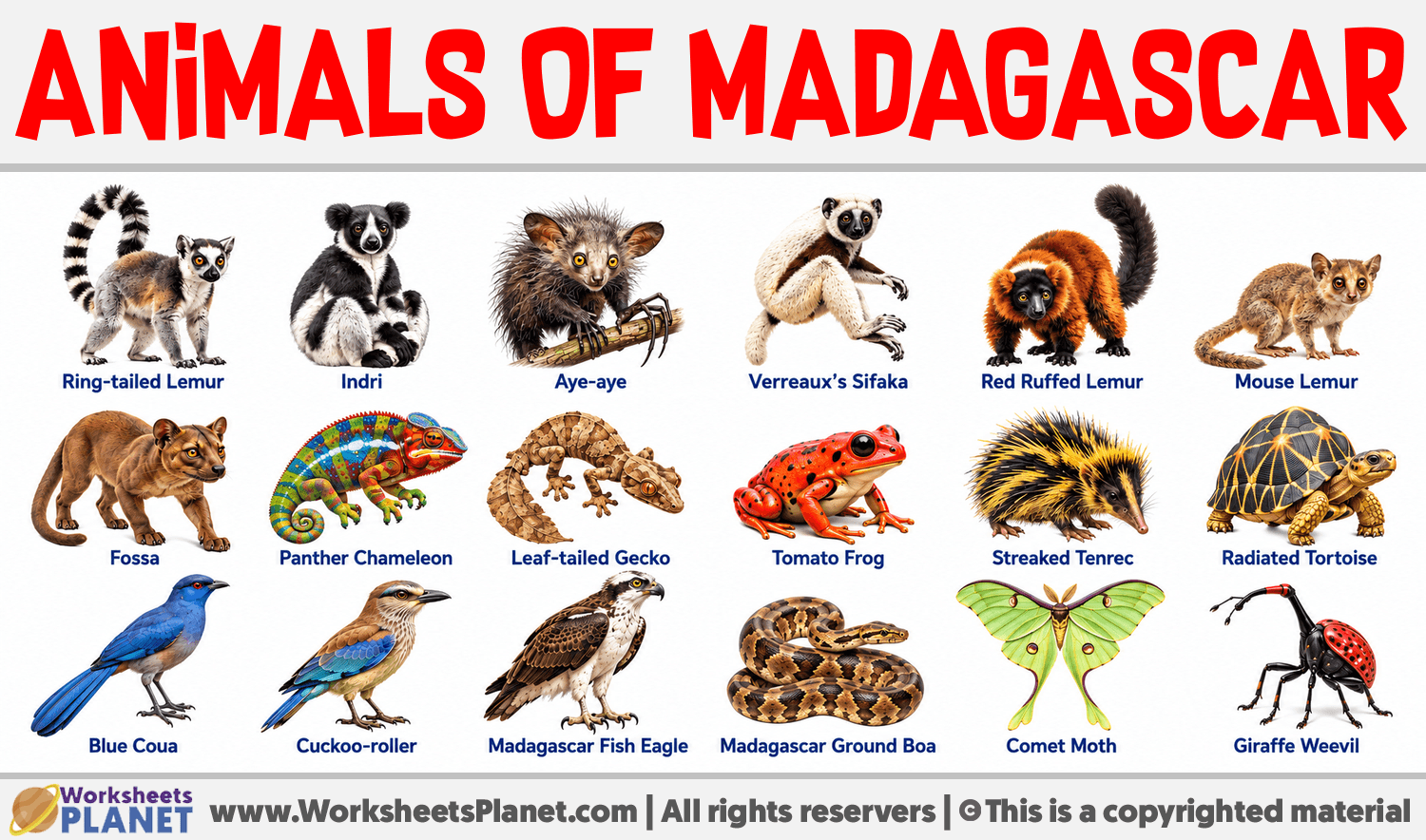
The ring-tailed lemur is easy to recognize because of its long black-and-white tail. It lives in groups and often moves on the ground as well as in trees. The tiny mouse lemur is one of the smallest primates in the world, while the indri is one of the largest living lemurs and is known for its loud, haunting calls that travel through the forest.
Lemurs are important because they help forests grow. Many eat fruit and spread seeds in their droppings. In this way, lemurs act as forest gardeners, helping new plants grow in different places.
- Ring-tailed lemur: known for its striped tail and social groups.
- Indri: famous for loud calls and strong jumping between trees.
- Aye-aye: uses a long thin finger to find insects inside wood.
- Mouse lemur: very small, nocturnal, and quick-moving.
Reptiles, amphibians, and colorful small creatures
Madagascar is home to many remarkable reptiles and amphibians. Chameleons are among the most fascinating. They can move their eyes separately, catch insects with a fast sticky tongue, and many species can change color. Color change does not only help with camouflage; it can also show mood, temperature, or communication with other chameleons.
Geckos are another important group. Some leaf-tailed geckos are experts at hiding. Their bodies can look like bark, dead leaves, or moss, making them difficult for predators to see. Madagascar also has many frogs, including brightly colored species that live in rainforests. Frogs are useful indicators of environmental health because they need clean, moist habitats to survive.
These smaller animals may not always be as famous as lemurs, but they play essential roles in food webs. They eat insects, provide food for birds and snakes, and help keep natural systems balanced.
- Panther chameleons can show bright colors such as green, blue, red, and orange.
- Leaf-tailed geckos use camouflage to blend into tree bark and leaves.
- Mantella frogs are small, colorful frogs often compared to poison dart frogs.
- Radiated tortoises have beautiful shell patterns and live in dry southern areas.
Birds, insects, and other surprising wildlife
The animals of Madagascar also include many unusual birds and insects. Some birds, such as the Madagascar fish eagle, are rare and need healthy lakes, rivers, or coastal areas. Others, like couas, move through forests searching for insects, fruit, and small animals. Many of these birds help control insect populations or spread seeds.
Insects and other invertebrates are extremely diverse on the island. Madagascar has giant hissing cockroaches, strange-looking weevils, colorful butterflies, and many moths. Although insects are sometimes overlooked, they are essential to ecosystems. They pollinate flowers, recycle dead material, and serve as food for birds, reptiles, frogs, and mammals.
One of the island’s most unusual predators is the fossa. The fossa looks a little like a cat, but it is more closely related to mongooses. It is an agile climber and one of the main natural predators of lemurs. This makes it an important part of the food chain.
- Fossa: a top predator that can climb trees and hunt lemurs.
- Madagascar fish eagle: one of the rarest birds of prey in the world.
- Giant hissing cockroach: makes a hissing sound by pushing air through breathing openings.
- Couas: bird species found only in Madagascar.
Why are many Madagascar animals endangered?
Many Madagascar animals are threatened because their habitats are changing or disappearing. Forests may be cut for farming, charcoal production, mining, or building. When forests are fragmented into small pieces, animals have trouble finding food, mates, and safe places to live. Species with small ranges are especially at risk.
Another problem is illegal wildlife trade. Some reptiles, amphibians, and rare animals may be captured and sold. Climate change can also affect rainfall, temperatures, and the survival of sensitive species such as frogs. Protecting Madagascar’s wildlife means protecting habitats, supporting local communities, and using natural resources carefully.
Students can learn an important lesson from Madagascar: biodiversity is valuable, but it is also fragile. When one species disappears, other parts of the ecosystem can be affected. For example, if fruit-eating lemurs decline, fewer seeds may be spread, which can change the future of the forest.
- Create and care for protected areas where animals can live safely.
- Support farming methods that reduce forest destruction.
- Teach communities and visitors not to buy illegally captured wildlife.
- Study endangered species so conservationists know how to protect them.
Key facts students should remember
Madagascar is a living classroom for understanding evolution and adaptation. Its animals show how isolation, climate, and habitat shape life over long periods of time. From lemurs leaping through the trees to chameleons gripping branches with special feet, each species has features that help it survive.
The most important idea is that Madagascar’s wildlife is both unique and at risk. Protecting these animals is not only about saving beautiful or unusual species. It is also about preserving forests, water systems, food webs, and the natural history of an island unlike any other place on Earth.
- Madagascar has many endemic species, meaning they live naturally only there.
- Lemurs are primates and are among the island’s most important seed spreaders.
- Chameleons, geckos, frogs, birds, insects, and fossas all help keep ecosystems balanced.
- Habitat loss is one of the biggest threats to the animals of Madagascar.

Leave A Comment